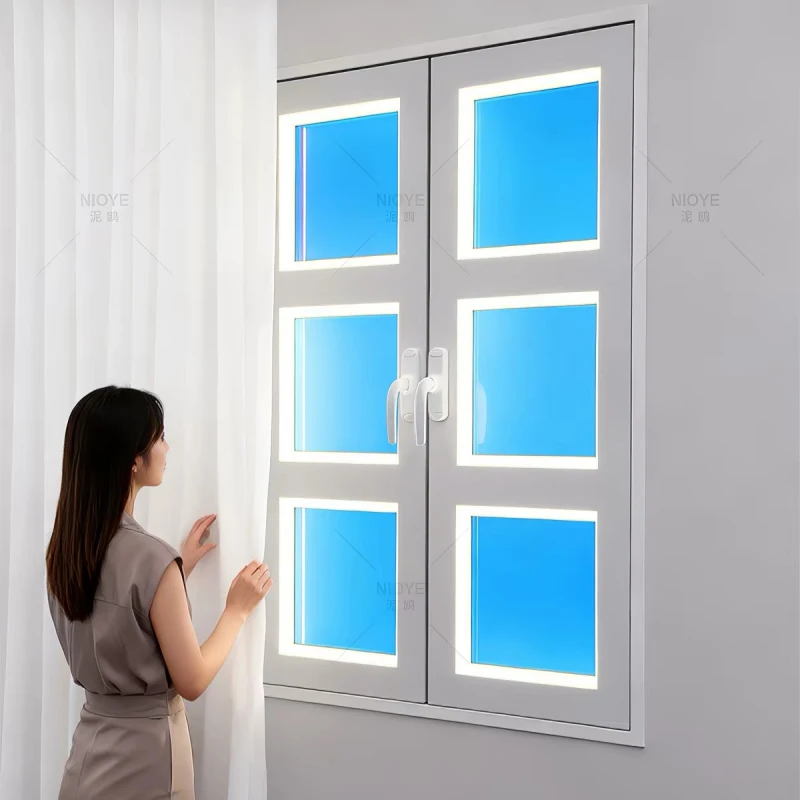
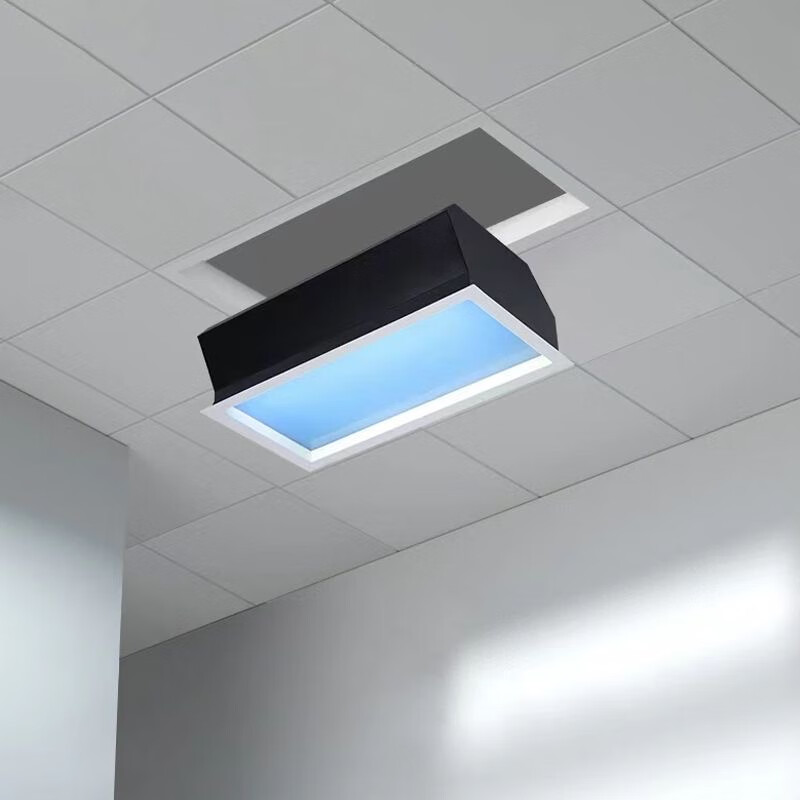
Windowless basements, dark living rooms, and windowless offices can easily feel oppressive. Many people search for how to make fake windows with light, hoping to create the impression of a window with natural daylight at a relatively low cost.
However, a fake window light is far more than simply stuffing LED strips into a wooden frame. Uniformity, color temperature, color rendering, and power supply safety all determine whether the final result resembles an artificial sky light, or just a blue-tinted light box.
Combining artificial sky light product design and installation experience, this article breaks down DIY fake window light construction methods, common pitfalls, and purchasing recommendations.
Bill of Materials: Frame, Diffuser Panel, LED Strip, Power Supply and faux window led light panel
When building a diy faux window, materials account for 70% of the final effect.
- Frame: Aluminum alloy frame or wooden frame, recommended depth 30–60mm to allow light mixing.
- Diffuser Panel: Opal acrylic, light guide plate or professional diffuser. Ordinary frosted film alone is not sufficient.
- LED Strip: 24V high-density strip, color temperature 5000–6500K, CRI≥90.
- Power Supply: Low-voltage 12V/24V power supply, reserve 20% power margin; dimmable type is recommended.
- Auxiliary Materials: Aluminum channel, reflective film, light shielding tape, dimmer, timer, heat shrink tubing.
For a more uniform faux window led light panel, prioritize the edge-lit light guide plate structure. It produces far fewer hotspots than directly mounted LED strips.
Construction Steps: Measure Dimensions, Build Frame, Wire, Mount to Complete the led fake window light
When learning how to make a fake window light, follow the correct sequence.
- Measure dimensions: Confirm wall aspect ratio; common options are 16:9 or 4:3. A window sill height of 90–110cm from the floor creates a natural look.
- Build frame: Construct a cavity using wooden or aluminum frame, reserve internal space for light mixing.
- Wire routing: Attach LED strips to aluminum channels, connect to 24V power supply and dimmer, hide all wiring.
- Mounting: Fit diffuser panel, apply light shielding tape, install on wall, then power on to inspect hotspots and light leakage.
If you intend to make a fake window for office use, adopt a diffuse reflection structure to prevent direct glare into eyes. The finished led fake window light should mimic sky light, not a row of bright LED beads.
How to Avoid Blue Cast, Hotspots and Light Leakage for a more natural fake window with natural light
There are three most common issues: blue cast, hotspots and light leakage.
- Blue cast: Usually caused by excessively high color temperature, poor color rendering and strong blue light peak. Full-spectrum LED strips around 5000K with CRI 90+ are recommended.
- Hotspots: Caused by large spacing between LED beads and insufficient light mixing distance. High-density LED strips paired with diffuser panel and reflective cavity can greatly improve this issue.
- Light leakage: Occurs without edge light shielding tape or sealed back panel. Seal edges, add light shielding and fit a back panel — all three steps are required.
A true fake window with natural light is not about maximum brightness. Brightness should be adjustable: simulate skylight in daytime, lower color temperature and brightness at night.
Power Supply Safety: Low Voltage vs High Voltage
Low-voltage 12V/24V is more suitable for DIY projects with high safety and low electric shock risk. High-voltage 220V installation must be completed by professional electricians, covering insulation, earthing, fire protection and residual current protection. IP rating should be considered for humid spaces.
Whichever solution you choose, never overload the power supply. Joints should be soldered and sealed with heat shrink tubing, and wire gauge must be adequate. Fake window lights often run for long hours, so heat dissipation and driver quality are critical.
Drawbacks of DIY: Uniformity, Color Rendering and After-sales Service
DIY offers customization and controllable cost, yet it has obvious drawbacks. It is hard for DIY builds to achieve sky uniformity comparable to real sky, color rendering may be unstable, and color temperature tends to drift.
For a fake window light for office, low-quality LED strips may flicker, suffer light decay and overheat after prolonged operation.
After-sales support is another major concern. DIY builds have no standard warranty. Once the power supply or LED strip fails, full disassembly and repair are usually required.
When to Buy a Ready-made Artificial Sky Light Instead of searching for best fake window light
DIY is acceptable if you only want a decorative window. But if you want authentic blue sky effect, adjustable sunlight angle, Rayleigh scattering effect, zero hotspots, high color rendering and certified safety, ready-made artificial sky lights are a better choice.
The best fake window light is not necessarily the most sky-like one. It may merely have high brightness and plain white illumination.
For basements, windowless offices and high-end residences, purchasing finished products saves more trouble. Products such as EASY artificial sky light feature complete optical design, heat dissipation, driver, installation and warranty systems, cutting down trial-and-error costs.
Conclusion
Whether you choose diy faux window or buy finished products, clarify your primary goal first: supplementary lighting, decoration, or natural light simulation.
You can fake a window to achieve great visual results, but optical performance, safety and stability cannot be compromised. If you want a low-cost trial, carefully handle diffusion, light mixing, light shielding and power supply following the steps in this guide. If you prefer a hassle-free solution with a realistic sky appearance, mature artificial sky light products are the more reliable option.