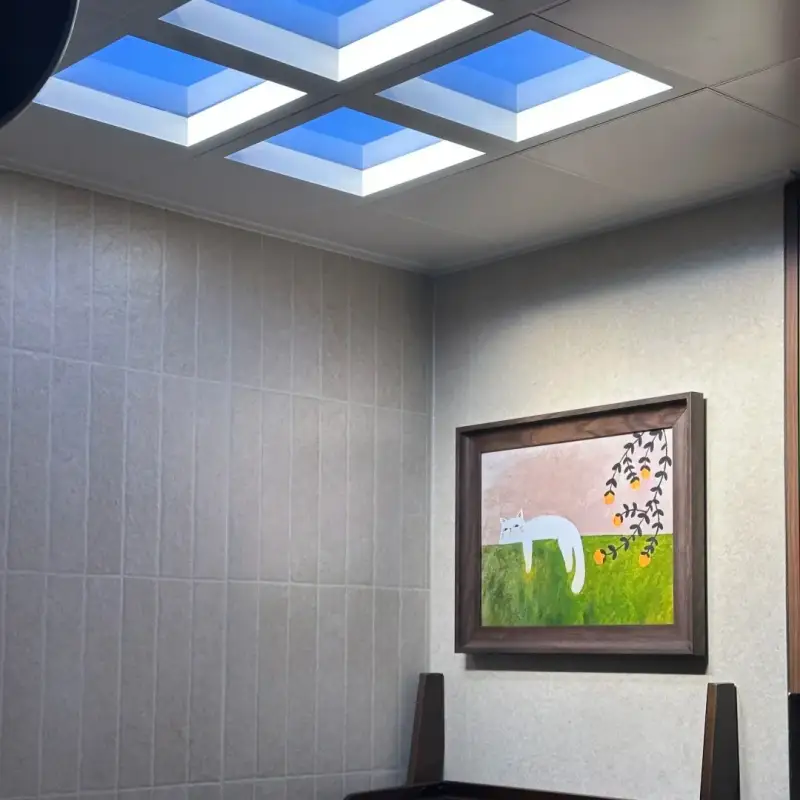
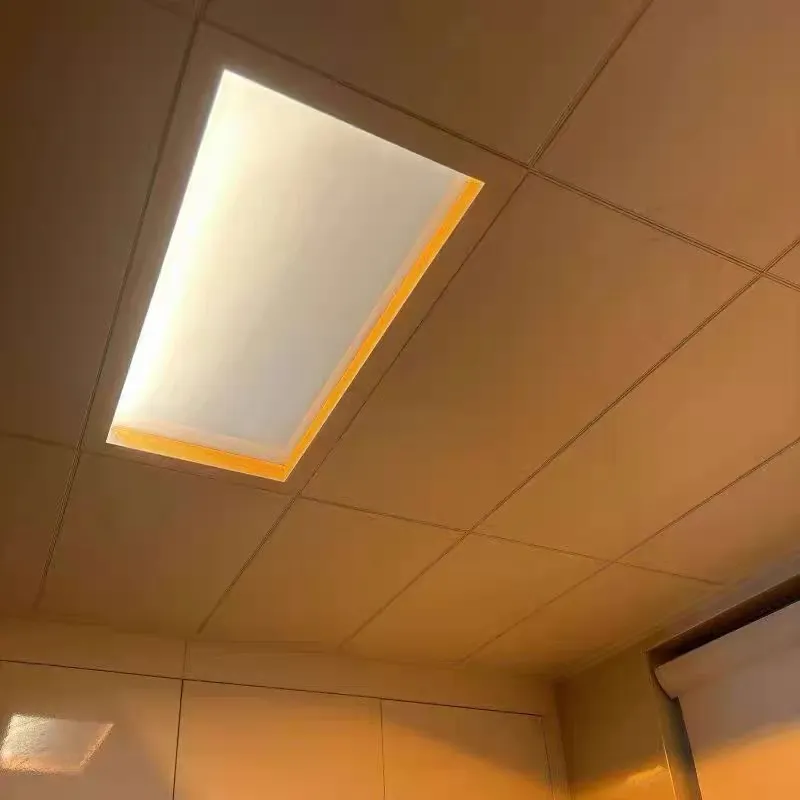
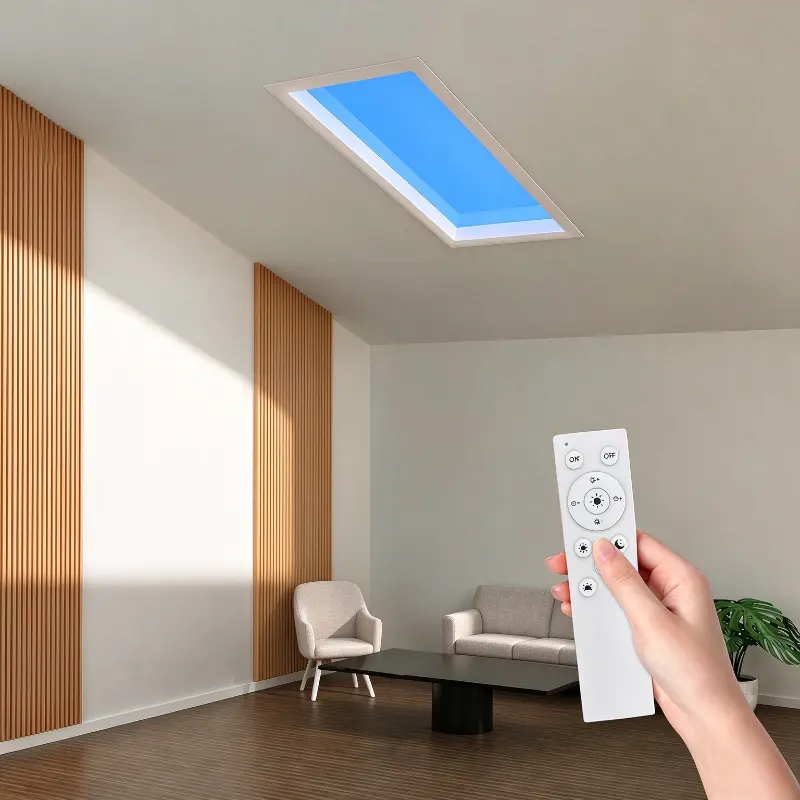
Insufficient daylighting is a common problem in many spaces, especially basements, corridors, bathrooms, interior apartment rooms, and windowless offices. The traditional solution is to install skylights, but not all buildings allow or are suitable for roof openings. For this reason, artificial skylight has gradually become a popular alternative.
The artificial skylight discussed in this article falls under the category of clear sky lights and blue sky lights. It can also be referred to as fake skylight, virtual skylight or blue sky ceiling light.
It simulates natural daylight, blue sky and sunlight effects through LEDs, optical diffuser panels, light guide materials and intelligent controls.
Below is a systematic FAQ covering definition, working principle, comparison with traditional skylights, cost, lifespan, alternative solutions, manufacturer selection and China supply chain.
What Is an Artificial Skylight?
What is an artificial skylight? Simply put, it is a lighting product that mimics the visual effect of a real skylight. Instead of cutting an opening on the roof, it is mounted on ceilings or walls. Optical design creates the visual impression of natural daylight or blue sky overhead.
Definition
An skylight artificial usually consists of LED light sources, diffuser panels, light guide plates, optical films, control systems and housing. Its purpose is not merely to illuminate the space, but to replicate the natural feeling of sunlight passing through a skylight.
Working Principle
It achieves the visual effect via the following mechanisms:
- High-CRI LEDs to simulate sunlight.
- Blue diffuser layers to mimic the sky.
- Optical structures to create a sense of depth, so the light source does not look like an ordinary lamp.
- Intelligent controls to adjust color temperature, brightness and day-night cycles.
- Some premium models can simulate sunrise, sunset, clear sky and dynamic cloud movement.
Application Scenarios
- Basements
- Windowless bathrooms
- Corridors and stairwells
- Interior apartment rooms
- Offices and meeting rooms
- Hotels, commercial spaces and exhibition halls
- Hospitals, nursing homes and other spaces requiring comfortable lighting environments
Relationship between fake skylight and artificial skylight
Fake skylight and artificial skylight are basically synonyms. The difference lies in tone: fake skylight is more colloquial, while artificial skylight is more professional and suitable for blogs, product pages and B2B content.
Artificial Skylight vs Real Skylight
To understand the value of artificial skylight, it helps to first review traditional skylights. What are the three types of skylights? Common traditional skylights fall into three categories:
- Fixed skylights: non-opening, mainly for daylight harvesting.
- Ventilated skylights: operable, providing both daylighting and ventilation.
- Tubular skylights: channel outdoor roof daylight indoors via tubes, suitable for small spaces.
Advantages of real skylights
- Deliver genuine natural daylight.
- Can provide real ventilation.
- May introduce ultraviolet rays.
- Visually authentic when integrated into building structures.
Advantages of skylight artificial
- No roof opening required.
- Flexible installation.
- Not affected by weather conditions.
- Controllable brightness and color temperature.
- Suitable for locations where real skylights cannot be installed.
- Generally manageable maintenance costs.
Core Difference
Real skylights supply authentic daylight, while artificial skylight provides simulated daylight. The former relies on building structures and outdoor weather; the latter relies on electricity, LEDs and optical design.
Can Artificial Skylights Replace Real Skylights?
Can artificial skylights replace real skylights? The answer is yes under certain conditions.
Cases where replacement is feasible
- Spaces where roof openings are prohibited, such as apartments and rental properties, and basements.
- Projects needing improved daylight feel with budget or structural constraints.
- Demand for stable, controllable lighting unaffected by weather.
- Commercial spaces aiming to create natural daylight ambiance.
- Avoiding leakage, thermal insulation and cleaning issues associated with real skylights.
Cases where full replacement is not possible
- Real ventilation is required.
- True ultraviolet exposure is needed.
- Building-grade daylighting structures are mandatory.
- Fully authentic natural daylight experience is required.
- Local codes or building standards mandate real daylight access.
Conclusion
Artificial skylight can serve as a functional and visual substitute, but it cannot fully replace real skylights. It works best to solve the problem of poor daylight perception in windowless spaces.
How Much Does an Artificial Skylight for a Home Cost?
How much does an artificial skylight for a home cost? Prices vary widely and cannot be summarized by a single figure.
Major factors affecting pricing
- Size: larger units generally cost more.
- Brightness and uniformity: high brightness and high uniformity raise costs.
- Color rendering index: high CRI models better resemble natural daylight and carry higher prices.
- Intelligent controls: dimming, color tuning and day-night cycle simulation increase cost.
- Installation type: recessed, surface-mounted and modular splicing have different cost structures.
- Brand and certifications: CE, UL, RoHS and other certifications affect pricing.
- OEM/ODM availability: B2B procurement follows a separate quotation system.
Price range reference
- Entry level: lower cost for basic sky daylight simulation.
- Mid range: improved brightness, color rendering and appearance for residential and commercial spaces.
- Premium level: dynamic blue sky, smart controls and custom dimensions at higher price points.
Total cost rises if professional installation is included. Final pricing shall be subject to formal quotations from the artificial skylight manufacturer.
What Is the Lifespan of an Artificial Skylight?
What is the lifespan of an artificial skylight? It mainly depends on LED quality, driver power supply, thermal design and operating hours.
LED light source lifespan
Many products advertise an LED lifespan of 30,000 to 50,000 hours. This is only the theoretical lifespan of the light source and does not represent the whole unit lifespan.
Whole unit lifespan
Whole unit service life is affected by:
- LED chip quality
- Driver power supply quality
- Heat dissipation structure
- Ambient operating temperature
- Daily operating hours
- Frequency of power cycling
- Stability of control systems
Under normal operation and adequate heat dissipation, the complete unit typically lasts 5 to 10 years or longer, depending on manufacturer design and warranty policy.
Maintenance recommendations
- Clean the surface regularly to prevent dust from reducing brightness.
- Maintain proper ventilation to avoid overheating.
- Avoid continuous full-load operation for extended periods.
- Use stable voltage supply.
- Keep warranty documents and after-sales support channels available.
Alternatives to Artificial Skylights
What are the alternatives to fake skylights? If artificial skylight installation is not desired, the following options can be considered.
| Alternatives | Advantages | Disadvantages |
|---|---|---|
| Traditional skylights | Real daylighting, ventilation available | Requires roof penetration; risk of water leakage |
| Tubular skylights | Suitable for small spaces | Limited daylight capture area |
| Light wells | Strong architectural effect, good daylighting | Complex construction, high cost |
| Full-spectrum lamps | Close to natural daylight | Cannot replicate skylight visual effect |
| LED panel lights | Low cost, simple installation | Weak realism |
| Virtual windows | Can simulate outdoor scenery | Wide variance in price and performance |
| skylight artificial | Excellent blue sky simulation | Powered by electricity, not genuine daylight |
Each solution has pros and cons. Selection should be based on space conditions, budget, installation constraints and visual requirements.
How to Choose an Artificial Skylight Manufacturer
When selecting an artificial skylight manufacturer, price should not be the only consideration.
Key inspection items
- Certifications: CE, UL, RoHS, FCC, etc.
- Optical parameters: color temperature, color rendering index, brightness, uniformity.
- Thermal design: impacts lifespan and stability.
- Control system: support for dimming, scheduling, day-night simulation.
- Installation method: compatibility with ceiling structure.
- After-sales and warranty: warranty period, spare parts availability, technical support.
- OEM/ODM capability: support for custom dimensions, branding and packaging.
- Project cases and reputation: availability of real project references.
A qualified manufacturer does not merely sell products; it can provide installation guidance, parameter matching and long-term after-sales support.
Artificial Skylight China: Sourcing Tips
Artificial skylight China draws attention from many buyers. China has a mature supply chain for LED lighting, optical materials and intelligent controls, well suited for B2B procurement.
Sourcing recommendations
- Request samples first to test brightness, color temperature and realism.
- Confirm whether factory audits are allowed.
- Clarify MOQ, lead time and packaging methods.
- Verify completeness of certifications.
- Confirm OEM/ODM support.
- Compare quotations from multiple artificial skylight manufacturer.
- Define after-sales responsibilities and shipping risks.
- For engineering projects, confirm installation guidance in advance.
For wholesalers, importers and brand owners, the China supply chain offers flexible options, but supplier screening and quality control must be implemented carefully.
FAQ
What is an artificial skylight? It is a lighting product that mimics the visual effect of real skylights, categorized as clear sky lights. It simulates natural daylight and blue sky via LEDs and optical design.
Can artificial skylights replace real skylights? Partial replacement is possible for spaces where roof openings are not feasible. It cannot fully substitute real ventilation, true ultraviolet exposure and building-grade daylighting.
What is the lifespan of an artificial skylight? LED light sources are often rated for 30,000 to 50,000 hours. Whole unit lifespan is affected by power supply, heat dissipation and operating environment, commonly 5 to 10 years or longer.
How much does an artificial skylight for a home cost? Cost depends on size, brightness, color rendering index, smart features, brand and installation method. Final pricing shall follow supplier quotations.
What are the alternatives to fake skylights? Options include traditional skylights, tubular skylights, light wells, full-spectrum lamps, LED panel lights, virtual windows and skylight artificial.
Are artificial skylights worth it? If the space is windowless with poor daylight perception and real skylights cannot be installed, artificial skylight is usually worth considering. When genuine ventilation and natural daylight are required, real skylights are more appropriate.
Conclusion
Artificial skylight is a daylight simulation solution within the clear sky light category. It cannot fully replace real skylights, yet it delivers a near-natural daylight visual experience for basements, corridors, bathrooms, apartments and windowless spaces.
During procurement, focus on cost, lifespan, optical performance, installation method and reliability of the artificial skylight manufacturer. When sourcing from the artificial skylight China supply chain, pay attention to sample testing, certifications, MOQ, lead time and after-sales support.
The final selection depends on your space conditions, budget and objectives. If your goal is to improve daylight perception and enhance space comfort, artificial skylight is a solution worthy of thorough evaluation.