Why Fake Window Light Is Needed for Windowless Offices
Windowless offices are commonly found in building core zones, basements, renovated mezzanines and open-plan workspaces. While they solve space constraints, they deprive employees of “outside window cues”: sense of time, weather perception, spatial orientation, and brief visual relaxation from distant gazing.
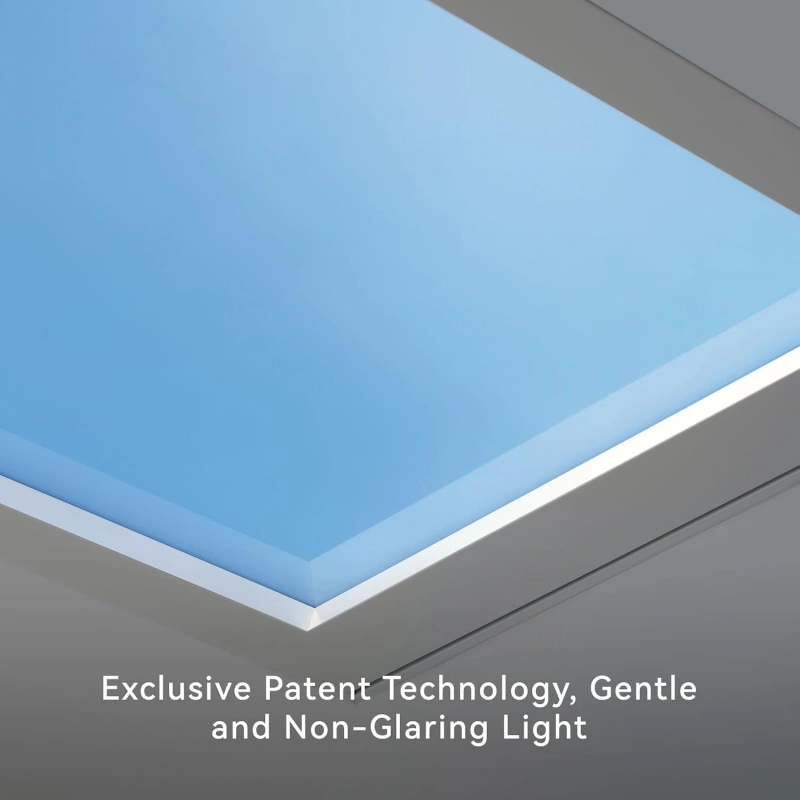
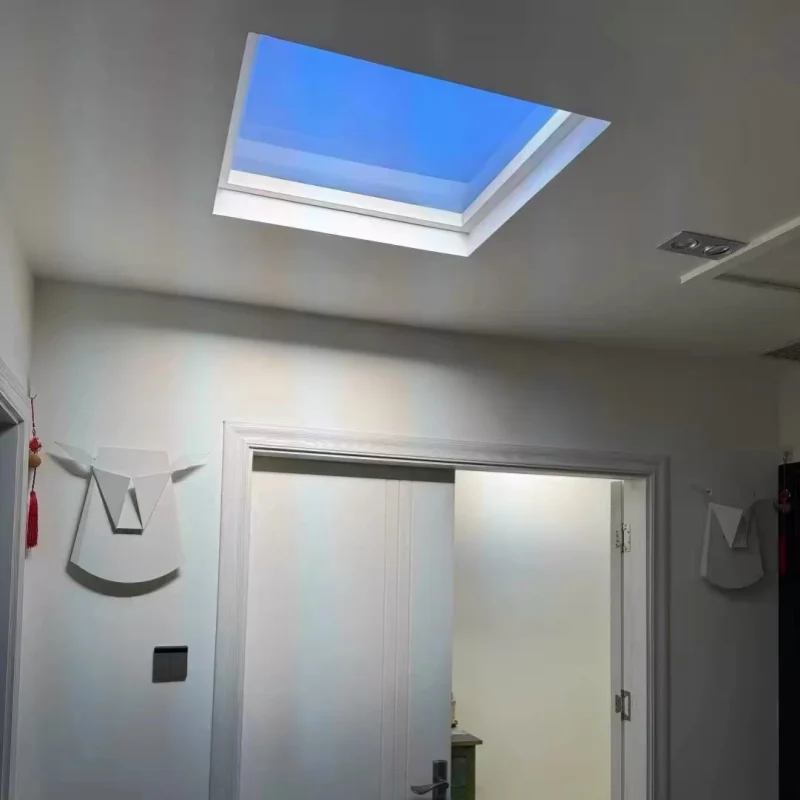
Standard ceiling lights only address brightness requirements, not the feeling of natural outdoor light. EASY artificial skylight converts LED light into diffuse illumination close to blue sky and sunlight. It is not a simple blue light panel, but a wellness lighting interface that can be perceived as a fake office window.
Office faux windows are not decorative paintings; they are lighting solutions to boost comfort, focus and space utilization.
Impacts on Focus, Mood and Fatigue
Windowless environments tend to trigger several issues: afternoon drowsiness, dry eyes, low mood and weakened perception of time passing. The root cause is not merely insufficient illuminance, but the lack of natural light cues.
Natural light regulates our circadian rhythm. Cooler, brighter light in the morning helps people stay alert; warmer, dimmer light in the evening supports relaxation. The artificial skylight can simulate this shift, offering employees circadian cues similar to daylight through real windows, even indoors.
Unlike static light boxes, high-quality fake natural light windows retain sky gradients, soft diffusion and subtle dynamic effects. They do not glare like ordinary blue-rich LED lights, delivering a visual experience closer to real sky.
This “outdoor window perception” benefits concentration: employees do not need to walk to actual windows. They can get short visual breaks when looking up, reducing eye strain from prolonged screen viewing.
Installation Locations: In Front of Workstations, Meeting Areas and Corridors
For faux window for windowless office, installation placement matters more than simply increasing brightness. The artificial skylight should sit within the natural line of sight of staff, instead of only providing uniform white light overhead.
Workstation front: fake window for office with light as visual anchor The area in front of or slightly to the side of workstations is the preferred location. Placing fake window for office with light within view lets employees see simulated sky when thinking, taking calls or looking up to rest their eyes.
Avoid mounting it directly behind screens, which creates excessive contrast between the display and bright background. Better positions include the side front of workstations, above partitions or mid-wall sections.
Meeting areas: virtual window for office to reduce enclosed feeling Meeting rooms often have no exterior windows. Long discussions can easily feel stuffy. virtual window for office can be installed on the front or side wall of the meeting table to add directional awareness and openness to the space.
For meeting zones used for video calls, select dimmable, low-glare artificial skylight panels to prevent overexposure on camera.
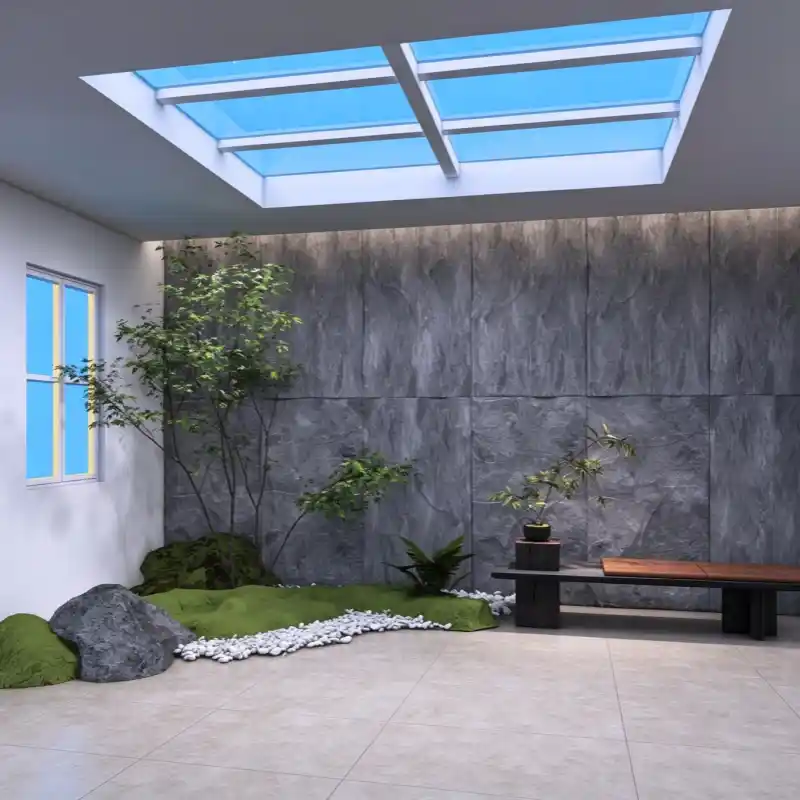
Corridors: fake windows for windowless rooms with light to guide circulation Continuous or intermittently arranged fake window light is suitable for hallways, passages and circulation routes. fake windows for windowless rooms with light not only mitigate tunnel-like sensations but also guide walking directions.
Install artificial skylights at corridor ends or corners to create a psychological hint of “an exit ahead”, lifting the oppressive feeling of windowless spaces.
Color Temperature Selection: How to Use 4000K–6500K
Higher color temperature does not equal better effect, nor does bluer light make a more authentic sky. The key is matching color temperature, brightness, time and scenarios.
4000K: Neutral white, ideal for deep work, screen-heavy areas and long-hour office work. It keeps users alert without harsh cool tones, serving as the base color temperature for offices.
5000K: Suitable for morning hours, meeting areas and zones requiring heightened alertness. It resembles daytime light more than 4000K without overstimulation.
6500K: Close to midday sky, for short-term alertness boost, morning activation or simulating clear sunny outdoors. It is not recommended for full-time high-intensity use, as it may cause fatigue.
For stronger “outdoor window sensation”, separately control the visual color temperature of fake outside window and general indoor lighting. Keep the sky portion slightly blue and sunlight portion warm to build more realistic layers.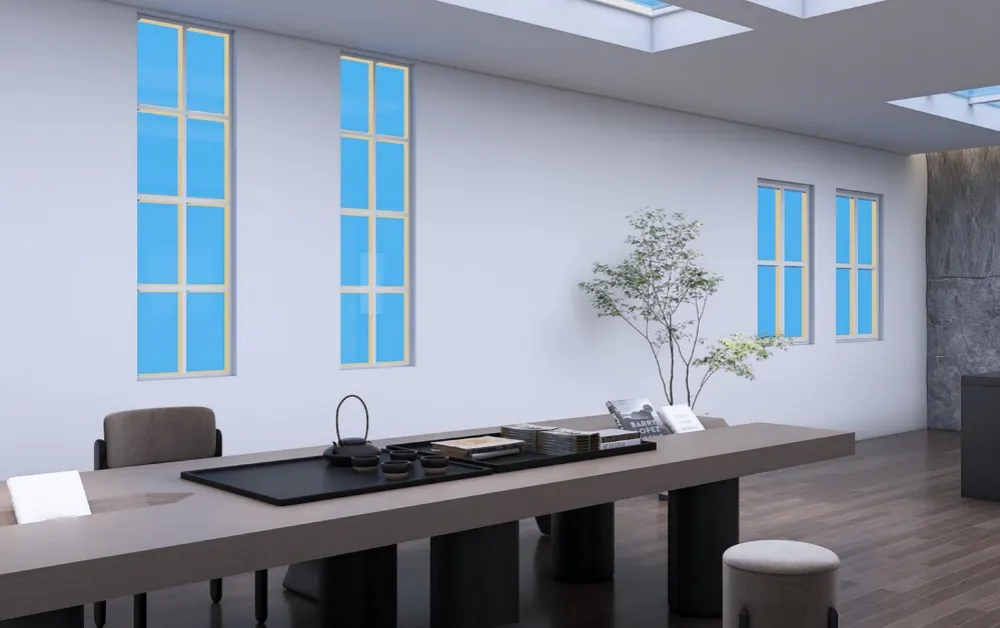
Smart Control and Schedule Simulation
A true artificial skylight should not only have an on/off function. It should vary according to local time, office schedules and staff circadian rhythms.
7:30–9:00 a.m.: fake outdoor window can gradually brighten from 4000K to 5000K to simulate wakefulness after sunrise. 10:00–12:00 a.m.: shift to 5500K–6500K, approximating midday outdoor light. After 14:00: gradually revert to 4000K–5000K to ease afternoon sluggishness. For overtime work in the evening, lower to 3000K–4000K to reduce blue light exposure.
Smart controls support timers, sensors, DALI, KNX or 0–10V dimming systems. Staff can switch between preset modes: Focus, Meeting, Break and Overtime via scene panels.
For an experience closer to real windows, fake window with artificial sunlight can feature slowly moving cloud patterns and sky gradients to avoid the artificial look of static imagery.
ROI for Office Spaces: Employee Experience & Space Premium
Pain points in windowless offices ultimately reflect on employee experience and space value. Fake window light is not merely an aesthetic upgrade; it is a renovation solution to improve office asset efficiency.
Employee experience: Improved visual comfort, time perception and mood support help raise satisfaction, retention and afternoon productivity. Spaces with window-like lighting also leave deeper impressions on job candidates during recruitment.
Space premium: Previously hard-to-rent or underutilized windowless areas can be converted into functional offices, meeting rooms or focus booths. For property owners and operators, this means higher utilization, flexible leasing options and stronger spatial differentiation.
Renovation cost: Compared with relocation, expansion or actual window opening projects, artificial skylight solutions feature lighter construction, shorter lead time and simpler maintenance. No exterior facade modification is required, and they are not limited by floor or building orientation.
For enterprise clients, it transforms windowless areas into healthier, more appealing workplaces.
FAQ: Will It Affect Screen Work?
It will not if properly designed. Three key considerations:
- Prevent reflections of the artificial skylight on screens. Do not place panels within the reflection angle directly behind or in front of displays.
- Manage brightness contrast. Avoid large gaps between ambient light and screen brightness. For screen-intensive zones, prioritize 4000K–5000K; reserve 6500K only for short-period alertness.
- Choose low-glare panels with even diffusion. Rayleigh scattering artificial skylight delivers light similar to sky diffuse light rather than direct harsh glare. With lighting design meeting UGR<19, it generally does not add strain to screen-based work.
For offices with heavy video conferencing, graphic design or precision tasks, perform illuminance simulation and on-site testing before finalizing installation positions and color temperature settings.
Office Space Solutions
EASY artificial skylight provides Rayleigh scattering artificial skylight solutions for windowless offices, meeting rooms, corridors and basements. We can customize installation positions, color temperature strategies and smart control logic for fake window office based on space structure, workstation layout, screen orientation and office schedules.
If you are planning office spaces, co-working hubs, corporate headquarters or renovation projects, contact the EASY artificial skylight team for office space plans and product recommendations.