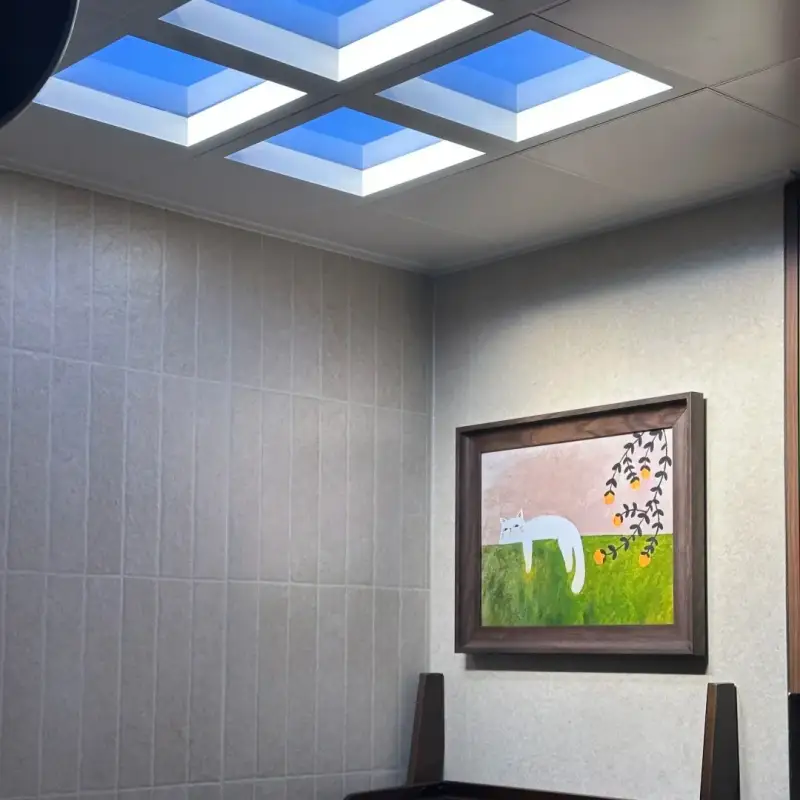
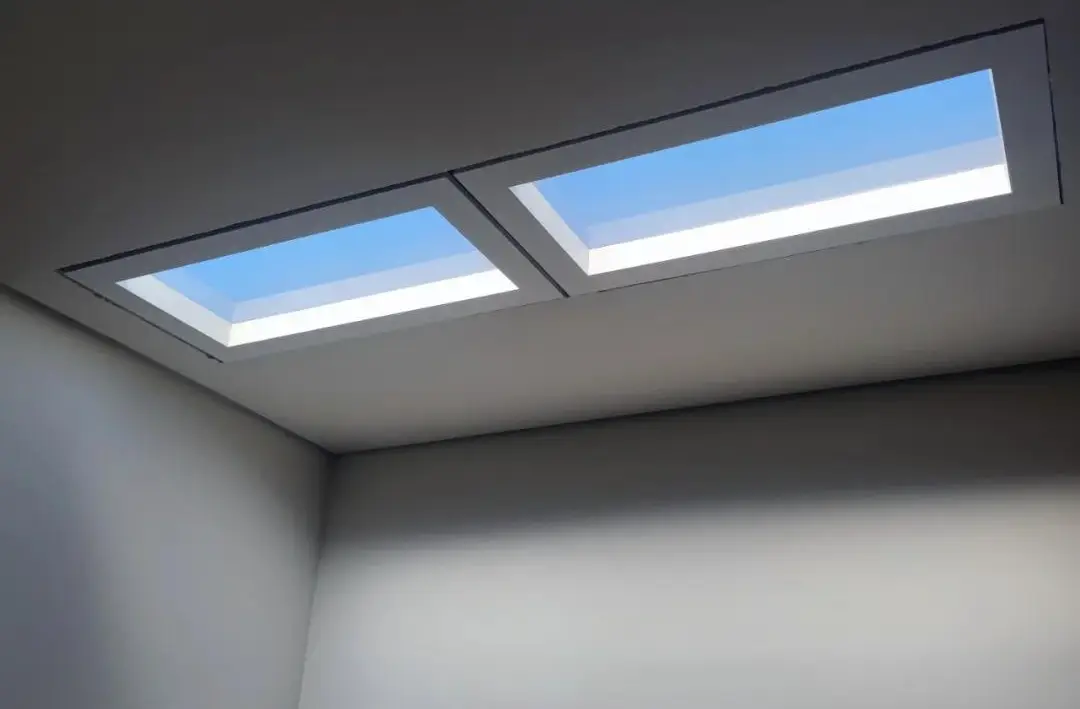
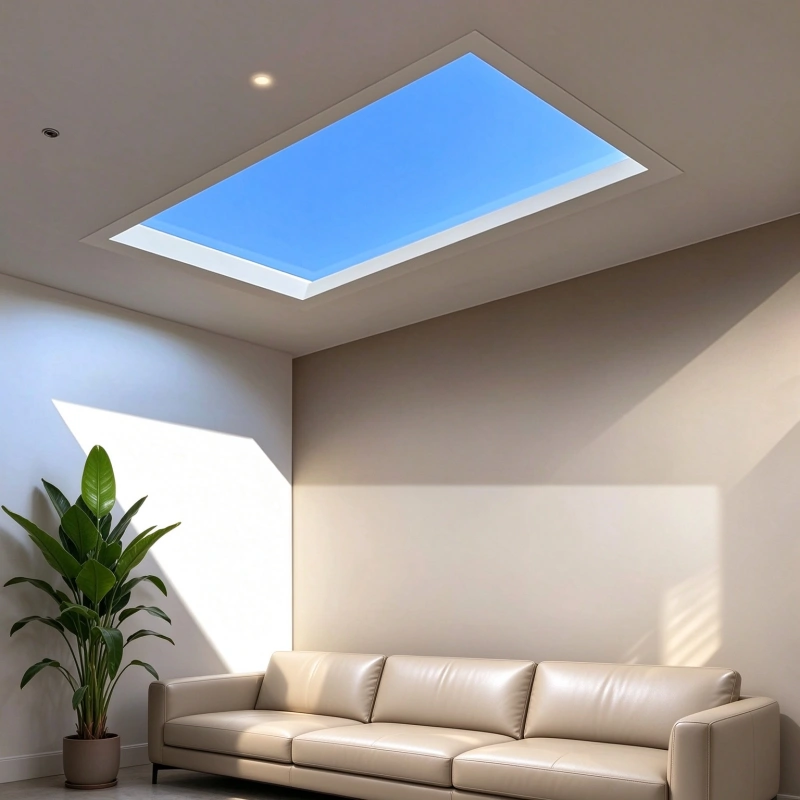
In windowless spaces, what people lack most is often not “brightness”, but a credible natural daylight sensation. The EASY artificial skylight turns an artificial window into a product built on Rayleigh scattering, rather than a simple luminous panel. Its goal is to create a visual experience inside the room that resembles the sky, sunlight and spatial depth.
What Is an Artificial Window?
An artificial window can be understood as an artificial window lighting system. It uses LED light sources, nano scattering layers, light guide structures and intelligent controls to simulate the blue scattering of natural sky and the directional quality of sunlight.
Traditional lighting fixtures only solve the problem of “being able to see”, while artificial windows focus more on “how real it looks like a genuine window”. It is not merely bright; it also delivers sky gradation, morning and dusk transitions and a comfortable light environment.
How Rayleigh Scattering Works
The core of Rayleigh scattering is that short-wavelength blue light is scattered more easily by tiny particles. The EASY artificial skylight applies this principle to make the panel display sky blue, while the direct light stays close to warm white sunlight.
This is also the fundamental difference between it and ordinary blue LED panels. A high-quality artificial window requires control over scattering uniformity, color temperature, brightness and glare, instead of just adding a layer of blue light.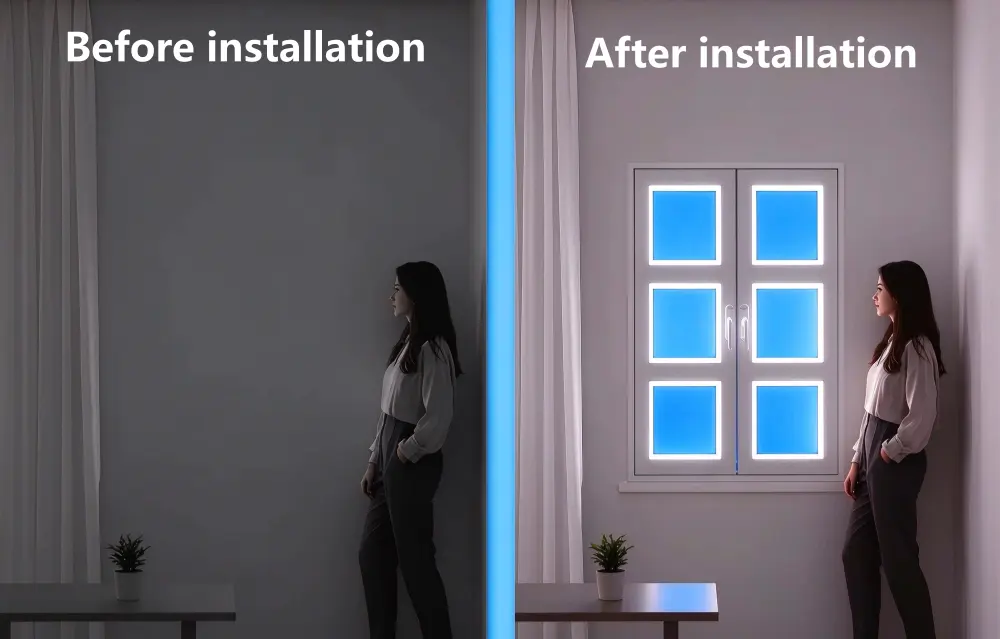
More Than a Luminous Panel
A luminous panel only delivers flat light. A mature artificial window also takes installation depth, viewing angle, color rendering, flicker and circadian rhythm effects into consideration.
For offices or basements, it should also support dimming, timing and scene changes. Only then can users feel the space is closer to a real natural daylight environment.
Artificial Window vs Imitation Window
Many people confuse artificial window with imitation window. Both aim to “look like a window”, yet they differ in technical approach and experience focus.
Imitation windows are more about appearance simulation, such as fake window frames, window scenery paintings, backlit curtains or decorative films. They can improve visuals but may not provide high-quality lighting.
In contrast, an artificial window emphasizes functional natural light simulation. It normally comes with genuine light sources, scattering layers and control systems, and can be used as primary or auxiliary lighting for a space.
Comparison Table
| Artificial Window | Imitation Window | |
|---|---|---|
| Core Objective | Simulate natural sky and sunlight | Simulate window appearance |
| Light Source Quality | High color rendering, dimmable, low glare | Depends on backlight or decorative lamps |
| Technical Focus | Rayleigh scattering, light guiding, circadian lighting | Patterns, window frames, visual masking |
| Typical Applications | Windowless offices, basements, inner rooms | Home decoration, photography backdrops |
| Experience | Closer to the sensation of opening a real window | More for decoration and atmosphere |
Window imitation is not inherently low-end. If you only want to make a wall less plain, decorative solutions are sufficient. But if your objective is to improve comfort in spaces where people stay for long periods, artificial window is the preferred option.
Types of Artificial Windows
An artificial window is not a single type of product. Based on functions and application scenarios, it is generally divided into decorative type, lighting type, screen type and panel type.
Decorative Type: Visual Techniques of Imitation Window and Window Imitation
Decorative solutions include fake window frames, window landscape paintings, light-transmitting films and backlit curtains. They are suitable for quickly upgrading wall visuals, with low cost and simple installation.
However, such imitation window usually does not serve as primary lighting. If the room itself is dark, relying solely on decorative solutions will still leave the space feeling oppressive.
Lighting Type: Daylight Simulation Lamp and All-Day Circadian Rhythm
Lighting-type artificial window puts more emphasis on light quality. It often integrates daylight simulation lamp technology to deliver high color rendering, adjustable color temperature and low blue-light hazard lighting.
In residential and office scenarios, this type of product can help users stay alert during daytime and reduce cool white light ratio in the evening. It cannot completely replace real sunlight, yet it can greatly improve the feeling of windowless spaces.
Screen Type: Dynamic Images of LED Fake Window Panel
Screen-type solutions usually adopt led fake window panel or display panels to play dynamic images of sky, sea views, woods and so on. It delivers strong visual impact and fits hotels, interior cabins, exhibition halls and high-end residences.
Nevertheless, brightness, color accuracy and surface reflection are critical for screen-type products. Over-saturated images or direct light shining into eyes will instead reduce realism.
Panel Type: Rayleigh Scattering and Artificial Skylight LED Panel
The panel type is the main route focused on by the EASY artificial skylight. An artificial skylight led panel uses a Rayleigh scattering layer to spread blue light evenly inside the panel and form a visual effect close to the sky.
Premium panel-type artificial window is usually thinner, more uniform, and easier to integrate into suspended ceilings and walls. It is ideal for spaces requiring a skylight-like natural sensation, rather than simply displaying images.
Best Uses for Artificial Windows
The value of artificial window lies in bringing natural daylight sensation to spaces originally lacking windows. Different scenarios have different requirements for brightness, color temperature and installation methods.
Windowless Offices: Faux Window for Windowless Office
Meeting rooms, back-office work areas and basement offices often have no exterior windows. A faux window for windowless office can act as primary lighting or ambient lighting to reduce the sense of enclosure.
When paired with smart controls, it can provide fresher cool white light in the morning and gradually lower color temperature in the afternoon, helping employees maintain a comfortable rhythm.
Basements and Dark Rooms: Fake Window with Natural Light
The biggest drawback of basements is feeling “like a cave”. A fake window with natural light provides visual cues closer to daytime and restores natural colors for walls and furniture.
Basement installation needs attention to moisture resistance, heat dissipation and ceiling depth. If floor height is limited, thin panels or surface-mounted structures are preferred.
Corridors, Bathrooms, Inner Rooms and Cruise Cabins
These spaces usually have no exterior windows but require stable lighting. Artificial window can reduce claustrophobia and serve as a design focal point.
In cruise cabins, hotel dark rooms and high-end bathrooms, Rayleigh scattering artificial skylights create the illusion of “opening a window to see the sky”. It is not just lighting; it reshapes the mood of the space.
How to Choose an Artificial or Imitation Window
When selecting artificial window or imitation window, first clarify your goal: decoration or lighting? Short-term set design or long-term use?
Check Optical Parameters
Focus on color rendering index, color temperature range, flicker, glare control and brightness uniformity. For office and reading use, color rendering and low glare are more important than high brightness alone.
If a product claims to simulate sky, observe whether the blue tone is natural, white light is clean and edges are not grey. A good artificial window should not make people instantly notice “this is a light emitting”.
Check Installation and Maintenance
For panel-type products, confirm ceiling depth, power supply location, heat dissipation space and maintenance access. Screen and light box types also need checks on weight, noise and cleaning difficulty.
For faux window for windowless office applications, models with dimming, timing function and easy maintenance are recommended. Stable long-term operation matters more than initial visual effect.
Check Certifications and Safety
Users should look for CE, RoHS, UL or local electrical standards. Blue light safety, driver quality and flame-retardant materials also need verification.
EASY artificial skylight suggests users prioritize suppliers with authentic test data, clear after-sales service and installation guides. Artificial window is a long-term lighting device; appearance alone should not be the only consideration.
FAQ
What is the difference between Artificial window and ordinary fake window?
Ordinary fake window mostly refers to imitation window, which focuses on appearance. Artificial window emphasizes light source, scattering and natural light simulation, and can normally undertake practical lighting tasks.
Can it fully replace real windows?
It cannot fully replace real windows. Real windows bring fresh air, outdoor views and full-spectrum sunlight. Artificial window works better as a lighting and psychological compensation solution for windowless spaces.
Will Rayleigh scattering artificial skylight hurt eyes?
Qualified products control blue light, flicker and glare. Check safety certifications and optical parameters before purchase. Do not stare directly at high-brightness light sources, and avoid low-quality panels with harsh glare.
Is installation complicated for windowless offices?
It depends on the type. Panel-type versions are usually embedded into ceilings or walls and require reserved power supply and installation depth. Decorative types are simpler but have limited lighting capacity.
Can it be used for plants?
Conventional artificial window is designed mainly for human visual comfort and spatial atmosphere, and may not support photosynthesis for plants. If used for plant growth, genuine full-spectrum grow lights should be selected.
How to judge the quality of imitation windows?
Check whether light is uniform, color is natural, window frame is well-finished and backlight is non-glaring. For decorative purposes, visual realism is the priority; if lighting function is required, refer back to optical parameter evaluation.