What Is a Sunlight Portal?
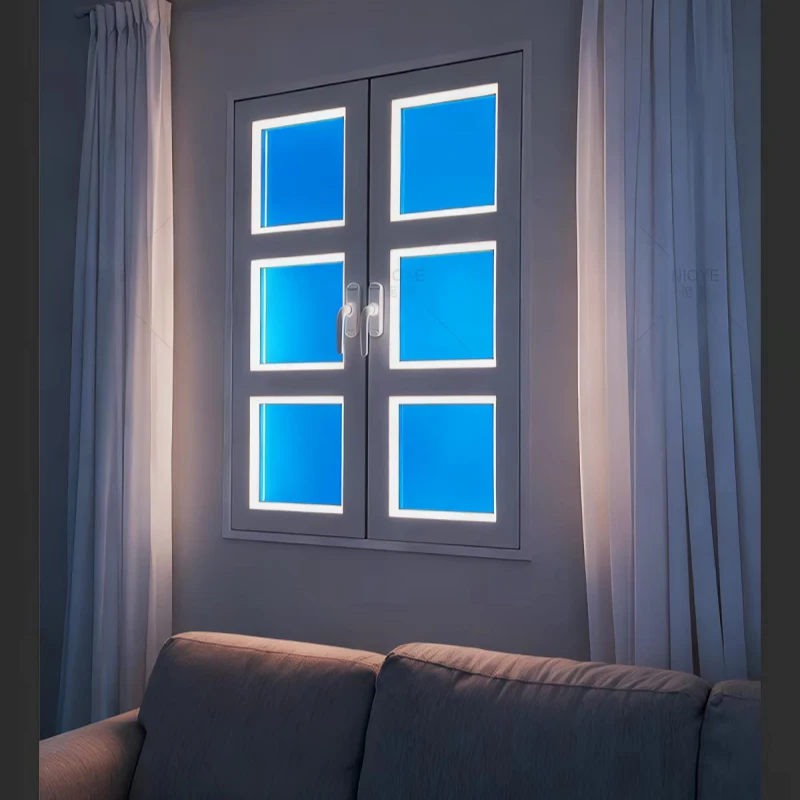
Sunlight Portal is the Rayleigh scattering clear sky lamp launched to the market by EASY. It looks like a “sky window” on a ceiling or wall, but inside it is not an ordinary light box.
Its core lies in using a Rayleigh scattering layer to simulate the scattering effect of the atmosphere on sunlight. Short-wavelength blue light is evenly scattered, forming a natural sky gradient, rather than a harsh white LED panel.
When you look up or look at the wall, what you see is “sky” and “sun,” not light beads. What it brings is not mere illumination, but a spatial experience closer to indoor sunlight. For rooms lacking windows, this light can reduce the sense of enclosure and make home sunlight more natural.
The goal of Sunlight Portal is: in spaces where windows or skylights cannot be installed, bring in the visual and emotional value of sun in home.
Sunlight Portal vs Skylight vs Traditional Window
Real skylights require roof openings, structural assessment, waterproofing, and are also subject to floor and property management restrictions. Traditional windows depend on exterior walls, orientation, and building spacing, and privacy, insulation, and security must also be considered.
Sunlight Portal does not require opening the roof, nor does it depend on exterior walls. It can be embedded in suspended ceilings and walls to simulate blue sky, sunlight, and dusk. It cannot replace ventilation windows, nor can it replace real windows in all scenarios, but it is suitable for spaces where windows cannot be opened.
If you pursue a more realistic natural light feel and home sunlight, it is a low-damage and highly controllable solution.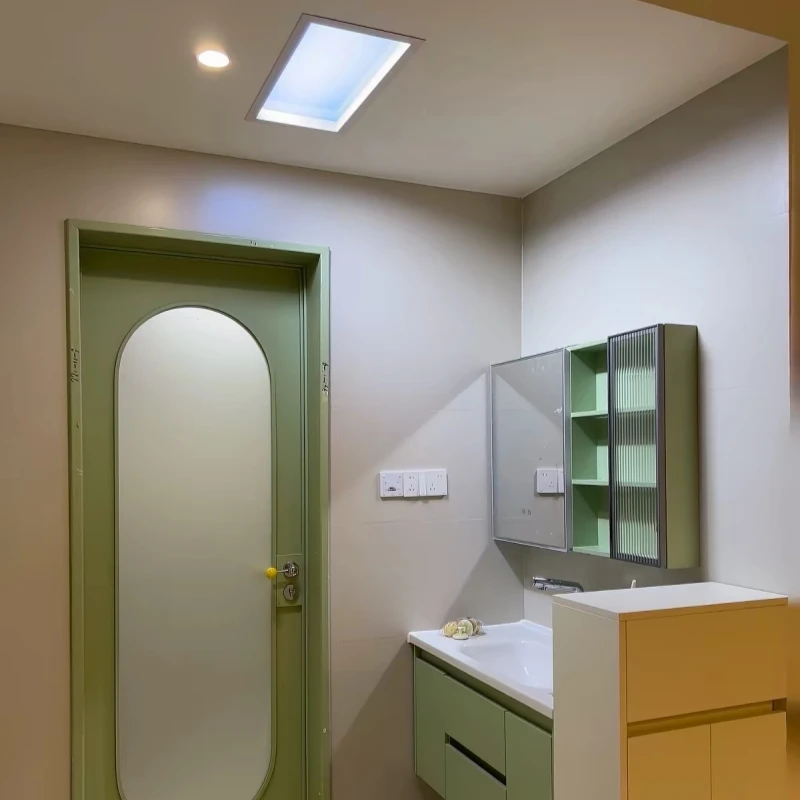
Where to Install a Sunlight Portal
Installation location determines the experience. It is recommended to plan from four dimensions: space height, viewing angle, power supply, and maintenance.
Ceiling: Installation Logic of artificial skylight ceiling
The ceiling is the most common location. artificial skylight ceiling can be embedded in gypsum board, mineral wool board, or integrated ceilings while keeping a flat surface. It is suitable for living rooms, dining rooms, studies, and offices.
When the floor height is below 2.6 meters, it is recommended to choose ultra-thin modules to avoid a sense of oppression. Reserve power supply and access panels for later maintenance.
Wall: Fake Window Solution with fake window with artificial sunlight
Walls are suitable for making a “fake window.” fake window with artificial sunlight can be combined with window frames, blinds, and curtains to simulate sunlight outside the window. It can be used in bedrooms, corridors, meeting rooms, and livestream rooms.
If used for office workstations, faux window for office can make enclosed workstations feel more open. Pay attention to viewing distance and avoid the sun simulation point being too bright.
Basement and Corridor: Daylighting for Dark Spaces with artificial skylight for basement
Basements, corridors, dark bathrooms, and elevator halls often lack natural light. artificial skylight for basement can simulate sunrise, noon, and dusk through timed scenes, reducing the monotony of all-day “white wall lights.” Basements need attention to moisture protection, heat dissipation, and voltage safety. Corridors can use long strip or circular modules to create a sense of rhythm.
Design Ideas for Indoor Sunlight
When designing, first decide “sky” or “sun.” Blue sky mode is suitable for relaxation, warm sun mode is suitable for reading, and dynamic clouds are suitable for living rooms. Pairing Sunlight Portal with wood veneer, microcement, and white walls can make indoor sunlight more natural.
The fake window solution can add window frames, blinds, sheer curtains, and even windowsill plants. Circular modules are suitable for entryways and corridors, while long strip modules are suitable for meeting rooms. Smart control can set scenes for morning wake-up, work, cinema, and meditation.
If you originally searched for indoor lights that mimic sunlight, Sunlight Portal emphasizes more of a “sky feel” and spatial integration, rather than a single point of strong light.
How to Buy the Right Sunlight Portal
First, look at the technology. A true clear sky lamp should be based on Rayleigh scattering, not an ordinary RGB light strip plus a milky white panel.
Second, look at the parameters. Pay attention to color temperature range, color rendering index, illuminance uniformity, no flicker, low blue light, and glare control.
Third, look at size and installation. Ceiling and wall thicknesses differ, so you need to confirm openings, power supply, and control method.
Fourth, look at the scenario. Bedrooms should be soft, offices should be uniform, and basements should be moisture-proof.
Fifth, look at brand cases and warranty. Low-priced light boxes often have hot spots, blue spots, and short lifespans, resulting in poor long-term experience. Do not only ask “how much does it cost”; ask “in what space will it be installed, how long will it be viewed, and is it close to natural light.”
FAQ
Q1: Can Sunlight Portal completely replace real windows?
No. It mainly supplements indoor sunlight and the visual feel of sky. It does not replace ventilation, escape, and real views. But it can make windowless spaces closer to the sun in home experience.
Q2: What is the difference between it and ordinary fake window lights?
Ordinary fake window lights are mostly a bright panel. Sunlight Portal uses Rayleigh scattering to simulate the sky, so the light is more even, and the sky and sun have layers. For offices, faux window for office can reduce the sense of enclosure.
Q3: Is installation complicated?
Ceiling and wall installation require cooperation between an electrician and a carpenter. Modular products can reduce the difficulty, but professional installation is still recommended.
Q4: Is it suitable for basements?
Yes. artificial skylight for basement is often used in windowless basements, corridors, and dark bathrooms. Choose moisture-proof models and ensure heat dissipation.
Q5: Can it simulate sunrise and sunset?
Yes. With smart control, it can set color temperature and brightness changes to simulate early morning, noon, and dusk.
Q6: Is it equal to a plant grow light?
No. indoor lights that mimic sunlight mainly serve people’s visual and spatial experience; plant growth requires a separate plant grow light.