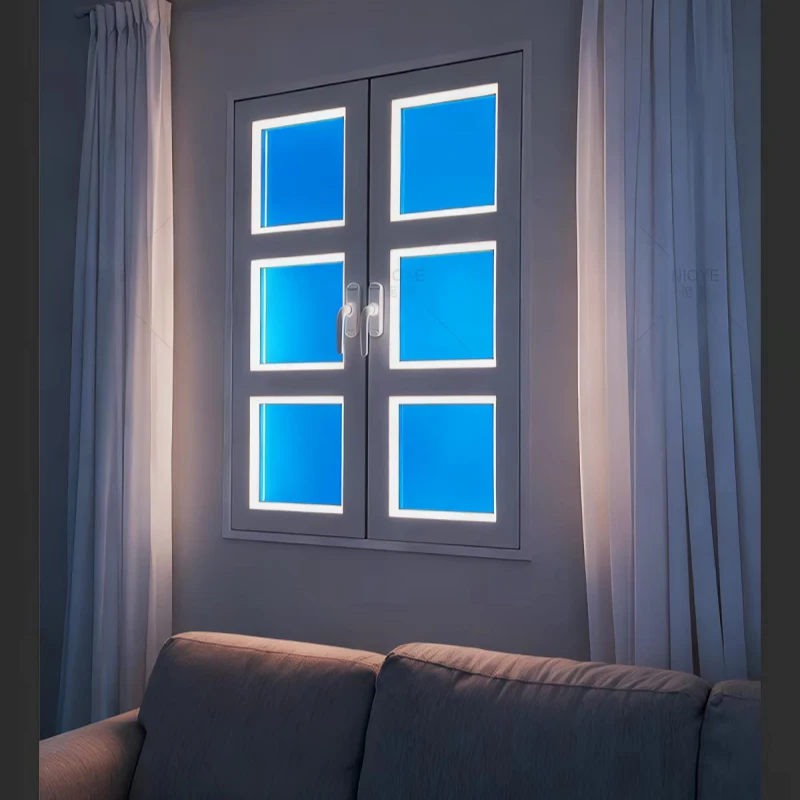
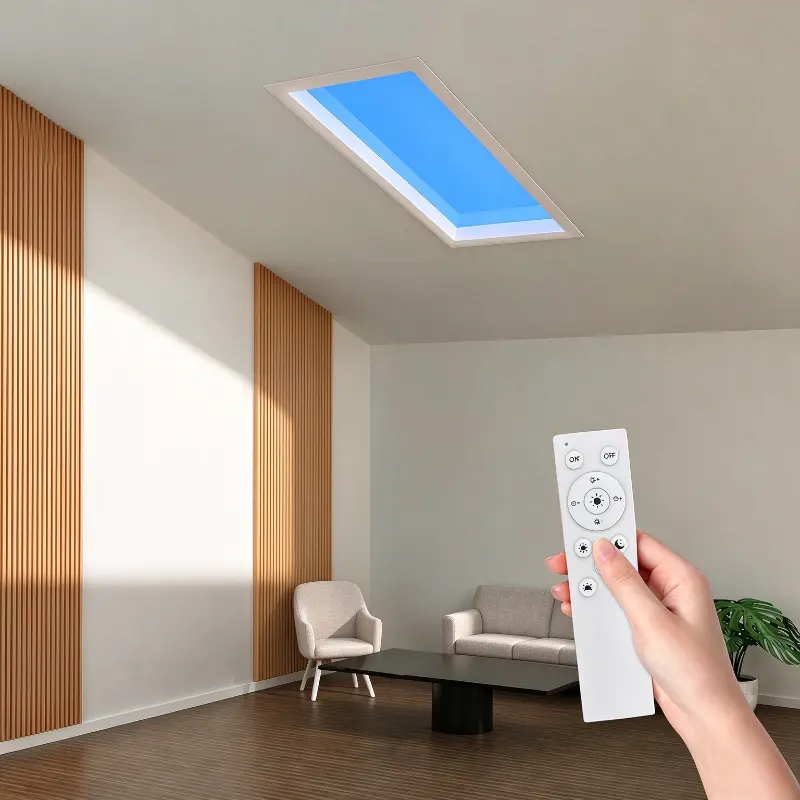
Many windowless basements, enclosed offices, and internal bathrooms have difficulty obtaining real natural light.
Traditional decorative-picture-style fake windows look stiff, while a realistic fake window (simulated fake-window clear-sky lamp) built on Rayleigh scattering optical technology can recreate the feeling of a real blue sky and daylight indoors.
As an R&D team deeply engaged in natural-light simulation lighting, we combine extensive project testing and user feedback to break down a complete framework for judging whether a fake window is realistic enough, helping you distinguish low-quality decorative fake windows from clear-sky lamp products that truly provide a natural-light experience.
What Makes a Fake Window Look Realistic?
A sufficiently realistic fake window is by no means simply printing a blue-sky-and-white-cloud pattern onto a light panel.
Most low-priced products on the market rely on printed graphics or a blue film on the surface to achieve a “blue sky”; once the light is turned off, the pattern is directly exposed and can easily be seen through at a glance. A truly high-level fake window uses optical scattering principles to generate a blue-sky appearance, rather than a flat printed image.
The core of an artificial skylight panel is replicating the Rayleigh scattering phenomenon in nature. When a white light source passes through a nano-scattering panel, short-wavelength blue light is scattered to present sky blue, while the rest of the light passes through to provide indoor illumination, visually resembling looking up at the real sky.
To be sufficiently realistic, it is necessary to balance three aspects at the same time: light performance, appearance and structure, and scene imagery. Excelling in only one dimension will still create a sense of incongruity. Whether it is a finished luminaire or a DIY solution, these indicators need to be included in the evaluation.
Lighting, Depth, and Color Temperature
Light is the soul of a realistic fake window and the core factor that separates products.
The blue light of ordinary flat panel luminaires comes from colored LED beads; the color tends to be garish and purplish, lacking the transparent layering of the real sky. In a Rayleigh scattering clear-sky lamp, the blue of the sky changes slightly in depth with the viewing angle, restoring the spatial depth of the atmosphere rather than being a rigid flat blue block.
Color temperature matching is equally critical. The color temperatures corresponding to a clear noon sky and a sunset at dusk are completely different; good products support multi-level color temperature adjustment. A simulated sunlight lamp can simulate the dynamic changes of natural light throughout the day, rather than being fixed to a single cold blue light.
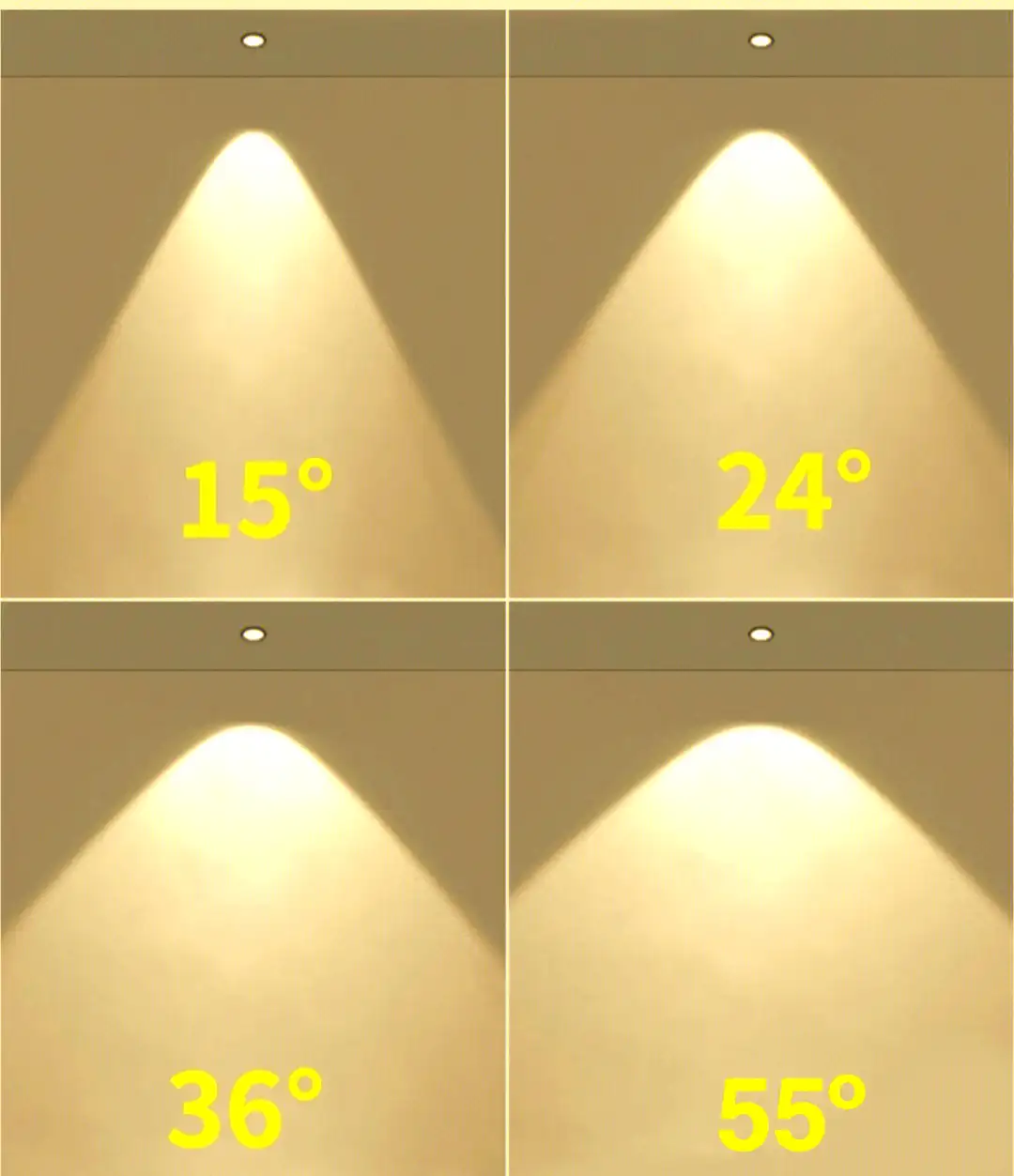
Also pay attention to the light output angle. Sunlight from a real skylight projects obliquely onto the wall, forming soft light and shadow; some inferior products only emit uniform diffuse light without projected light and shadow, so the space lacks the illusion of a “window being opened.”
Frame Proportion and Window Grids
Frame and grid design directly affects the visual credibility of a fake window, and many DIY solutions fail at this step.
The frame border should not be too thick; an overly thick border strengthens the industrial feel of a “luminaire” and ruins the atmosphere of a window; but if the border is too thin, structural strength is insufficient and it can also look cheap. The proportions need to match the conventional length-to-width ratio of realistic windows (real windows), avoiding odd sizes that are too square or too narrow and long.
Window grids can be optionally selected as needed. Residential spaces can choose a minimalist gridless style; office and commercial scenarios can use simple thin grids to be closer to real architectural windows. Grid lines must not be too thick; otherwise they will cut apart the sky image and destroy the sense of the sky’s completeness.
For office renovation scenarios, a faux window for windowless office should balance office aesthetics; the frame color should be as close as possible to the ceiling and interior hard-finish tones to reduce the obtrusiveness of the luminaire.
Scenery and Image Quality
The choice of scene imagery is a mistake many people easily make.
Some fake windows have built-in seascape or mountain forest images; if such images lack sufficient resolution, pixel grain will appear at close range, instantly breaking the sense of realism. A Rayleigh scattering clear-sky lamp, however, does not rely on static images; it generates a pure blue-sky effect with no fixed landscape graphic, avoiding image distortion at the root.
If you want to pair it with landscape imagery, choose a high-resolution backlight solution; the image brightness must coordinate with the brightness of the sky’s luminous area, and there must not be a split where the image is too bright or too dark.
At the same time, pay attention to reflection issues. If the surface of the luminaire reflects strongly, you will see reflections of the LED light source, directly exposing the nature of the luminaire. High-quality clear-sky lamps use anti-glare optical treatment; you cannot see the internal LED beads, only a clear blue sky.
Realistic Fake Window vs Realistic Windows
Many users struggle with this question: since a realistic fake window can be made, is it still necessary to pursue realistic windows? The two have their own applicable scenarios and are not substitutes for each other.
The advantage of real windows is that they can provide real outdoor air and direct sunlight, changing in real time with the weather. But they are limited by building structure: basements, internal offices, and windowless bathrooms cannot have windows installed; at the same time, real windows come with a series of maintenance problems such as heat insulation, water leakage, privacy, and strong sunlight exposure.
A realistic fake window, represented by clear-sky lamps as simulated skylight products, is exemplified by the fake skylight ceiling light. It is not constrained by building walls and can be installed in any room; it is not limited by rain, snow, day, or night, and can produce a clear-sky effect at any time; it has no trouble with water leakage or heat insulation, and brightness and color temperature can be freely controlled.
Of course, a fake window cannot completely replace the full spectrum of real sunlight. It is more suitable as a daylighting supplement or a solution for completely windowless spaces. When conditions permit, interiors should still prioritize using the building’s native realistic windows to obtain natural light.
Common Mistakes That Make Fake Windows Look Fake
Based on our extensive project commissioning experience, we have compiled the most common types of mistakes that directly ruin realism; try to avoid them when purchasing or doing DIY.
-
Relying on printed graphics to achieve a blue sky. When the light is off, the printed pattern is exposed; as soon as power is cut, it is completely “given away.”
-
Fixed, non-adjustable color temperature, with only a harsh cold blue and no soft dusk mode.
-
Severe surface glare; internal LED beads are clearly visible, and it is recognized as a luminaire at a glance.
-
Disproportionate frame; the border is too thick and wide, and the size does not match conventional window proportions.
-
Imbalanced image brightness; the brightness of the landscape graphic differs too much from the sky’s luminous area.
-
No directional projected light and shadow at all, only uniform diffusion, lacking the oblique lighting effect of a skylight.
Many fake windows made by DIY enthusiasts will fall into 2–3 of the above traps, which is why many homemade solutions are far less atmospheric than mature finished clear-sky lamp products.
Buying and DIY Checklist
Whether you plan to purchase a finished clear-sky lamp or try to DIY a realistic fake window, you can check item by item against this list.
Checklist for buying finished products
✅ Whether it uses Rayleigh scattering optical panels, rather than printed blue film or blue LED dyeing
✅ Supports stepless adjustment of color temperature and brightness, and can simulate daytime clear sky and dusk effects
✅ The luminaire surface is anti-glare; the internal light source cannot be seen when looking directly at it
✅ The frame proportions match realistic windows, and the frame color suits home decoration
✅ Can produce oblique projected light and shadow, not just flat illumination
✅ Suitable for ceiling installation conditions; confirm ceiling height and reserved opening dimensions
DIY production checklist
❌ Do not directly print blue-sky-and-white-cloud images as the luminous surface
✅ Prioritize nano-scattering optical panels; do not use ordinary blue acrylic panels
✅ Uniformize the light source to avoid local overbrightness and LED bead spots
✅ Design the outer frame reasonably and replicate the length-to-width ratio of real windows
✅ Reserve a dimmable power supply to make color temperature and brightness controllable
Tip: It is difficult for DIY to replicate the nano-scattering effect of a mature artificial skylight panel. To obtain a highly realistic blue sky, in most scenarios it is more advisable to choose a tested, mass-produced clear-sky lamp product.
FAQ
Q: In which rooms is a realistic fake window clear-sky lamp suitable for installation?
A: It is especially suitable for windowless basements, internal offices, bathrooms, and corridors without daylight. A faux window for windowless office can significantly improve the oppressive feeling of enclosed office spaces; in homes, bedrooms and entryways can also be used to supplement a natural-light atmosphere.
Q: Does a fake skylight ceiling light consume a lot of electricity?
A: The power consumption of mainstream LED clear-sky lamps is close to that of household flat panel ceiling lights; brightness is adjustable, and energy consumption is very low when running at medium brightness in daily use.
Q: Can a fake window completely replace realistic windows?
A: No. A clear-sky lamp can replicate the visual feeling of blue sky and daylight, but it cannot provide the full spectrum of real sunlight or ventilation. If the building can have windows, priority should still be given to using real windows for daylighting.
Q: Can DIY achieve a professional-level realistic fake window effect?
A: DIY can make a decorative fake window, but Rayleigh scattering requires special nano-optical panels and precise light path tuning; under personal conditions, it is very difficult to replicate the realistic blue-sky effect of a mass-produced clear-sky lamp.
Q: Are a simulated sunlight lamp and a clear-sky lamp the same type of product?
A: A simulated sunlight lamp is mostly a desk lamp-type daylight simulation luminaire; a clear-sky lamp belongs to ceiling simulated skylights. In addition to simulating daylight illumination, it can also visually present a complete sky appearance. The two product forms are clearly different.