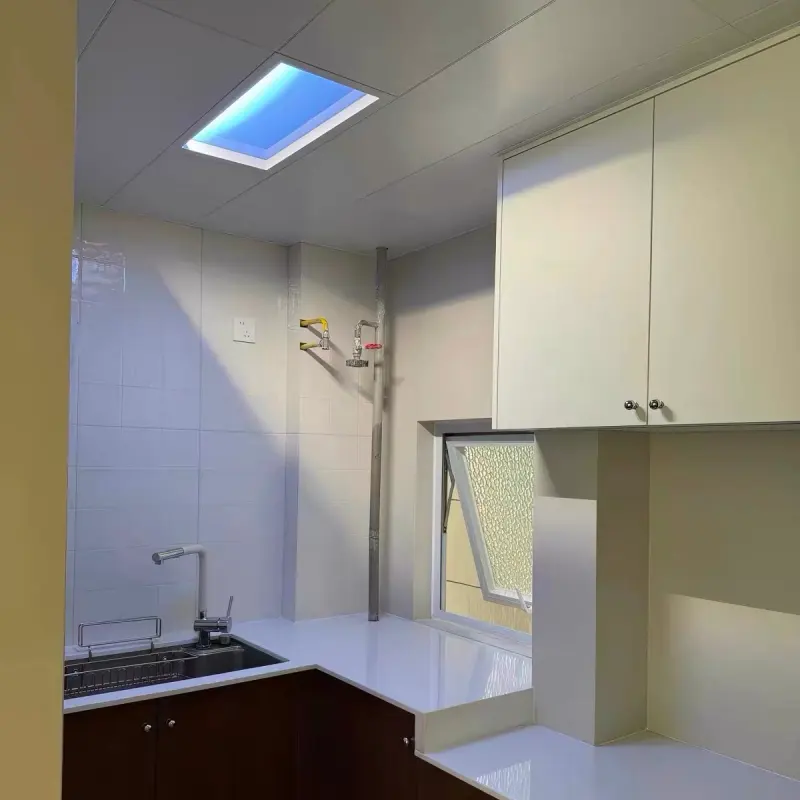
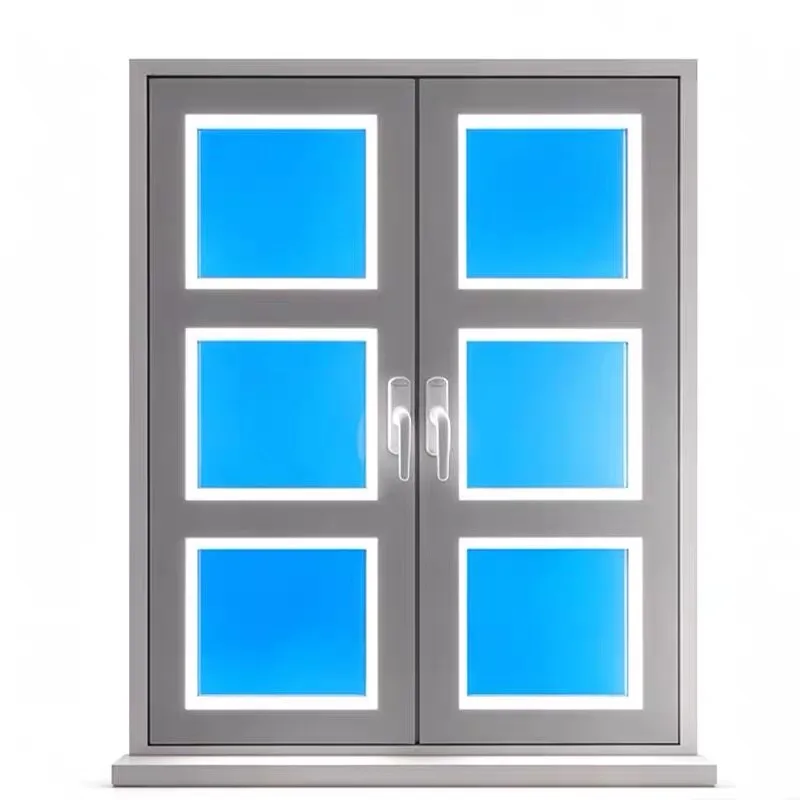
What is Artificial Sky? What exactly is an artificial sky / simulated blue sky light?
If you are new to the term artificial sky, you can understand it as a lighting system that reconstructs a perceptible blue sky indoors.
It is not simply a ceiling painted blue, nor a sky poster pasted up. Instead, it uses optical structures, nano scattering materials and controllable light sources to create brightness, colour temperature and depth on the ceiling similar to a real sky.
Many people searching for fake sky are actually looking for a solution that brings a sense of sky without windows. The term electronic sky places more emphasis on a dimmable, timer-enabled, programmable electronic lighting system. Both terms refer to the core product we commonly call the clear sky light, simulated blue sky light or artificial skylight.
Its applications are mainly for windowless or poorly lit spaces: basements, windowless offices, corridors, bathrooms, interior cabin rooms, retail shops, waiting areas, elderly care spaces and more. It addresses more than just basic brightness. It improves spatial orientation, visual comfort, sense of openness and daytime atmosphere.
Artificial Sky is not a blue panel: How Rayleigh scattering creates a “realistic sky”
The real sky appears blue not because it is painted blue. Sunlight travels through the atmosphere, and short-wavelength blue light is scattered by air molecules far more strongly than long-wavelength red light.
This phenomenon is known as Rayleigh scattering, where scattering intensity is roughly inversely proportional to the fourth power of wavelength. This scatters blue light in all directions, giving us the uniform, translucent, gradient sky we see when looking upward.
The core of the Artificial Sky clear sky light is to simulate this process. It typically consists of high-CRI LED light sources, light guide plates, nano scattering layers, blue light diffusion structures and warm white light sources.
After passing through the scattering layer, blue light will not form glaring colour spots like ordinary blue LEDs. Instead, it turns into soft blue close to natural sky. Some premium models also integrate a “sun” optical module, using lenses or collimating structures to produce directional light beams, generating bright patches and shadows indoors similar to sunlight.
This is the biggest difference from conventional LED panel lights, light boxes and projected sky effects. Ordinary blue panels are merely “blue”, while genuine artificial sky replicates sky brightness distribution, colour temperature transition, sun direction and visual depth.
From fake sky to electronic sky: Suitable spaces
Clear sky lights work best for spaces lacking real windows yet requiring a daytime atmosphere. Examples include basement home theatres, windowless studies, internal office cubicles, hotel interior rooms, underground commercial areas, hospital waiting zones, gyms and yoga studios. They prevent the space from feeling like a closed box and visually relieve feelings of confinement.
It is important to clarify: a clear sky light is not a complete replacement for windows. It cannot provide ventilation, emergency escape function, UV disinfection or genuine outdoor views that real windows offer.
It delivers a sky experience at the lighting level. Therefore, in basements and interior rooms, it functions primarily as comfort lighting and psychological ambient lighting rather than a window substitute as defined by building codes.
Based on industry experience, a 1:1 on-site mockup is recommended before installation, focusing on three key checks:
- Whether light source particles or colour spots are visible from main viewing positions.
- Whether the blue tone is natural, free from purple, cyan or oversaturated cast.
- Whether it remains comfortable after dimming for daytime and night modes. On-site testing is the only reliable way to verify its suitability for the space.
Artificial skylight cost: Where price gaps come from
Artificial skylight cost varies widely, and size is not the only factor. Core elements affecting pricing include scattering layer craftsmanship, light source spectrum quality, colour rendering index, glare control, sunlight simulation module, dimming and timing system, installation depth, heat dissipation structure, control protocol and brand after-sales service.
Low-cost products usually combine blue LEDs with diffusion plates, which tend to suffer from blue light spill, uneven colour temperature, flicker and poor colour rendering.
High-end clear sky lights invest more in spectral continuity, sky gradient, sun angle adjustment, unified glare rating and long-term stability.
For residential users looking only to enhance basement atmosphere, smaller sizes with basic dimming are viable. For offices, commercial spaces or high-end residences, systems with adjustable colour temperature, timers and linkage capability are recommended.
DIY artificial skylight: Feasible, but watch out for these points
DIY artificial skylight is popular online. Common builds use LED strips, acrylic diffusion plates, blue filters and wooden frames. It can create a “sky-like” appearance, but achieving natural-looking results is challenging.
There are four major risks:
- Over-concentrated blue light creating obvious colour spots.
- Uneven diffusion with bright edges or dim centres.
- Insufficient colour rendering causing colour distortion of objects indoors.
- Inadequate heat dissipation and electrical safety hazards during long-term operation.
DIY can be tried for low-cost decoration purposes. However, if you want a sky effect close to reality, finished clear sky lights with professional optical design are preferred.
How to judge whether a realistic faux skylight looks natural
When evaluating a realistic faux skylight, do not rely solely on promotional images. Check its performance in real environments:
- Whether the blue sky has a gradient from horizon to zenith.
- Whether sun patches are soft and directional instead of harsh bright white blobs.
- Whether the colour rendering index is sufficient.
- Whether visible flicker exists.
- Whether uniformity is maintained when viewed from the side.
- Whether it looks like a clean ceiling when switched off.
Professional lighting design pays attention to parameters including CRI, R9, colour tolerance, UGR, flicker percentage and illuminance uniformity. For clear sky lights, visual naturalness outweighs single brightness metrics.
A well-designed artificial sky should not draw constant attention to “where the light fixture is”. Instead, it naturally makes you feel “this space seems to have a sky”.
Artificial sunlight skylights and circadian rhythm: Manage expectations reasonably
Artificial sunlight skylights are often discussed in relation to mood, alertness and circadian rhythm. Higher illuminance and blue-rich light during daytime do help maintain alertness and biological clock rhythm. Still, clear sky lights are not medical devices and cannot replace outdoor activities, medication or professional phototherapy.
A reasonable expectation is that they provide a more daytime-like light environment in windowless spaces, ease spatial confinement, improve visual comfort and support regular daily routines to a certain extent.
For usage, maintain high brightness and cooler colour temperature during daytime, reduce brightness and switch to warmer tones in the evening. Avoid prolonged direct viewing of high-brightness blue light before bedtime.
Artificial skylight system purchasing checklist
Use this checklist when selecting an Artificial skylight system:
- Continuous spectrum and colour rendering index above 90.
- Low glare, no harsh viewing from side angles.
- Flicker-free or low-flicker; stable capture under slow-motion phone camera.
- Supports dimming and timing, simulating sunrise, noon and sunset.
- Natural blue sky tone with gradient and depth.
- Soft sun patches and natural shadow rendering.
- Convenient installation depth, heat dissipation and maintenance.
- Clear statement that it cannot replace ventilation windows, emergency escape windows or real UV exposure.
The value of Artificial Sky clear sky lights is not simply mounting a blue light panel on the ceiling. It applies Rayleigh scattering principle to bring the “visual logic of the sky” indoors. For windowless spaces, it acts as a solution balancing illumination, atmosphere and spatial experience.
When making a selection, prioritise optical design, spectrum quality and real visual performance over price or marketing pictures.
EASY clear sky lights focus on turning artificial sky from a concept into a stable, natural and long-lasting indoor clear sky experience.