Why Fake Window Light Is Needed for Windowless Rooms
A windowless room is not merely “a room missing a window.” What it lacks are temporal cues, weather changes, distant views and natural light gradients. When people stay in basements, dark living rooms, interior bathrooms, storage rooms or enclosed offices, they tend to feel oppressed and drowsy, and the space also appears smaller.
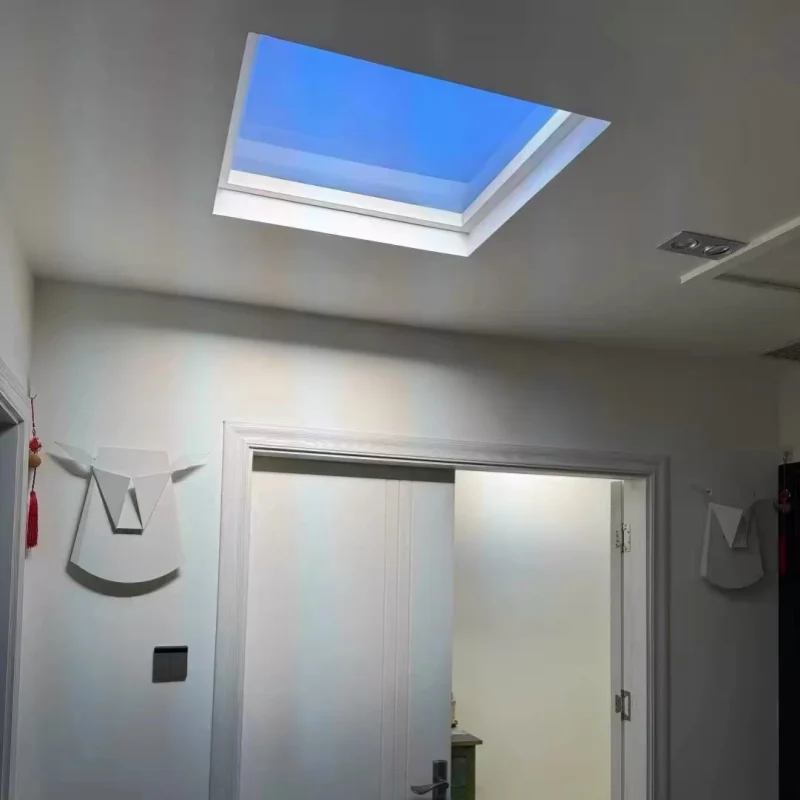
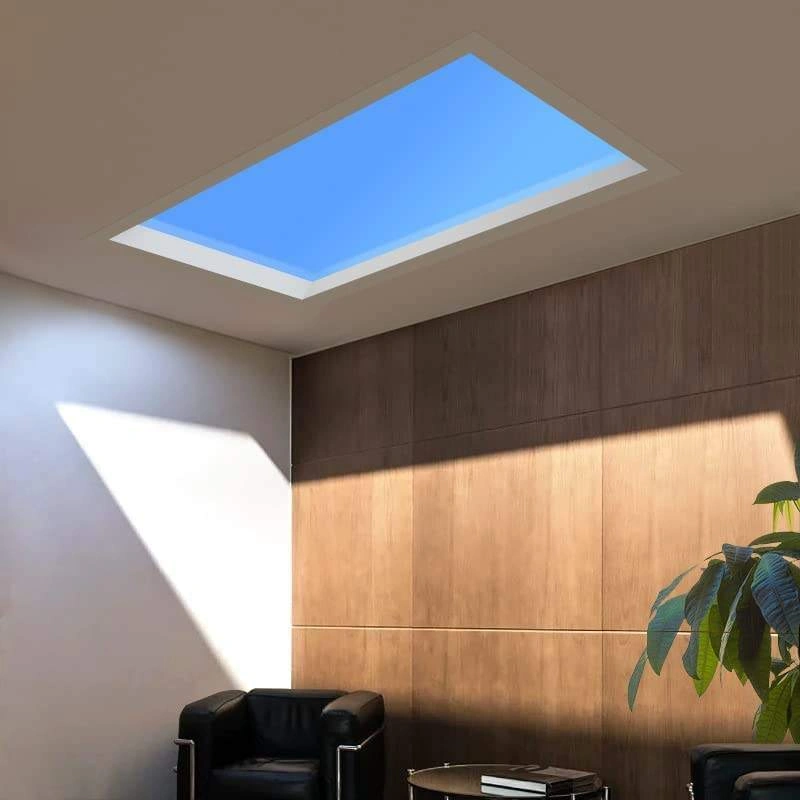
In projects, EASY Artificial Skylight often breaks down fake window for windowless room into three variables: light source quality, mounting position and indoor reflection. An effective fake window light is not simply a printed landscape picture. Instead, it uses Rayleigh scattering artificial skylight to simulate blue sky, sunlight and soft diffusion, restoring a sense of “daytime” to windowless spaces.
Health and Mood Issues in Windowless Rooms
In a windowless room, people can easily lose the ability to distinguish day from night. Without sufficient bright light in the morning, the body remains in a nighttime state; in the afternoon, fatigue may be triggered by overly cool white ceiling lights. In the long run, mood, concentration and spatial comfort will all be affected.
A well-designed fake window in windowless room is more than decorative. It can deliver bright, even, bluish-white sky light during daytime to reinforce circadian cues, and visually create a sense of “distance” to ease enclosure. It cannot replace real sunlight, yet it serves as a stable daylight cue for windowless spaces.
Wall-mounted Fake Window, Ceiling Artificial Skylight and Corner Light Wall: How to Choose
If you want a “window view” directly in front of your line of sight, fake window wall is the priority. A recessed window frame is built on the wall with Rayleigh scattering artificial skylight installed inside. The recommended frame depth is 80–120 mm with soft light transition along edges. When sitting at a desk, sofa or bed, people will naturally look toward this “window”.
If the room has no exterior wall or sufficient ceiling height, the ceiling artificial skylight works more like a roof window. It fits basements, dark bathrooms, corridors and dark living rooms. Light falls from above for a more complete spatial perception.
Corner light walls suit narrow rooms. Wash lighting is applied on two walls or one corner, paired with a compact fake window to expand visual boundaries. These three solutions are the most common combinations for fake windows for windowless rooms.
Layout Principles: White Walls, Viewing Angles and Avoiding Direct Glare
First, white walls matter a lot. The wall surface reflectance should be maintained at 70%–85%. Light matte walls capture light from the artificial skylight and deliver a uniform blue-sky effect. Dark walls absorb light, turning the fake window into an isolated glowing panel.
Second, viewing angles need control. Rayleigh scattering artificial skylight requires a specific viewing angle to present natural blue sky and soft halo. Avoid direct line of sight to the luminous surface. Mount it slightly higher or laterally, and use window frames, light baffles or louvers to reduce direct glare.
Third, avoid direct light. Fake window light, similar to real window light, should illuminate the window frame, wall and interior space first before reaching human eyes. For basements with limited ceiling height, artificial skylight for basement can be considered, but moisture-proofing, ceiling structure and access panel design must be incorporated.
Circadian Lighting: Energize by Day, Support Sleep at Night
Lighting for windowless rooms should not stay at the same brightness all day long. During daytime, activate fake window with artificial sunlight mode with a color temperature of roughly 5000–6500K and elevated illuminance to mimic morning or afternoon daylight. Switch to warm light at 2700–3000K with dimmed brightness at night to cut blue light stimulation.
A practical method is to set timers or dimming scenes: gradual brightening at 7:00, peak brightness at 10:00, warm light transition at 18:00, low brightness at 22:00. In this way, the artificial skylight acts not only as an attractive fake window, but also as part of the circadian architectural lighting environment.
Case Studies: Small Rooms, Dark Living Rooms and Storage Rooms
Small study room: A fake window wall of around 2 ㎡ with deep frame and louvers. It provides distant view perception in daytime, and only retains warm wash lighting at night.
Dark living room: Ceiling artificial skylight delivers overall sky atmosphere, while corner light walls supplement vertical lighting to prevent only the floor from being lit.
Storage room: Compact fake window in windowless room, set to a 15-minute timer. It improves visibility for item retrieval and mitigates the enclosed feeling.
Basement: artificial skylight for basement integrated with moisture-proof ceiling, with maintainable light source structure to prevent service life degradation caused by long-term humidity.
FAQ: Will It Look Fake?
It will, if the light source has visible grain, mismatched brightness against surroundings, excessively cool color temperature, shallow window frame, or direct line of sight to the luminous panel. These flaws easily make it look like a glowing screen.
It will not, when Rayleigh scattering artificial skylight is adopted, paired with diffusion layers, dimming function, white walls, deep window frames and proper viewing angles. The goal of a fake window is not to fool everyone, but to supply natural light cues, making windowless rooms more comfortable and close to real daylight.
EASY Artificial Skylight Recommendation: Complete illuminance simulation first, then confirm the size, position and color temperature scenes for fake window for windowless room.