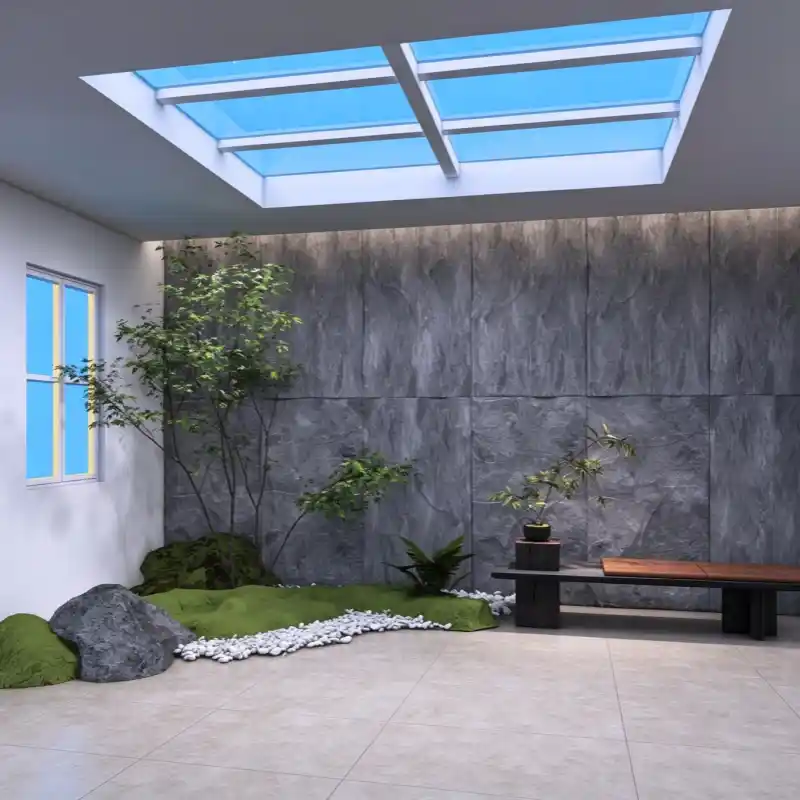
Many residential and commercial spaces face the problem of insufficient daylighting. Windowless rooms, north-facing layouts, and underground spaces find it difficult to obtain real sunlight, while the artificial sunlight brought by artificial skylight lamps provides a mature lighting solution for such scenarios.
Many people in the market colloquially call this effect fake sunlight or fake sunshine, but high-quality products are not simply pasting a blue-sky pattern. True artificial sun lighting relies on professional optical structures to restore a lighting experience close to the real outdoors.
What Is Artificial Sunlight?
Differences from Natural Sunlight
Natural sunlight comes from the sun. After passing through the atmosphere, it forms blue sky, daylight, and natural shadows, with a complete spectrum. However, it is limited by weather, time of day, floor, and orientation. It also contains ultraviolet rays; long-term direct exposure can damage furniture and skin.
The artificial sunlight produced by artificial skylight lamps replicates the visual experience and spectral characteristics of natural light, but is not affected by weather or day and night, and can be turned on and off at any time. It filters out harmful ultraviolet rays and will not cause sunburn damage. However, it cannot fully equal outdoor sunlight and lacks the dynamic cloud changes of the real sun.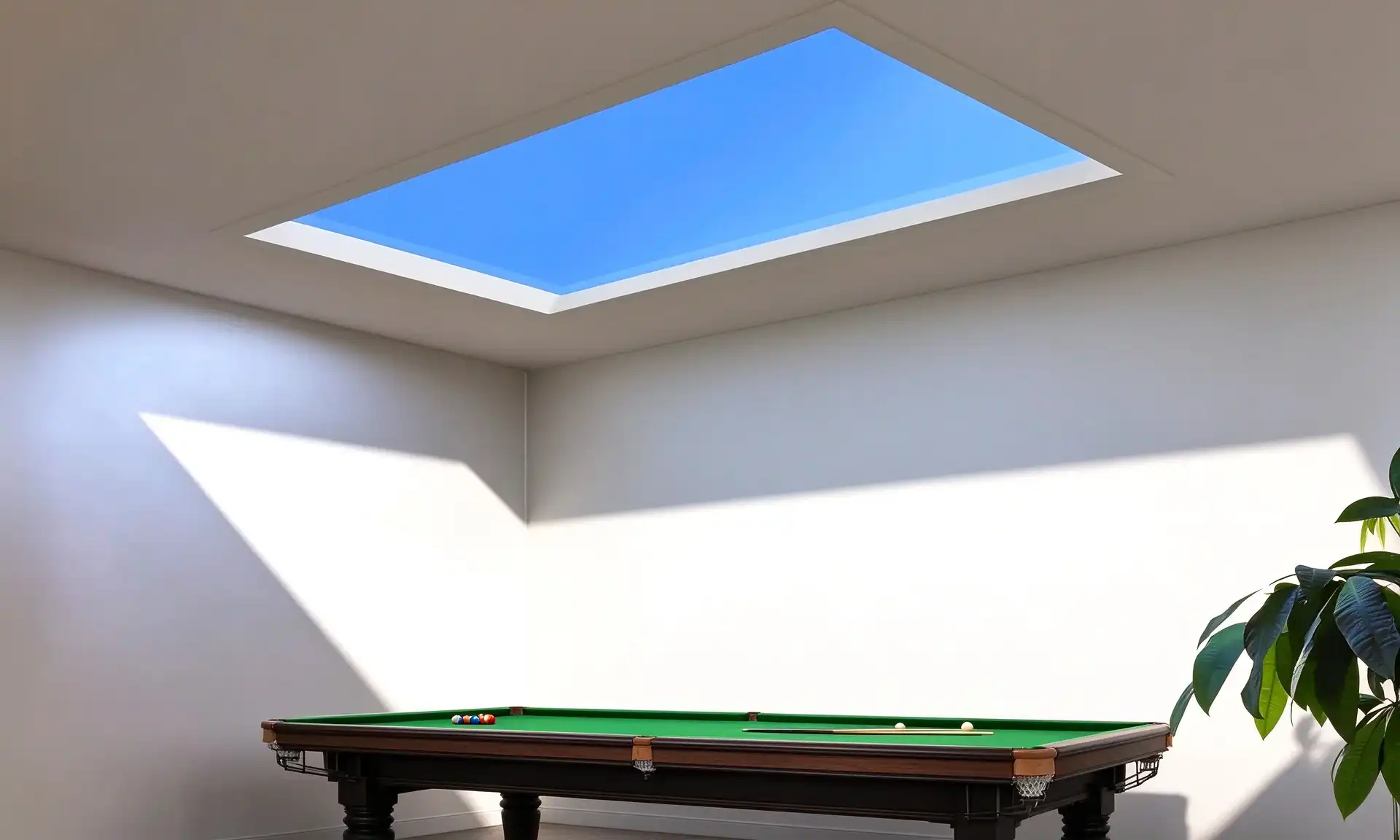
Differences from Ordinary Lighting
Ordinary LED downlights and panel lights only complete basic space illumination, casting light evenly downward. It is difficult for them to create the layered light and shadow of slanted sunlight, and they do not present a blue-sky visual effect.
Some cheap simulated sunlight lamp merely raise the color temperature, appearing whitish, with an incomplete spectrum and limited color rendering ability; long-term use can easily cause visual fatigue.
In contrast, the man-made sunlight output by artificial skylight lamps balances a sky visual panel with oblique light projection, capable of simulating the light and shadow of sunlight pouring into the room through a skylight, balancing functional lighting with a psychological natural-light experience.
How Artificial Sunlight Works
Spectrum, Color Temperature, and Color Rendering Index
Spectrum, color temperature, and color rendering index are the three core indicators for judging the quality of artificial sunlight. A complete spectrum reproduces the visible light band of sunlight as much as possible, avoiding color distortion caused by missing spectrum. Color temperature is used to simulate the changes of sunlight throughout the day: warmer in the early morning, cooler white at noon.
The higher the color rendering index CRI, the more realistic the object color reproduction. Professional-grade artificial skylight lamps generally have CRI≥90. Many low-priced fake skylight led panel only create a blue-sky appearance, with poor spectrum and color rendering parameters; they are only suitable for decoration, not for long-term residential or office use.
How Does an Artificial Skylight Lamp Simulate Blue Sky and Sunlight?
A true artificial skylight lamp relies on special optical materials to simulate atmospheric scattering. The lamp panel presents a blue-sky look, while the light source projects light outward at an oblique angle, casting soft sunlight-like light and shadow on walls and floors.
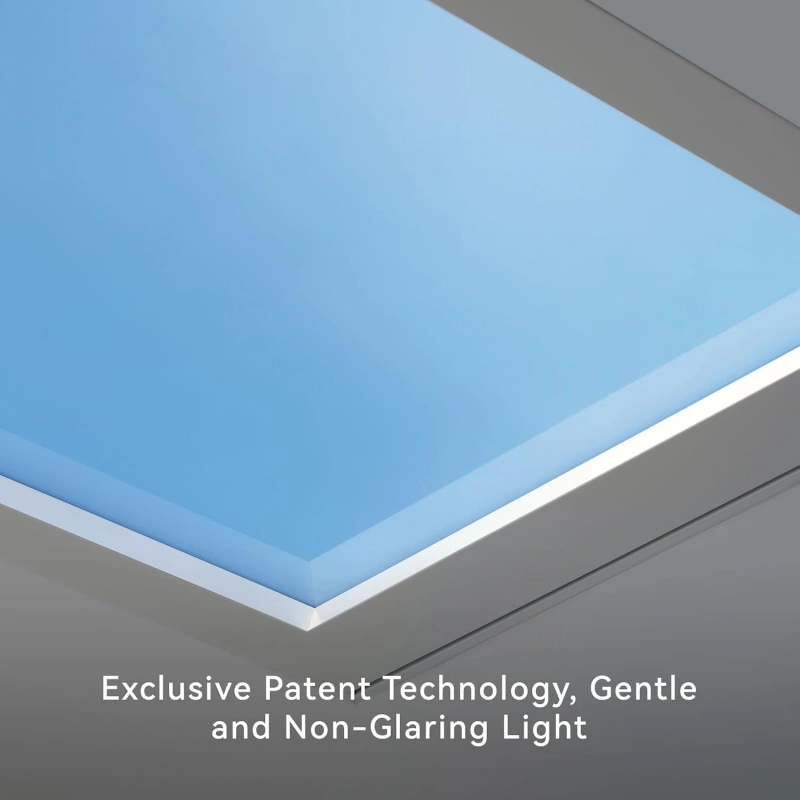
Unlike decorative lamps printed with blue sky and white cloud patterns, a high-quality artificial skylight panel achieves the dual effect of “the panel looks like blue sky, but what it illuminates is sunlight,” rather than simply a static image. This optical system allows interiors to obtain a skylight-like lighting experience without actually opening a roof skylight. Xinhua.
Best Use Cases for Artificial Sunlight
Man-made sunlight is best suited for spaces with limited natural daylighting conditions, including four typical scenarios: basements, north-facing rooms, offices, and windowless spaces.
-
Basement: Basements have almost no natural daylighting, and long-term living can easily feel depressing. Artificial skylight lamps can dissolve the sense of enclosure in underground spaces and serve as a main lighting supplement for family activity rooms, home theaters, and fitness areas.
-
North-facing rooms: North-facing living spaces lack direct sunlight, and the overall atmosphere is rather cold and gloomy. After turning on artificial sunlight, it can supplement the daylight atmosphere and improve the living experience.
-
Office: Many companies have internal windowless workstations, and faux window for windowless office is a common solution for such scenarios. Man-made sunlight helps maintain people’s circadian rhythms, relieves fatigue caused by long-term indoor office work, and improves concentration.
-
Windowless spaces: In meeting rooms, changing rooms, corridors, and physiotherapy rooms without exterior windows, using artificial skylight lamps can weaken the stuffy feeling brought by enclosed spaces, balancing practical lighting and spatial atmosphere.
How to Choose Artificial Sunlight
When choosing an artificial skylight lamp with artificial sunlight effects, focus on four major dimensions: brightness, installation method, energy consumption, and maintenance.
-
Brightness: Choose illuminance according to the space area. Residential environments do not need excessively high brightness; office and commercial spaces need higher illuminance to avoid dimness. At the same time, pay attention to glare control; excellent products are not harsh when viewed directly.
-
Installation method: Mainstream options are divided into recessed ceiling installation and surface-mounted installation. Recessed installation has requirements for ceiling height; for old houses and renovation projects, prioritize surface-mounted styles, without large-scale ceiling renovation.
-
Energy consumption: Prioritize LED light source products and compare power at the same brightness. Although high-quality artificial skylight lamps have complex optical structures, their long-term operating energy consumption is controllable.
-
Maintenance: Confirm whether the lamp panel is easy to clean and whether the light source module supports individual replacement. Prioritize products with complete warranties to reduce later failure hassles.
FAQ
Q1: Will artificial sunlight hurt the eyes?
A1: Qualified artificial skylight lamp products have anti-glare treatment and filter out ultraviolet rays, so normal use will not hurt the eyes. However, inferior fake sunlight products have problems such as excessive blue light and severe glare. When purchasing, pay attention to optical parameters, not just appearance.
Q2: Can artificial skylight lamps completely replace real window daylighting?
A2: No. artificial sun lighting can replicate illumination and the blue-sky visual, but it cannot achieve the ventilation and distant view of a real window. It is a daylighting supplement, not a replacement for a real window.
Q3: For a small windowless room, what size artificial skylight lamp is needed?
A3: For small spaces, it is recommended to choose a small-to-medium artificial skylight panel, and not blindly pursue a large size. An oversized panel can create visual pressure; matching the room area will balance aesthetics and lighting effect.
Q4: Can it be used in bathrooms and damp basements?
A4: It depends on the IP protection rating of the lamp. Damp environments must use models with the corresponding moisture-proof rating; ordinary indoor models are not suitable for high-humidity areas.
Q5: What is the difference between fake sunshine-type products and artificial skylight lamps?
A5: Many fake sunshine decorative lamps only have visual decorative effects, with insufficient spectrum, color rendering, and light projection ability, and are only suitable for temporary sets; artificial skylight lamps balance decoration and healthy lighting, and are suitable for daily long-term use.