Circadian lighting is reshaping the design philosophy of modern commercial and residential lighting. For a long time, indoor lighting focused merely on brightness, color rendering and decorative effects, ignoring the profound physiological impacts of light on the human body.
Places such as offices, meeting rooms, healthcare facilities and residential basements contain numerous enclosed windowless spaces with no natural daylight access. This directly disrupts the human circadian rhythm, and in turn affects concentration, mood and sleep quality.
What is Circadian Lighting
Humans have an innate circadian system that relies on natural light signals to regulate melatonin secretion. Cool, bright light in the morning suppresses melatonin and helps us stay alert; soft warm light in the evening stimulates melatonin production and supports nighttime sleep.
The circadian clock becomes disturbed when indoor environments lack lighting that follows natural daily patterns.
Circadian lighting, also commonly referred to in the industry as Human-Centric Lighting (HCL), is not a single type of luminaire. It is a lighting design concept that dynamically adjusts the brightness and color temperature of light sources to simulate natural daylight changes from sunrise, midday through sunset, sending correct time cues to the human body.
A common misconception is equipping ordinary tunable-white LED fixtures with circadian rhythm lighting. Standard fixtures only allow switching between cool and warm light presets, without brightness curves engineered for human biological rhythms. True circadian lighting features linked, dynamic shifts in color temperature and brightness, matching the body’s physiological response to natural daylight.
Practical Benefits of Circadian Lighting
Based on field measurements from architectural lighting projects and user feedback, properly implemented ccircadian rhythm lighting delivers multiple benefits in windowless spaces:
- Improved work focus: For office environments, rhythm-aligned lighting relieves mental fatigue and visual strain during long hours of desk work.
- Mood enhancement and relief of seasonal low mood: Regions at high latitudes experience short daylight hours in winter, and this problem is amplified in windowless rooms. Circadian lighting offsets the negative mood impacts of insufficient natural sunlight.
- Better nighttime sleep quality: Adequate daylight-mimicking light exposure during the day normalizes melatonin secretion at night, supporting a stable sleep cycle.
- Higher overall spatial comfort: For basements and internal meeting rooms with no outdoor access, rhythm lighting reduces the oppressive feeling of enclosed spaces and improves space experience.
These benefits explain why architects and interior designers increasingly integrate circadian rhythm lighting into design specifications when renovating windowless projects.
Practical Challenges of Implementing Circadian Lighting in Windowless Spaces: faux window for windowless office
Designers typically face several practical constraints when implementing circadian lighting in windowless offices and enclosed rooms.
The first option is building modification to install physical rooflight /skylight. Physical skylights bring in real natural daylight, yet they come with high implementation barriers: roof penetration is required, involving waterproofing and structural construction. Older buildings and underground spaces often cannot support such works, which greatly increases project cost and construction time.
The second option uses conventional dynamic rhythm panel lights. These luminaires can dynamically adjust color temperature and brightness to meet the optical parameters for circadian lighting. However, they only produce light output, lacking the visual perception of sky and windows. Occupants still clearly feel they are inside a sealed room, and psychological oppression cannot be eliminated.
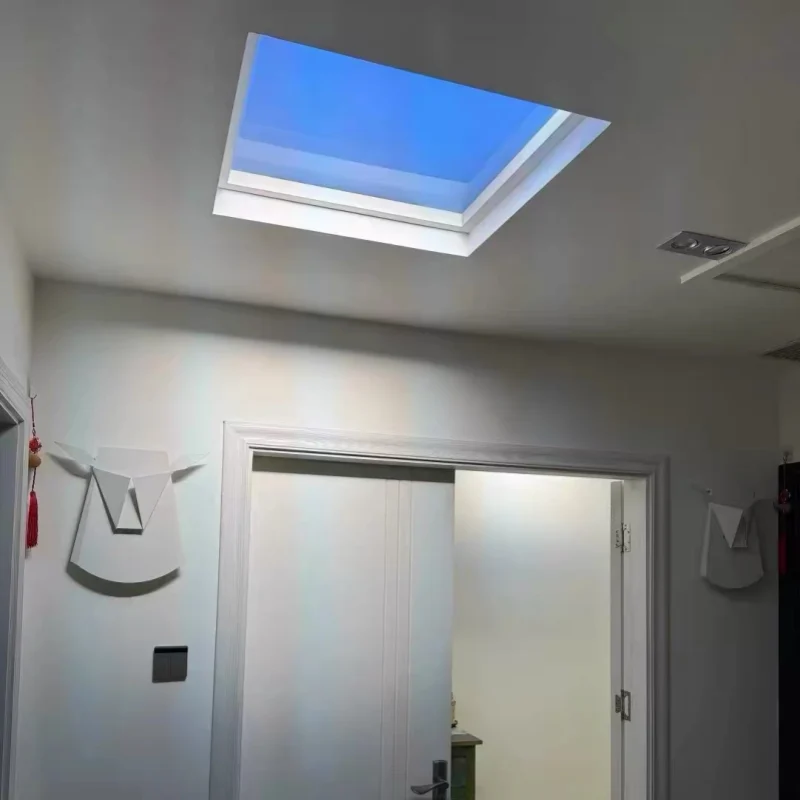
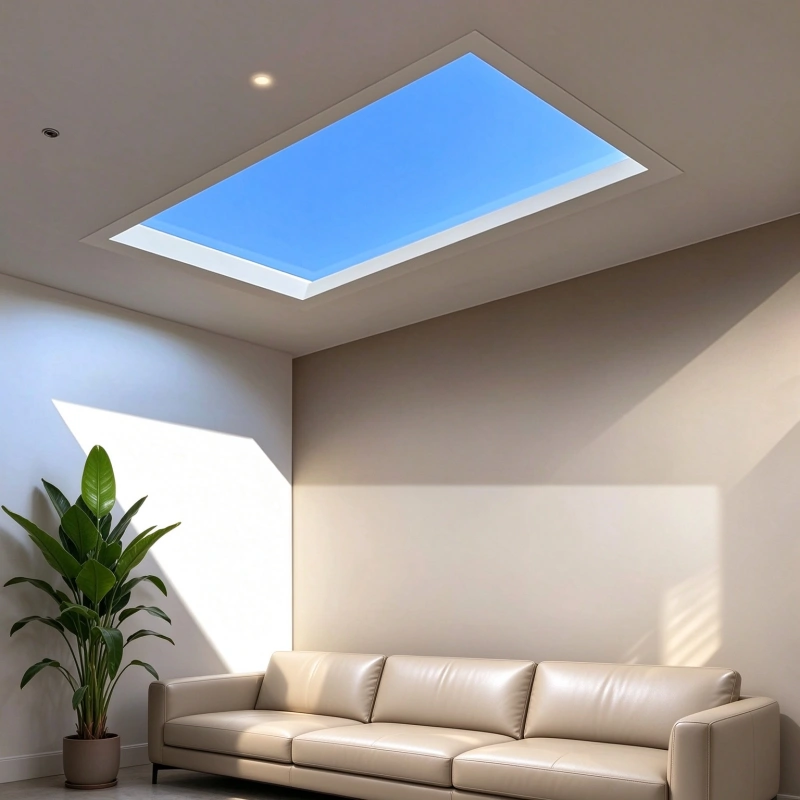
This drives growing market demand for products such as faux window for windowless office. Clients require not only light parameters that meet human circadian needs, but also a visual recreation of the experience of looking out at the sky from a window, combining physiological lighting effects and spatial visual comfort.
artificial skylight for basement: Achieving Rhythmic Natural Light Effect in Basements
Basements are a typical example of windowless spaces. Most basements have no exterior windows and receive neither direct nor indirect skylight. In the past, basement lighting only aimed to deliver sufficient brightness, with little consideration for circadian rhythms. Many residents who spend long periods in basements tend to suffer from fatigue and low mood.
artificial skylight for basement serves as a key solution for this scenario.
Traditional ceiling-mounted artificial skylights suit spaces with suspended ceilings. But many basements have limited ceiling height and are unsuitable for recessed ceiling installation. wall mounted led panel fake window offers an alternative installation method, deployed directly on walls without roof structural modifications.
Many buyers confuse ordinary backlit decorative paintings and projection fake windows with professional artificial skylights. Ordinary decorative products only display static images, with no complete circadian lighting dynamic rhythm programs. They function merely as soft furnishing decor and cannot regulate human biological clocks.
Qualified artificial skylights are more than window appearances. They are built with full preset circadian scenes, linking brightness and color temperature changes, while delivering the visual effect of fake natural light window.
Selecting a Suitable Circadian Rhythm Lighting Faux Skylight Solution for Your Project
Whether for commercial office renovation or residential basement retrofits, refer to the following industry selection criteria:
- Verify complete circadian rhythm programs: Distinguish simple multi-preset color temperature adjustment from genuine circadian lighting systems with linked dynamic brightness and color temperature. The fixture must support automatic scene cycles of sunrise – midday – sunset.
- Light source color rendering performance: Prioritize products with high CRI, whose color rendering closely matches real outdoor daylight and avoids color distortion.
- Compatibility with on-site installation conditions: Evaluate whether the site fits ceiling-mounted artificial skylight or wall mounted led panel fake window. Wall-mounted solutions are preferred for old buildings, basements and windowless offices to avoid civil construction work.
- Control method: Confirm the unit supports automatic scheduled operation and remote control, enabling full automatic daily rhythm cycles without frequent manual mode switching.
- Differentiate decorative and biologically targeted lighting: Many DIY fake natural light window products are purely decorative and lack rhythm lighting sequences. If your goal is to implement circadian lighting, select professional-grade artificial skylights engineered for lighting projects.
Circadian Lighting FAQ
Q: Are circadian lighting and full-spectrum luminaires the same thing? A: No. Full-spectrum lighting focuses on light spectra close to sunlight; the core of circadian lighting lies in dynamic changes, altering brightness and color temperature over time. A luminaire can feature both full-spectrum output and circadian rhythm functions, but the two concepts are not interchangeable.
Q: Can artificial skylights improve seasonal low mood? A: When a product fully implements the dynamic lighting logic of circadian lighting and delivers physiologically appropriate light, it can compensate for daylight deficiency in windowless environments. However, it is an environmental lighting solution and cannot replace medical treatment.
Q: Does installing artificial skylight for basement require extensive civil construction?
Wall-mounted versions need no roof openings or structural modifications to the building roof. Only wall power supply is required for installation, making them ideal for renovation of existing spaces.
Q: Is faux window for windowless office a screen or projection product?
Not necessarily. There are two main types on the market. One uses display screens or projection to create images; the other is optical-structure artificial skylights that simulate blue sky and sun beams, which is the flagship solution of EASY artificial skylight. Projection and screen options are more for decorative display, while optical skylights fully fulfill circadian lighting objectives.
Conclusion
Modern lighting design has long moved beyond simply “illuminating spaces”. Circadian lighting represents the human-centric evolution of the lighting industry.
Physical skylights are restricted by building structures and unavailable for numerous windowless offices and basements. fake natural light window and other artificial faux skylight solutions eliminate the need for complex civil construction, while satisfying both human biological lighting requirements and the visual experience of viewing the sky.
If you are planning lighting renovation projects for windowless offices, basements or healthcare spaces, feel free to contact the EASY artificial skylight team for customized project consultation.