How to Select a Fake Window Light Panel
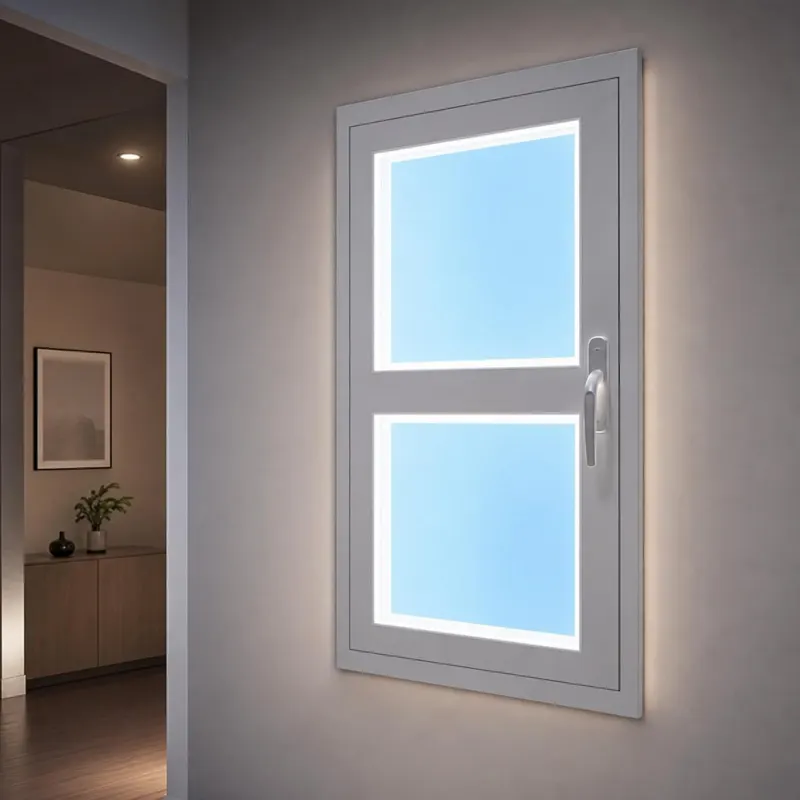
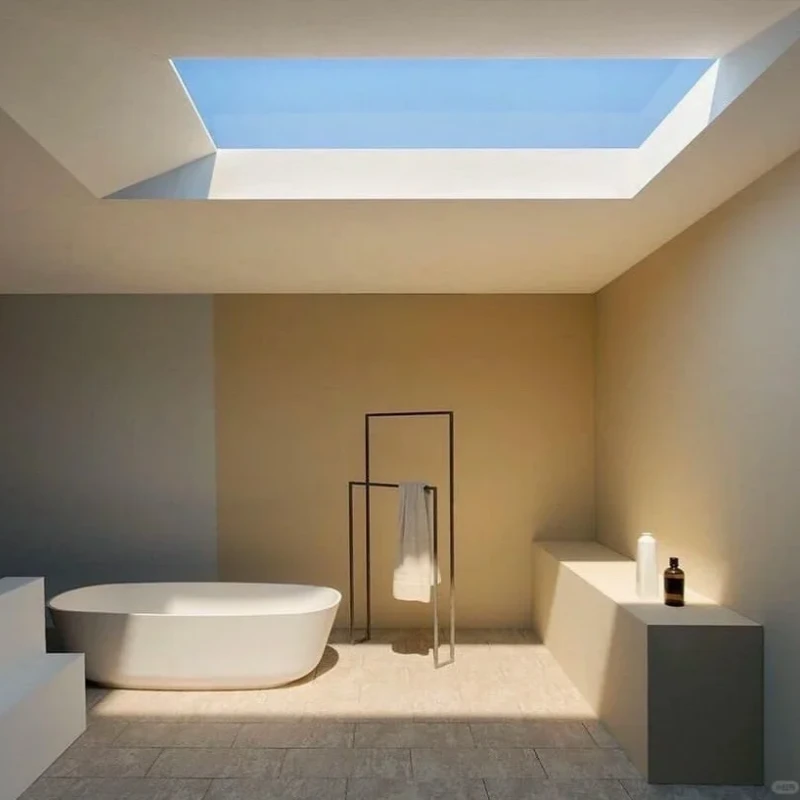
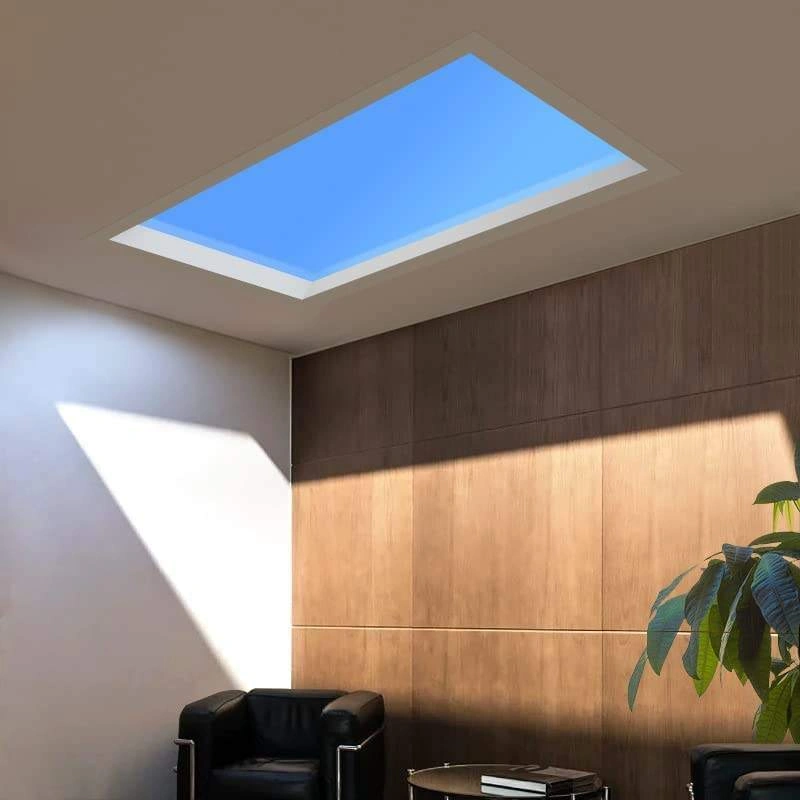
During product testing and installation projects for the EASY artificial skylight, we found many customers initially only care about whether it “looks like a window”. However, the actual experience is determined by the light path, scattering method, parameters and installation conditions. An inexpensive fake window light panel may be bright, yet look like a light box; a well-made Rayleigh scattering artificial skylight creates the perception of a blue zenith and pale white horizon, with directional light rather than a uniformly glowing flat panel.
Therefore, when choosing a fake window light panel, do not rely solely on product photos. Check whether it adopts LED direct backlit, edge-lit or backlight panel design; verify if it has a Rayleigh scattering layer or merely ordinary diffusion film. Also confirm whether recessed installation fits your ceiling.
Panel Structure: LED Chips, Light Guide Plate, Scattering Film, Frame
LED chips determine the base spectrum. LEDs used for artificial skylights should not only pursue high brightness; their blue peak, color rendering index and color temperature stability must be evaluated. Strong blue light peaks and poor phosphor formulation cannot be remedied by film layers afterwards.
The light guide plate governs light uniformity. Edge-lit structures are slim and suitable for shallow ceiling cavities. Direct backlit designs deliver higher brightness but require sufficient light mixing distance, otherwise hotspots from LED chips become visible.
The scattering film is the core component. Ordinary diffusion film only disperses light, while Rayleigh scattering film leverages nanoparticles to scatter short-wave blue light more intensely, forming the blue sky and gradient effect. The frame affects heat dissipation, light blocking and installation precision. Aluminum frames with properly designed cavities and maintainable structures are generally more reliable than ultra-narrow frames with poor heat dissipation.
Difference Between LED Fake Window and Appearance-only Imitation LED Fake Window
Terms including led fake window, fake led window, faux led window and led faux window are often used interchangeably in the market, but their internal structures differ.
led fake window generally refers to an active luminous LED fake window equipped with LED chips, light guide plate, scattering layers and driver, designed to simulate natural daylight. fake led window more often describes a window-shaped fixture with LED backlight inside, which may only be a semi-transparent picture paired with light strips. faux led window emphasizes decorative ambiance and may not pursue authentic spectral performance. led faux window can serve as a general term; the optical system is the critical factor.
If a fake window led solution only uses backlighting without Rayleigh scattering and gradient control, it resembles an advertising light box when viewed up close. When purchasing, directly ask these questions: Does it adopt a Rayleigh scattering layer? What are the CRI and R9 values? Is the color temperature adjustable? What is the light uniformity? These questions matter more than wattage.
Why Some Panels Appear Blue While Others Resemble Real Sky: Spectral Logic of fake window with artificial sunlight
Panels with excessive blue tint are usually caused by cold-white LEDs with strong blue peaks, paired with diffusion films lacking wavelength-selective properties. The result is an overall blue or purplish panel, even greenish edges. It is bright but unnatural.
Panels that mimic real sky implement Rayleigh scattering simulation: short-wave blue light is scattered more strongly within the scattering layer to create zenith blue, while direct light retains warmer white light to achieve directional sunlight similar to the sun. To approximate fake window with artificial sunlight, the panel cannot display a single solid color; it must have a soft transition from blue to white.
If a panel shows identical blue from all viewing angles, it is most likely not an artificial skylight but simply a blue light box. A high-quality comfortable artificial skylight does not produce glare when viewed directly, delivers sky-like appearance from side angles, and does not cast grey tones on illuminated objects.
Parameter Interpretation for Color Rendering Index, Color Temperature, Lumen and Uniformity: How to Evaluate daylight simulation lamp
For a daylight simulation lamp or artificial skylight, evaluate parameters as a set rather than focusing on a single value.
Recommended color rendering: Ra ≥90, R9 ≥50 preferred, and R12 is also a reference for blue color reproduction. For sky effect, 5000K–7000K color temperature is commonly used; 3000K–4500K works for dawn and dusk ambiance. Tunable color temperature products are better for bedrooms, offices and basements.
Higher lumen output does not equal better window-like natural effect. High total luminous flux does not guarantee authentic window appearance. Surface luminance and light distribution must also be considered to avoid glare. Pay attention to uniformity U0; values above 0.7 are preferred. Poor uniformity of led fake windows leads to dark corners, bright bands or blue-tinted edges.
In addition, continuous spectrum is more practical than “zero blue light”. Complete removal of blue light eliminates the sky effect. The key is to avoid excessive blue peak and maintain a smooth spectrum for long-term comfortable use.
Ceiling Requirements for Recessed Installation: Construction Tips for artificial skylight led panel
Recessed artificial skylight led panel has clear ceiling requirements. First, cavity depth: edge-lit versions are thin, while direct backlit models and units with scattering cavities require more space. Second, load-bearing: light steel keels need reinforcement, and gypsum board openings require border frames or wood backing. Third, heat dissipation: drivers and lamp bodies cannot be sealed inside insulation layers.
Opening dimensions must follow product drawings, with tolerance controlled within ±2mm. Power supplies should be accessible for maintenance and not fully sealed. For humid areas, moisture resistance and condensation prevention are required to stop fogging inside the film layers.
Installation methods differ for mineral wool boards and aluminum ceiling panels. Mineral wool boards need reinforcement, while aluminum panels must match keel specifications. Confirm these conditions in advance to reduce renovation costs compared with modifying the ceiling after delivery.
FAQ: Will the Panel Turn Yellow? How to Clean the Film? faux window led light panel Maintenance
Will the panel turn yellow? Yes, but this depends on materials. Low-grade PS diffusion plates, poor-quality phosphors and inadequate heat dissipation accelerate yellowing. High-quality PMMA, UV-resistant coating and stable drivers can significantly delay color drift. For faux window led light panel operating for long hours, thermal design is especially important.
How to clean the film? Cut off power first. Wipe dust gently with a dry microfiber cloth. For stubborn stains, use a slightly dampened neutral cleaner. Do not use alcohol, ammonia or abrasive cleaners. Do not disassemble the light guide plate and scattering film, and prevent water ingress at edges. Frequent disassembly will damage optical layers, resulting in localized blue tint or dark bands.
Conclusion
When selecting a fake window light panel, the core criterion is natural light performance rather than merely looking like a printed window image. Inspect LED chips, light guide plate, scattering film and frame; distinguish structural differences behind terms like led fake window and fake led window. Then verify CRI, color temperature, lumen, uniformity and ceiling installation conditions.
If your application is basements, windowless offices or dark living rooms, and you want a Rayleigh scattering artificial skylight close to natural sky, prioritize products with spectral design, uniformity data and installation support.
In this way, what you obtain is not just a luminous panel, but a “window” delivering natural daylight.