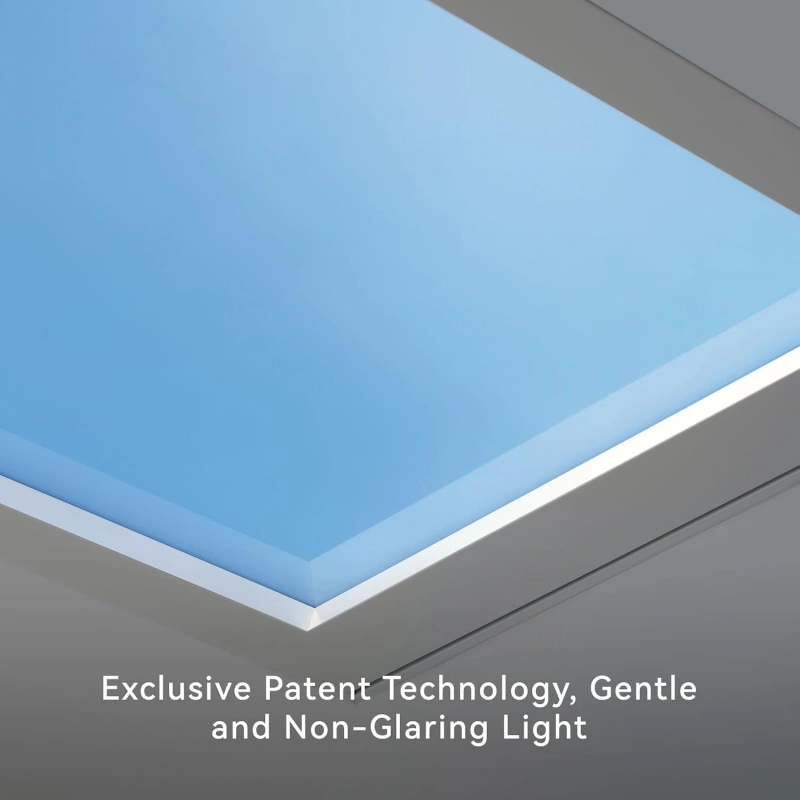
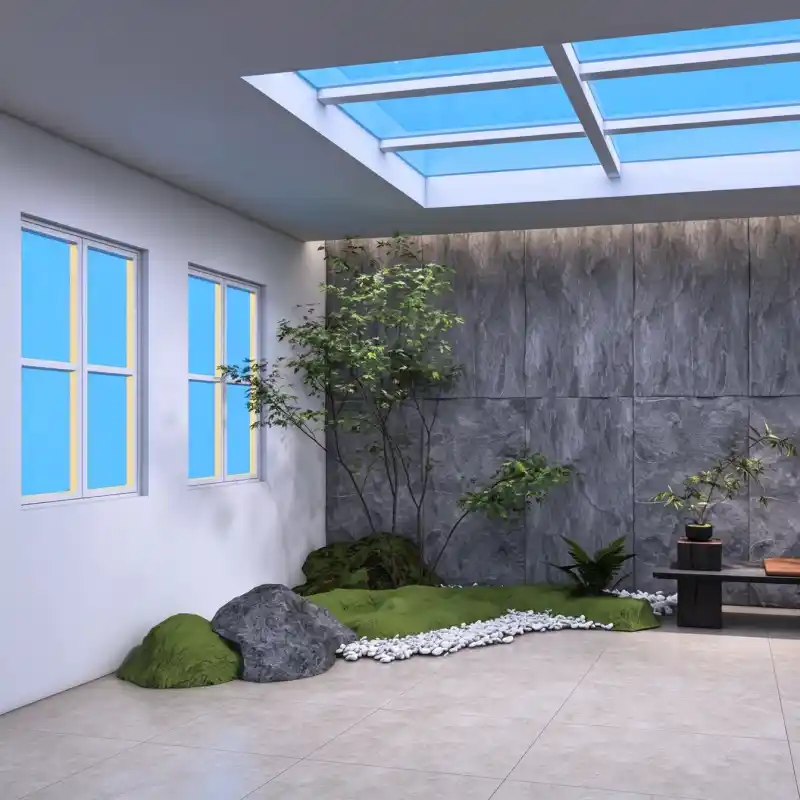
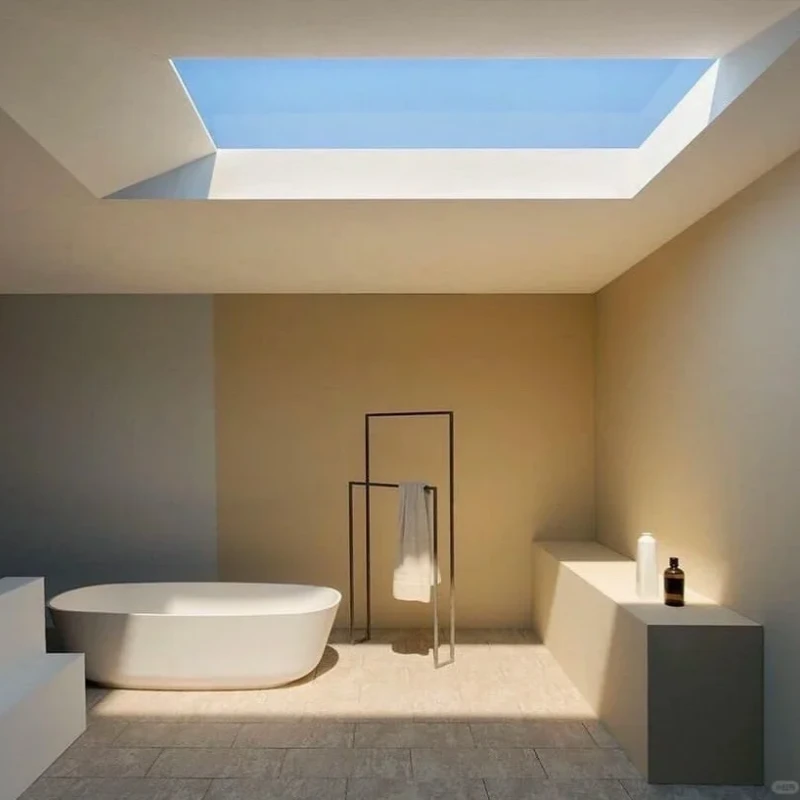
Windowless offices, basements, hallways, and rental apartments are never short of lights. What they lack is natural light that feels like it comes from a window. For products such as Fake window with light, the core concept is not to build a fake window. Instead, it uses LED panels, light boxes and optical diffusion to simulate the direction, color temperature and spatial sense of sunlight coming through a real window.
During the overseas project of EASY artificial skylight, we found that users tend to only focus on “how bright it is”, while ignoring installation methods, light spectrum, uniformity and ceiling conditions. This buying guide breaks down options by practical scenarios: plug-in, hardwired, surface-mounted/recessed, wall-mounted and more.
Plug-in, Hardwired, Surface-mounted / Recessed Models: First decide which faux window light box you need
Plug-in models are suitable for rental homes, temporary offices and basement renovations. They come with plugs or adapters, featuring low installation barriers with no circuit modification required. If you want to quickly set up a fake window with lights in a rental space, plug-in versions are the most convenient option. The downside is power cord management; exposed cables can look messy.
Hardwired models connect to wall switches or dimmers and usually require an electrician for installation. They work better for permanent residential spaces, commercial premises and hotel projects. A faux window light can be built as a fixed wall feature with a clean appearance, and it supports centralized control.
Surface-mounted / recessed models deliver an effect closer to a skylight rather than a regular wall window. They require reserved depth inside the ceiling, space for drivers and heat dissipation. Not all gypsum board or mineral fiber ceilings support direct recess mounting. If what you want is a “clear sky on the ceiling”, this type is more suitable than ordinary faux windows with light.
Wall-mounted / light box models are often made as faux window light box. The outer layer mimics a window frame, and the inner layer uses an LED panel or printed lightbox graphic, visually resembling a window. Ideal for windowless walls, corridor ends, basements and office partitions.
Brightness, Color Temperature and CRI: Understand core parameters of fake window light panel
Do not judge brightness solely by wattage; check lumens and actual illuminance instead. For general office environments, 300–500 lux is a reference value; hallways and auxiliary spaces need 100–200 lux. As a visual focal point, a clear sky light is not better when brighter. Its panel surface should be soft and glare-free.
Color temperature determines how closely it mimics natural daylight.
- To simulate midday clear sky: commonly 5000–6500K
- For long stays indoors: 4000–5000K is more comfortable
- For bedrooms or night-time use: adjustable 2700–4000K is preferred
Fixed 6500K fake window light panel with poor spectrum tends to appear blue and cold.
Check CRI / Ra for color rendering. Recommended specification: Ra≥90, R9≥50, R12≥80, color tolerance SDCM<5. For faux window light, continuous spectrum, flicker-free performance and low blue light hazard matter more than high brightness alone. If budget allows, prioritize dimmable, tunable-white panels with even diffusion.
Selecting dimensions for different spaces: fake window light for office and basement applications
Size selection should consider space proportion and viewing distance. Common aspect ratios for wall-mounted faux windows are 2:3, 3:4 or proportions close to real windows.
- Small spaces: 40×60cm, 60×90cm
- Offices and basements: 60×120cm, 90×120cm
- Commercial spaces: multiple units can be spliced into larger light boxes
Office: Prioritize fake window light for office. For workstation partitions, choose 60×60cm or 60×120cm, 4000–5000K with anti-glare design. Meeting rooms can feature full-wall window scenes to relieve claustrophobia.
Basement: Recommended size 90×120cm or larger with brightness adjustment. Basements lack natural daylight. Small-sized units easily look like “illuminated picture frames”, while larger sizes create a genuine window illusion.
Bedroom: 40×60cm or 60×90cm is sufficient. Color temperature must be tunable downwards to avoid midday-like brightness at night.
Living room / commercial space: Spliced panels or custom light boxes are available. Pay attention to frame thickness, image depth and wall color, otherwise the effect will look artificial.
For wall mounting, the centerline of the window frame is typically set at 1.4–1.6m above the floor, matching the visual habit of real windows. For ceiling recessed installation, select sizes such as 60×60cm, 60×120cm according to ceiling module standards.
Common pitfalls: blue tint, glare, uneven lighting, artificial appearance (especially fake windows for windowless rooms with light)
- Blue tint: Usually caused by excessively high color temperature, prominent blue light peaks or discontinuous spectrum from RGB white mixing. Solution: select high CRI, low blue light, tunable-white products. Do not blindly pursue 6500K.
- Glare: High surface brightness and direct illumination without diffusion. A clear sky light should imitate window light, not a spotlight. Choose designs with diffuser plates and light guide plates, plus dimming function.
- Uneven lighting: Dark edges, visible LED bead texture and local hotspots. This relates to LED bead quantity, light guide plate quality and frame structure. Before purchase, watch real-shot videos rather than only renderings.
- Artificial look: Wrong aspect ratio, overly thick frames, static graphics, mismatched color temperature with interior lighting. Many fake windows with light projects fail not because the light is dim, but because they look unnatural. Adding window frames, blinds, sheer curtains and scheduled light variation helps replicate natural sunlight.
For fake windows for windowless rooms with light, pay attention to light direction. Real window light has direction and light-dark transition. Over-bright ceilings and walls at the same time will destroy realism.
Pre-installation checklist for ceiling, power supply and cutout requirements: led fake window light
- Confirm ceiling type first. Gypsum board, mineral fiber board, integrated ceiling and bare ceiling require completely different installation methods. For recessed models, verify joist positions, cutout dimensions, ceiling depth and load-bearing capacity.
- Confirm power supply. Plug-in versions need available outlets and routes to hide wiring; hardwired versions need live/neutral wires, wall boxes and dimmer compatibility. For commercial led fake window light projects, also check voltage range, driver location, access panels and fire code requirements.
- Cutout size cannot be based merely on panel dimensions. Follow manufacturer cutout drawings during construction, avoid structural joists and reserve heat dissipation space. Insufficient heat dissipation shortens service life and accelerates light decay for surface-mounted/recessed models.
- For wall-mounted faux window light box, check wall load capacity and edge finishing. Fixing solutions differ for wood, gypsum board and glass partitions. Confirm power supply, cutout, heat dissipation and finishing details of faux windows with light before installation to avoid rework.
FAQ: Is dimming supported? Can it connect to smart systems?
Can it be dimmed? Most clear sky lights support dimming, but protocols vary. Common options: TRIAC, 0-10V, DALI, PWM, remote control and APP. Confirm compatibility with your existing dimmer or switch before purchase.
Can it link to smart systems? Yes. Common connectivity: Wi-Fi, Zigbee, Matter, compatible with Alexa, Google Home or Apple Home. If building smart scenes for fake window with lights, you can set sunrise, sunset, scheduling and gradual fading to achieve more natural lighting.
Can it replace real windows? It cannot replace ventilation, emergency egress or statutory daylighting requirements, but it improves psychological comfort and visual experience in windowless spaces.
Will it turn blue? Choose products with Ra≥90, low blue light, flicker-free performance and tunable color temperature. This is more reliable than deciding based only on price.
Can it be used for plant growth? Standard clear sky lights are not grow lights. Plant cultivation requires specific spectrum and PPFD. If growing plants, select dedicated grow lights.
Is installation difficult? Plug-in models are easy to install. Hardwired and recessed models should be installed by qualified electricians. Safety and compliance are priorities especially for commercial projects.
Summary
When selecting fake window with light, first decide between surface/recessed ceiling mounting or wall-mounted light box. Then evaluate brightness, color temperature, CRI, uniformity and installation conditions. For windowless spaces, a quality clear sky light should look like a window, not a glowing panel.