Want to install skylights but are restricted by floor level, roof structure, waterproofing, thermal insulation or property management approval?
For many basements, corridors, windowless offices and mall interior exhibition spaces, real skylights are often not something you can install whenever you want.
This is where products like Blue Sky Skylights become a more rational alternative to physical skylights.
As the EASY Blue Sky Skylights team, the most common comment we hear during projects is: “I don’t necessarily need to cut an opening in the roof. What I want is to look up and see blue sky, and make the space feel like it has natural daylight.”
This is exactly what Blue Sky Skylights is designed to deliver.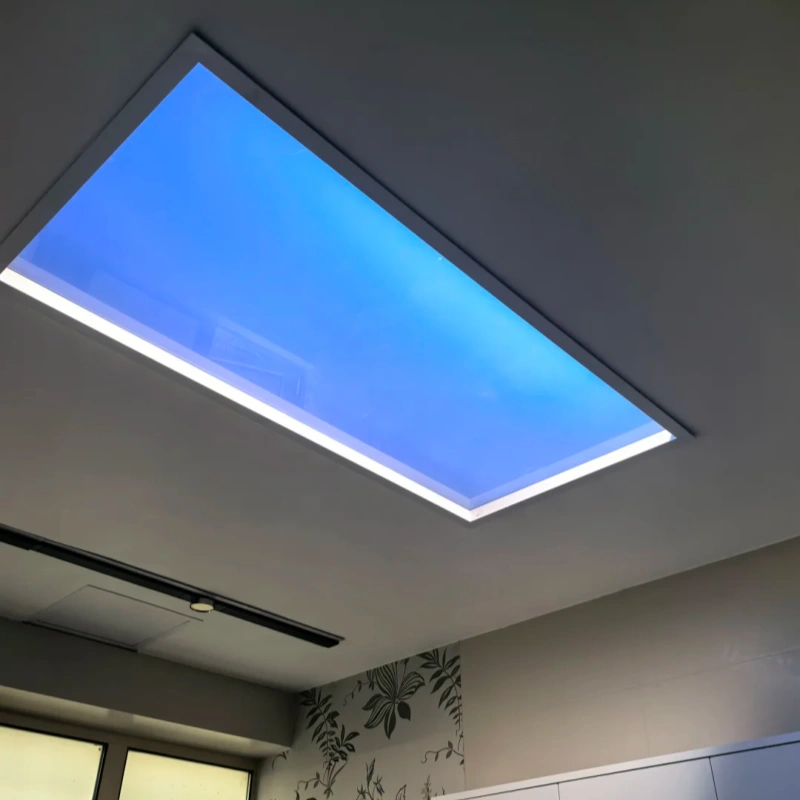
From artificial skylight ceiling: Why it works for users wanting skylights
Real skylights have clear benefits: bringing in natural daylight, expanding spatial perception and lifting mood. But they also come with tangible downsides: roof penetration, complex waterproofing details, summer heat radiation, winter thermal bridges, glare, cleaning and maintenance, and even potential approval issues affecting building facades.
For leased premises, underground spaces and in-mall exhibition areas, these constraints are almost impossible to bypass.
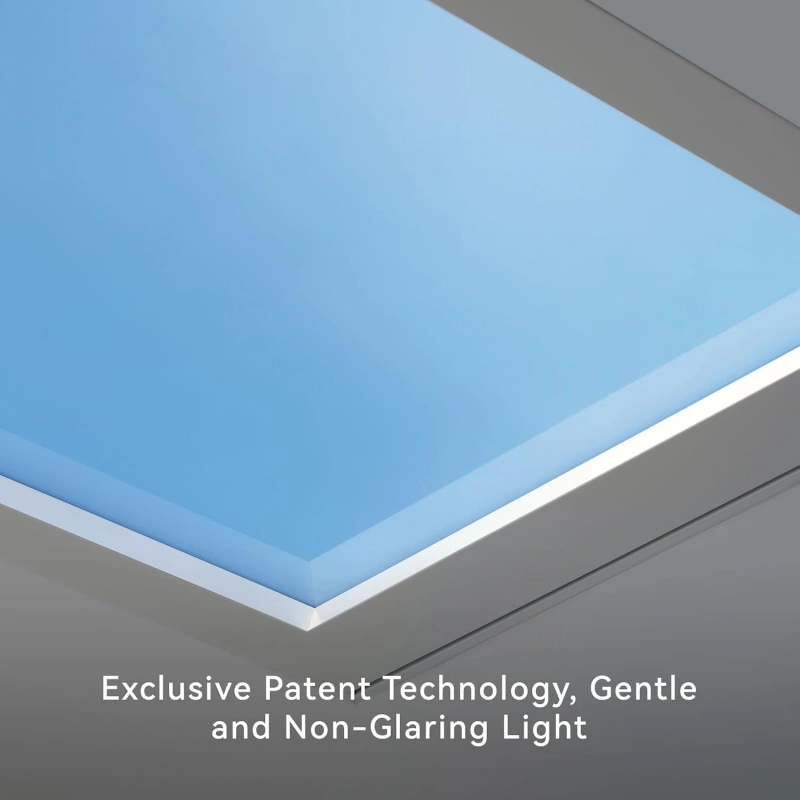
Blue Sky Skylights adopts the artificial skylight concept, using LED light sources paired with optical diffusion and scattering structures to simulate sky blue and daylight effects within suspended ceilings, delivering the visual experience of skylight blue sky, spatial openness and stable, controllable lighting. It is far easier to implement than conventional skylights.
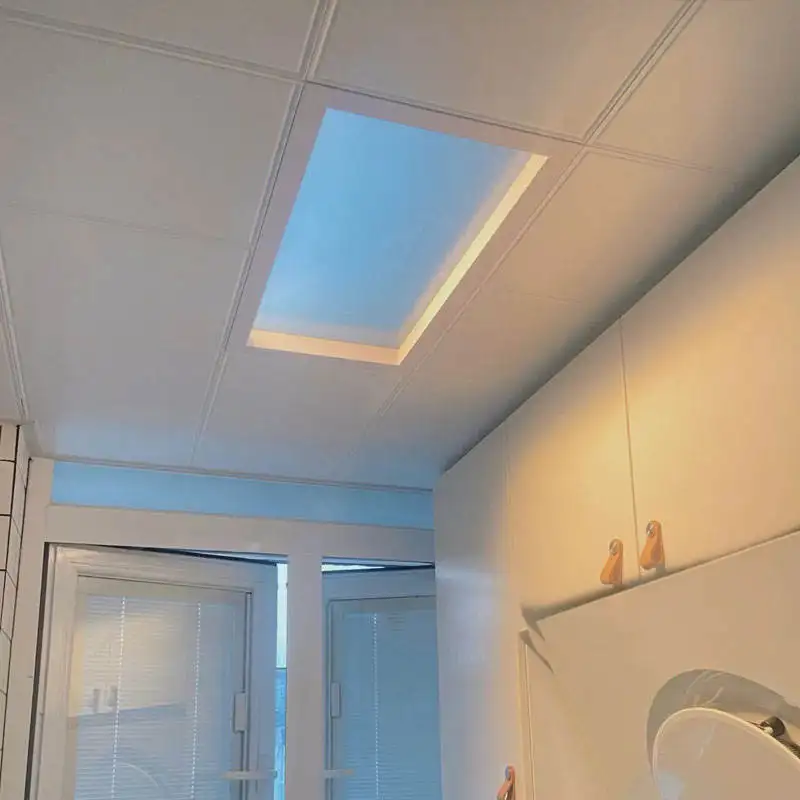
Especially for artificial skylight ceiling solutions, the skylight panels can be recessed into plasterboard ceilings, integrated ceilings or surface-mounted frames, without damaging the roof or requiring complex waterproofing work.
The key to skylight-style blue sky effect: Not just a blue panel, but natural light simulation
Many low-cost “blue sky lights” look like a simple blue acrylic sheet. Their common flaws include uneven brightness, overly cool colour temperature, poor colour rendering and greyed edges. High-quality Blue Sky Skylights must address multiple parameters at the same time: blue sky gradation, directional daylight feel, colour rendering index, glare control and dimming stability.
During on-site installations, we advise clients to focus on these specs: colour rendering index ideally above Ra95, adjustable colour temperature ranging from 3000K to 6500K, no flicker at low brightness and smooth 0–100% dimming capability.
For bedrooms and living rooms, the blue sky effect should not be overly bright; an illuminance level of 300–500 lux delivers greater comfort. For offices and classrooms, brightness can be moderately increased while direct glare remains avoided. The goal is to turn the artificial skylight from a “decorative blue panel” into a natural-looking ambient light source.
artificial skylight for basement: Implementation for windowless basements, corridors and offices
Basements are the most typical application scenario. Traditional basements suffer from poor daylight, high humidity and a strong sense of confinement, while real skylights are often unfeasible. artificial skylight for basement solutions generally use recessed skylight panels, paired with moisture-resistant drivers and serviceable structures, mounted on ceilings or corridor tops.
It cannot replace dehumidification and fresh air systems, yet it can greatly improve the psychological perception of the space, stopping basements from feeling like sealed boxes.
Windowless offices, meeting rooms, hospital waiting areas, gyms and bathrooms are also suitable application sites. We recommend selecting modes according to space functions: neutral white for office zones, warm white for rest areas, and bright blue sky mode for exhibition zones.
If the space has a low ceiling height, thin-profile models are preferred. Confirm joist spacing and driver placement in advance. Reserving access hatches during installation simplifies later maintenance.
led artificial skylights: 5 critical specifications for selection and installation
When comparing led artificial skylights, do not judge solely by “how blue it is”. First, check whether the optical layer is uniform and whether dark corners appear around edges. Second, verify flicker-free dimming support. Third, inspect driver quality and heat dissipation structure. Fourth, confirm panel thickness and ceiling compatibility. Fifth, review warranty and after-sales support. Artificial skylights are products that run for long hours or frequent use; drivers and heat dissipation usually determine service life.
For installation, our standard recommendations: verify ceiling load-bearing capacity and cutout dimensions first, then arrange power supply and dimming wiring. If smart control is required, confirm protocol compatibility beforehand.
For mall exhibition spaces or offices, zone-based control is recommended instead of turning all skylights to full brightness simultaneously. This saves energy and better mimics the gradual variation of real daylight.
fake skylight with moving clouds: Bringing more vitality to the blue sky
Static blue sky panels can already improve a space, but fake skylight with moving clouds takes it one step further. Dynamic cloud patterns or slowly shifting light effects turn the ceiling from a fixed light panel into something resembling a living sky. This solution suits high-end residences, exhibition halls, hotel lobbies, children’s rooms and immersive commercial spaces.
That said, dynamic effects need restraint. Fast-moving clouds or excessive contrast can be distracting. Based on our experience, residential applications should use slow, low-contrast, soft transitions. Commercial displays can have slightly more noticeable motion, yet the lighting must still serve the overall space rather than stealing visual focus.
realistic faux skylight: How to evaluate realism
You can run simple on-site tests to judge whether a realistic faux skylight looks natural. Step back and check if the blue sky tone is even. View it from the side to see if the edges look abrupt. When powered on, check whether walls and floors receive soft ambient light instead of harsh blue glow. When turned off, confirm the fixture blends into the ceiling. A well-made artificial skylight does not strike you as “very blue” at first glance; instead, it feels natural, authentic and comfortable for prolonged stays.
This is also the difference between Blue Sky Skylights and ordinary blue light boxes: greater emphasis on sky depth, daylight colour rendering and harmony with the overall space. For users pursuing skylight effects, realism matters more than pure blue colour.
IKEA showroom case: Blue Sky Skylights as a substitute for unconstructible real skylights
Take IKEA showroom applications as an example. Mall interiors usually prohibit arbitrary installation of real skylights, yet show flats require bright, open atmospheres that resemble natural daylight. Blue Sky Skylights are fitted to ceilings or the tops of exhibition zones to simulate skylight blue sky effects, making bedroom, living room and kitchen areas feel as if there is an outside view. It does not damage the mall roof structure, has a shorter installation cycle and can be dimmed to match different showroom themes.
Cases like this demonstrate that the value of artificial skylights extends beyond “replacing skylights”. They deliver controllable blue sky experiences for spaces where windows or roof openings are impossible. This solution is particularly appealing for retail displays, show flats, underground businesses and leased premises.
Conclusion: Who is Blue Sky Skylights suitable for?
If you want the blue sky atmosphere and spatial feeling of real skylights but face limitations from structure, budget, approval or maintenance, Blue Sky Skylights is a viable suspended ceiling alternative to physical skylights.
It fits basements, windowless offices, corridors, bathrooms, mall exhibition spaces, show flats and high-end residences. When selecting products, prioritise optical uniformity, colour rendering, dimming performance, flicker control, heat dissipation and after-sales service instead of only price or blue colour depth.
For users planning skylights, artificial skylights are not a perfect replica of real skylights. However, they can bring blue sky and daylight sensations indoors without modifying the building structure.