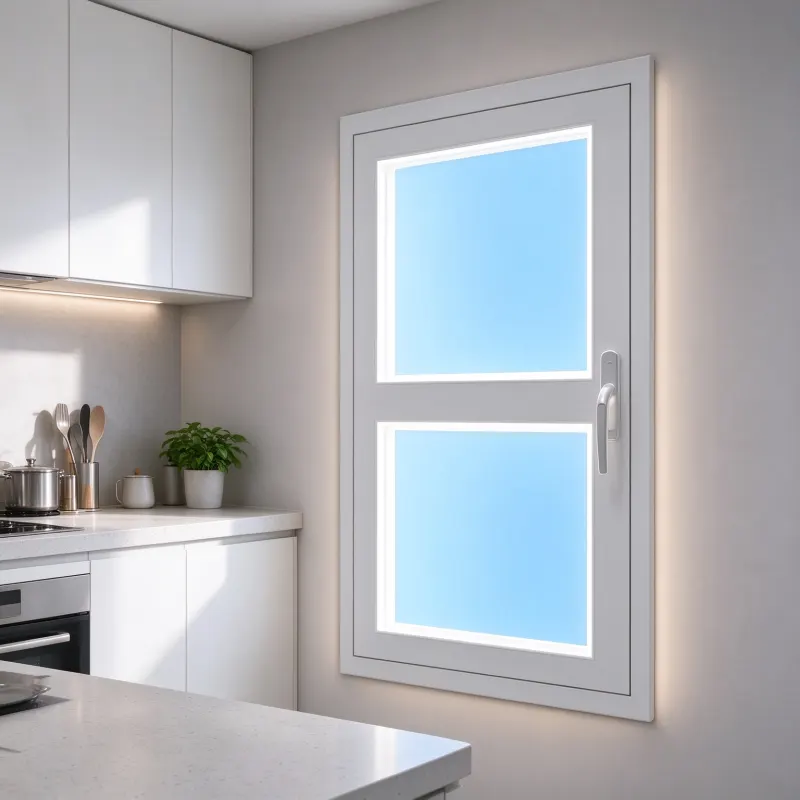
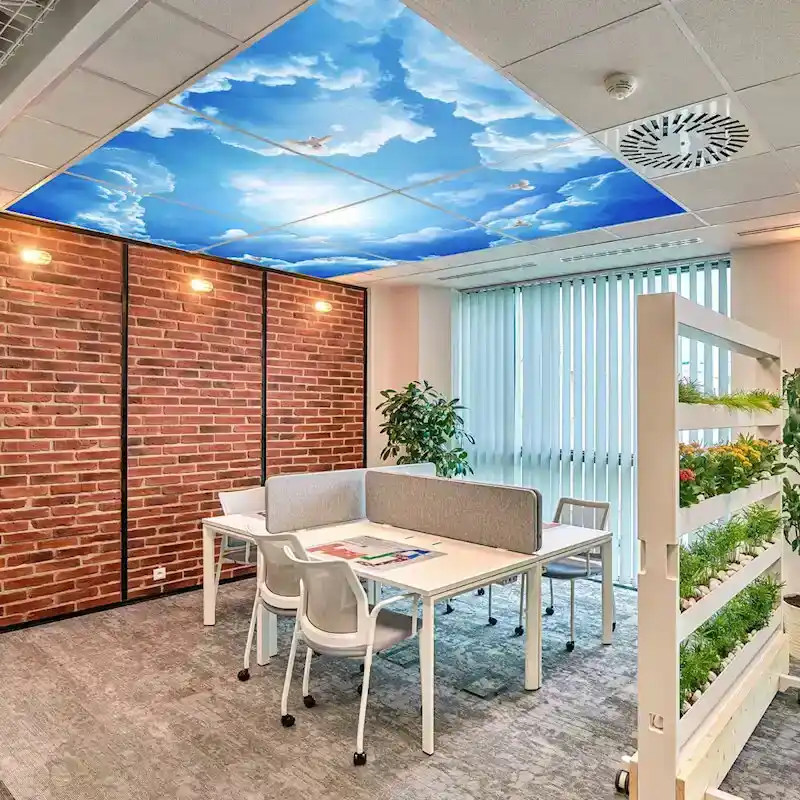
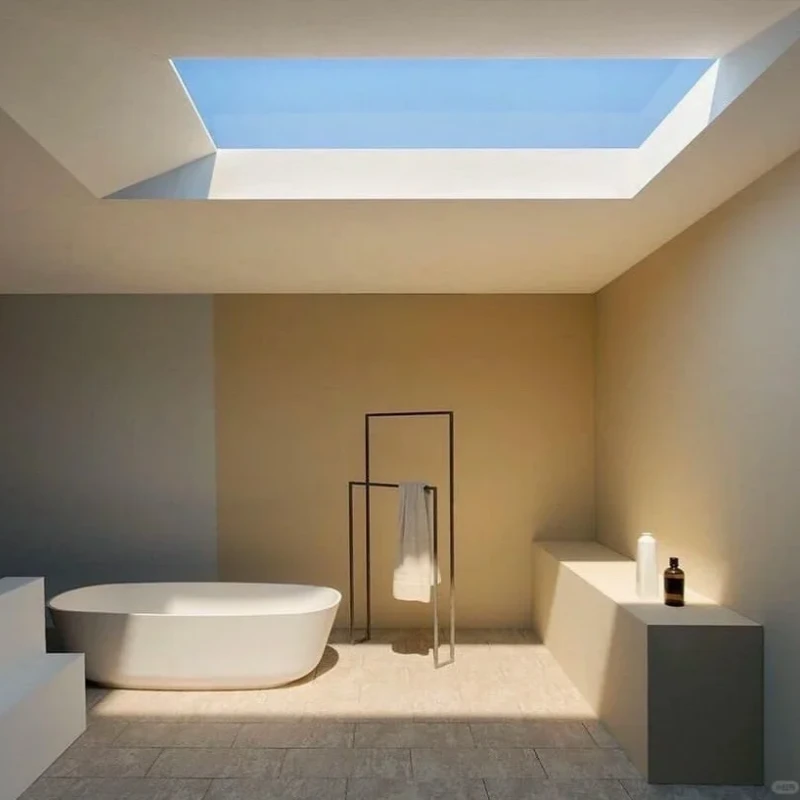
The current faux window is a system that simulates the appearance of a real window and natural daylight indoors through artificial light sources, optical materials and structural design.
The faux window discussed in this article specifically refers to Rayleigh scattering optical faux window. It is not an ordinary blue LED backlight panel, nor an LCD screen or projected image. Instead, it applies the Rayleigh scattering principle to make light form a blue gradient similar to the real sky, spatial depth and daylight atmosphere inside the panel.
The faux window product of EASY artificial skylight is developed around this optical direction.
What are faux windows called?
In the English market and industry communications, faux windows have many names. Common terms include: fake windows false windows artificial windows virtual windows artificial led window faux daylight window faux window light panel
These names emphasize different aspects. fake windows leans more toward decoration; false windows stresses replacing real windows; artificial windows highlights artificial light sources; virtual windows may involve screens or projection.
Rayleigh scattering-type faux window generally falls into the category of artificial led window or optical artificial window. Its pursuit is not merely “looking like a window”, but “making people feel there is real sky outside the window”.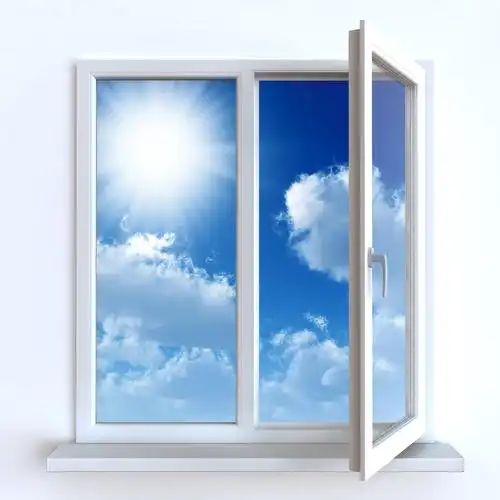
Rayleigh scattering: the key that turns faux window from a light panel into sky
Rayleigh scattering is a fundamental phenomenon in atmospheric optics. Its core rule is that scattering intensity is inversely proportional to the fourth power of wavelength. In other words, shorter-wavelength light is more easily scattered by tiny particles.
Blue light has a wavelength of approximately 450nm while red light is around 650nm. The scattering intensity of blue light is more than four times stronger than that of red light. This explains why the sky appears blue in daytime and turns reddish-orange at sunset.
A Rayleigh scattering optical faux window does not simply turn LEDs blue. By controlling the particle size, concentration, distribution of scattering particles, optical path length and LED spectrum, it enables preferential scattering of short-wavelength blue light inside the panel, creating visual layers close to the real sky.
The area near the “horizon” is usually brighter and softer; the upper sky shows deeper blue; a warm white halo may appear at the sun position. Such gradient and depth cannot be achieved by ordinary blue LED panels.
artificial led window: not a blue light panel, but a sky optical system
artificial led window is a highly watched category among faux windows. Buyers need to distinguish that not all artificial led window adopts Rayleigh scattering.
Many products on the market are merely blue LEDs plus diffuser plates with even brightness, lacking spectral layers and spatial depth. They look just like blue light boxes.
A genuine Rayleigh scattering faux window delivers the following optical performance:
- Sky gradient: natural transition from horizon to top instead of solid single blue
- Sun halo: soft, non-glaring bright area with warm white or pale golden tone
- Spatial depth: the panel should not look flat; it creates an illusion that light comes from “outside the window”
- Spectral comfort: avoid excessive blue light peaks and obvious flicker, suitable for long-stay spaces
- Color rendering performance: high color rendering index presents natural appearance of indoor materials, furniture and skin tones
These indicators determine whether a faux window is “premium sky simulation” or “cheap blue backlight”.
faux window with backlight: backlight is only the starting point, optical layers are the core
faux window with backlight is the most common structural description: LED light sources are hidden behind the window frame or panel, and light forms an even bright surface after passing through diffusive materials. However, backlight is only the foundation, not everything.
With backlight alone and no scattering layers, light mixing cavity and reasonable window frame depth, the light will look flat, fake and glaring. Professional design usually requires:
- Sufficient light mixing distance to avoid visible lamp beads and hotspots
- Multi-layer diffusion and scattering structure to form sky gradient
- Window frame depth matching viewing angles to strengthen the illusion of “outer space beyond the window”
- Hidden light sources, power supplies and control systems for clean visuals
- Dimming and timing functions to adapt light to different time periods
In short, backlight creates “brightness”, while Rayleigh scattering makes it “look like sky”.
How to evaluate the optical quality of faux window light panel
When selecting faux window light panel, do not rely only on promotional images. Pictures can be retouched, while on-site lighting effect is hard to disguise. It is recommended to evaluate from the following dimensions:
- Color temperature and spectrum: whether it is close to natural daylight, free of dead blue or purple cast
- Color rendering index: sufficient Ra and R9, especially red color reproduction capability
- Brightness uniformity: check for dark areas, bright spots or dim edges on the panel
- Glare control: whether it dazzles when viewed directly, and keeps natural appearance from side viewing
- Flicker performance: suitability for offices, bedrooms, medical and other long-occupancy spaces
- Installation depth: whether the window frame reserves enough light mixing distance
- Control method: support for dimming, timing, scene linkage and day-night variation
- Maintenance structure: modular replacement and heat dissipation design should be considered for commercial projects
For project procurement, it is better to request measured data, integrating sphere reports or on-site prototypes instead of judging merely based on renderings.
faux daylight window: daylight replacement solution for windowless spaces
The value of faux daylight window is especially prominent in windowless or low-light spaces. Interior office zones, basements, hotel corridors, cruise cabins, hospitals and senior care spaces often lack natural daylighting.
Staying in closed lighting environments for long periods may make people lose sense of time and orientation, and render spaces depressing.
Rayleigh scattering faux window forms a visual focal point on the wall and extends the perceived space. It cannot replace ventilation and the full spectrum of natural daylight from real windows, yet it can serve as part of lighting environment design to deliver visual cues and comfort close to natural sky light.
For offices, meeting rooms, live streaming rooms, entryways and stairwells, this optical faux window is often more practical than ordinary decorative paintings.
Key indicators to realize indoor lighting simulate sunlight
If the goal is indoor lighting simulate sunlight, the focus is not replicating glaring direct sunlight, but simulating scattered light from natural sky. Key indicators include:
- Color temperature close to daylight without excessive coolness
- Continuous spectrum to reduce narrow-band blue light peaks
- High color rendering to guarantee natural colors of objects
- Low flicker to reduce visual fatigue
- Adjustable brightness adapting to morning, noon and night
- Coordination with basic indoor lighting to prevent it becoming an isolated light source
The advantage of Rayleigh scattering faux window is that it does not merely “emit white light”. Through a combination of blue light scattering and warm white halo, it adds layers to indoor lighting. It fits spaces requiring naturalness, openness and comfort rather than places simply pursuing illuminance.
Installation and maintenance: recommendations from project practice
In real projects, the effect of Rayleigh scattering faux window heavily depends on installation quality. Window frame proportion, panel depth, light source position, viewing angle and basic indoor lighting all affect the final visual result. Common experience includes:
- Reserve power supply, control wires and heat dissipation space in advance
- Prevent direct visibility of light sources with adequate light mixing distance
- Do not blindly pursue high panel brightness; excessive brightness ruins authenticity
- Select maintainable structures for commercial spaces to facilitate later replacement
- Clean the panel surface regularly and keep heat ventilation unobstructed
- Timing and dimming can be added for residential or office use to simulate dawn, noon and dusk
Maintenance is not complicated, yet early-stage design determines later experience.
Conclusion
Faux windows generally refers to simulated windows or false windows in English, while in the professional lighting field, it can be a highly sophisticated optical system.
For windowless offices, basements, hotels, cruise ships, medical spaces and dark residential areas, Rayleigh scattering faux window delivers not only luminance, but also spatial perception, orientation and naturalness.
EASY artificial skylight develops faux window products based on Rayleigh scattering technology, aiming to bring light environments close to real sky to spaces without windows.