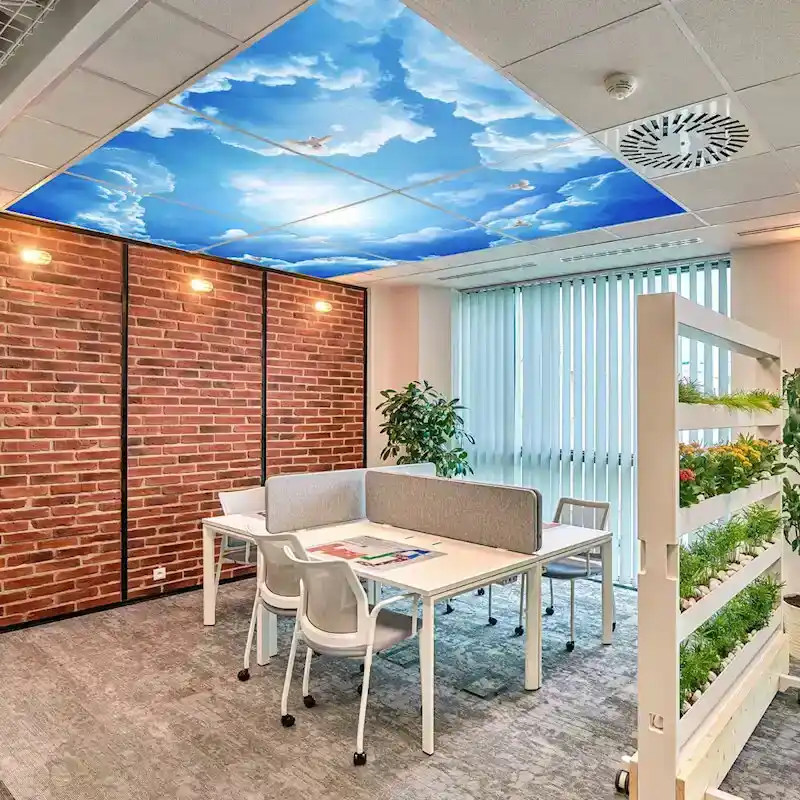
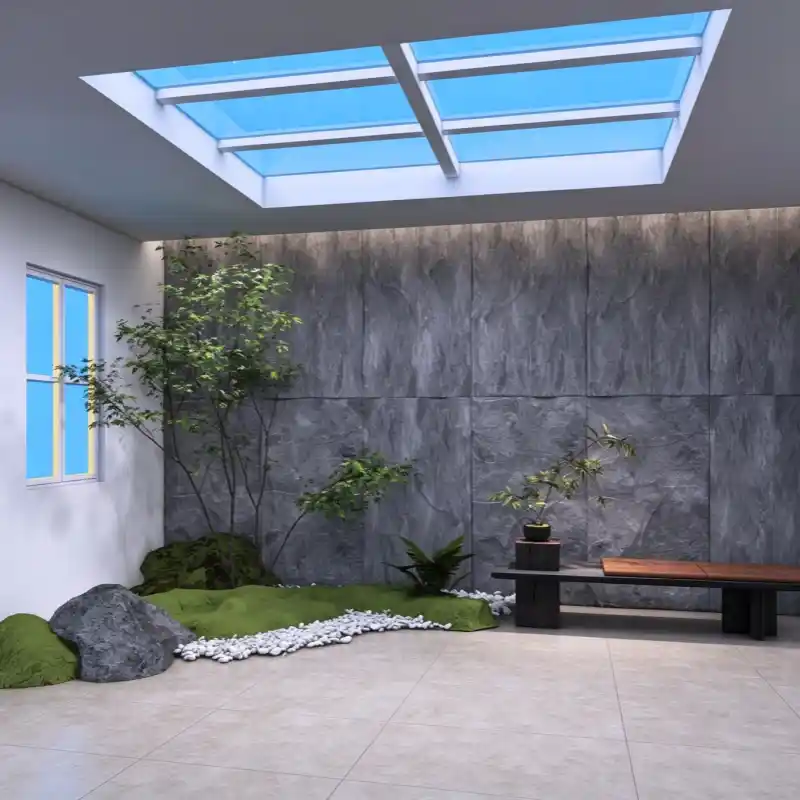
Basement Fake Window Light Installation Guidelines
Basements have no natural windows, and conventional panel lights tend to render the space flat, washed-out and cool, leaving occupants feeling oppressed after prolonged stays. The Rayleigh scattering skylight does not simply emit light; it uses a nano scattering layer to simulate sky blue, paired with a Sun module to create directional “sunlight”.
When designing a fake window in basement, it is not just hanging a printed fake window picture. Instead, we create the visual effect of light streaming in from an exterior window.
EASY artificial skylights have been validated in multiple underground space projects: installation position, lumen control, moistureproofing and smart linkage matter more than simply boosting brightness. Below is a breakdown following the actual construction sequence.
Position Selection: Avoid Direct Glare and Utilize White Wall Reflection(fake window with light for basement)
The primary rule for a fake window with light for basement is to prevent direct eye contact with the Sun module. The sunlight spot of the skylight is directional; direct viewing causes glare and breaks realism.
It is recommended to mount the fixture above or upper side of the fake window, tilted at 15°–25°, and set 15–30cm away from the wall. Light first strikes the white wall or ceiling, then reflects into the space to produce soft, permeable indirect lighting. Typical basement ceiling height ranges from 2.4–2.7m. The center of the fake window should sit slightly above seated eye level, avoiding direct alignment with sofas, tea tables or work desks.
Reserve 80–120mm of frame depth to conceal the fixture, accommodate heat dissipation and cable routing. Dark wall surfaces reduce reflection efficiency, so increase lumen output or add light-colored reflective surfaces as needed.
How Many Lumens Are Required? Preventing Unreal Appearance of fake window that mimics natural light
For a fake window that mimics natural light, higher brightness does not equal better realism. The key lies in matching brightness, color temperature and light direction. Lumen calculation for basement fake window lights can be based on fake window area:
- Small window (0.6㎡): 2000–3500 lm
- Standard window (1.2㎡): 4000–6500 lm
- Large window / full wall (2㎡): 7000–10000 lm
For ambient illuminance, living zones can be maintained at 150–300 lux; tea rooms and reading areas at 300–500 lux. The sky portion is set to 5000–7000K, while the Sun module is adjustable between 3000–4000K to simulate morning light, afternoon sun and dusk. High brightness without light and shadow gradients will turn the fake window into a light box instead of a real window.
Moistureproofing & Electrical Safety: Concealed Works for basement faux window lighting
Basements feature high humidity, so moisture protection must be prioritized for basement faux window lighting. The light fixture should have a minimum IP44 rating; select IP54 for areas near bathrooms, condensation zones or damp corners. Position the driver in a dry, serviceable location, or adopt an IP67-rated driver with a reserved access panel.
For a faux window for basement, transformer pre-embedding must be confirmed during the carpentry phase. A 24V or 48V low-voltage system is recommended, fitted with residual current protection and reliable earthing. Conduits shall be treated to resist condensation. Leave a clearance of over 50mm behind the fixture for heat dissipation; do not fully enclose it with gypsum board. Transformers concealed inside closed cabinets or deep ceiling cavities create major difficulties for future maintenance.
Coordination with Dehumidification and Ventilation Systems
The skylight itself does not dehumidify, but it can link with dehumidifiers and fresh air systems. Keep basement relative humidity at 50%–60%. When humidity rises, the smart system can reduce skylight power and activate the dehumidifier to lower condensation risk.
Air outlets must not blow directly onto the fixture, otherwise dust and water vapor easily penetrate the scattering panel. For a fake window basement, stable humidity protects the lamp as well as woodwork, tea sets and soft furnishings. When integrated into whole-home smart systems, scenes such as “turn on light on human detection, reduce power under high humidity, delayed shutoff when vacant” can be configured.
Case Study: Converting a Dark Basement into a Living Space — artificial skylight for basement
In Mr. Zhang’s villa in Tomson Riviera, Pudong, the basement tea room receives zero natural daylight. The designer installed a fake led window for basement to simulate slanting afternoon sunlight. The light carries a distinct direction, rather than flat diffused illumination, forming gentle light and shadow transitions on walls and greatly enhancing spatial permeability.
During construction, fixture positioning, tilt angle and wall clearance were locked in the carpentry stage. Transformers were pre-embedded and connected to the whole-home smart system. The system supports dynamic sky lighting presets for sunrise, midday and dusk.
Mr. Zhang later commented that the tea room no longer feels like an underground storage room, but a quiet tea space with a real window. This case proves that an artificial skylight for basement delivers more than lighting; it reconstructs the sense of time and orientation within the space.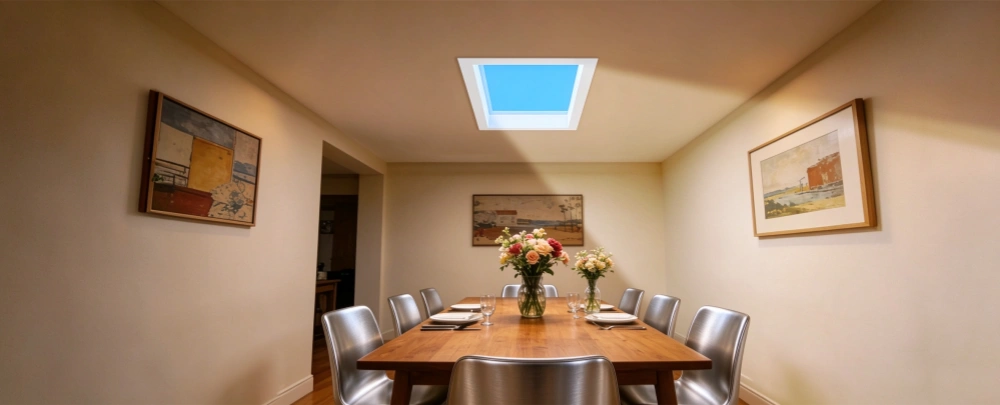
FAQ: Will continuous 24-hour operation damage the light?
Q: Will running the skylight 24 hours a day cause failure? A: It will not fail immediately, yet continuous operation accelerates lumen depreciation and driver aging. The rated service life of LED is generally 50,000 hours, and actual lifespan depends on heat dissipation and driver temperature. If long-hour operation is required, reduce power to 70%–80%, ensure adequate heat dissipation and set smart scenes for time-based dimming. For regular household use of 8–12 hours daily, the service life will be optimal.
For faux windows for windowless rooms, the skylight is not merely decorative lighting but part of the architectural luminous environment. With proper positioning, lumen tuning, moistureproof construction and smart linkage, the basement fake window light can deliver an experience closely resembling a real natural window.