What is a faux lighted window?
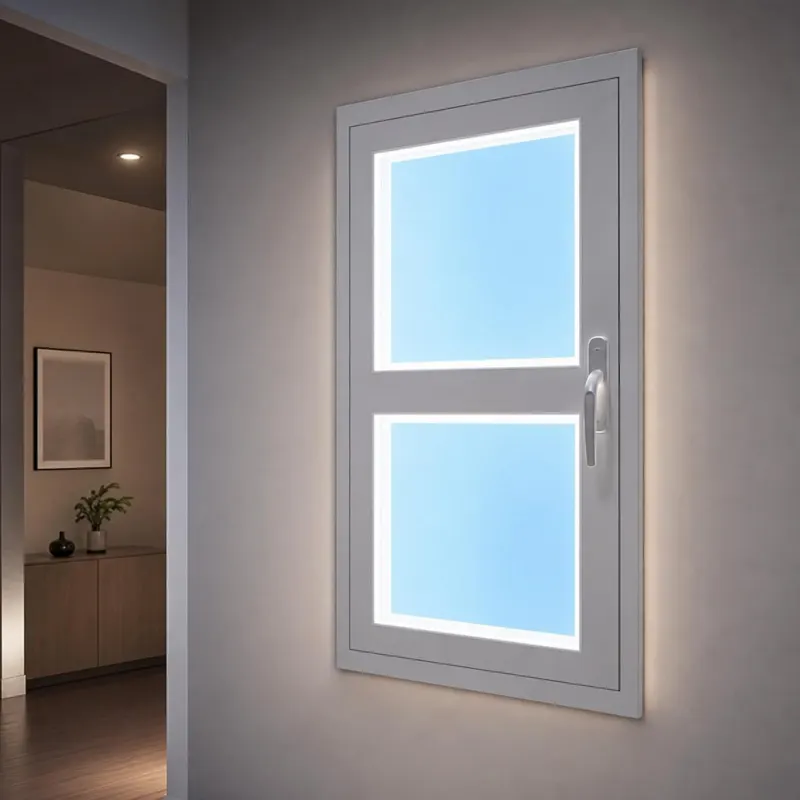
A faux lighted window is not a real window, but a lighting system that “looks like a window and delivers genuine natural light effects”.
It generally consists of LED backlights, nano scattering plates, light guide structures, power drivers and control modules. Mounted on walls, ceilings or window openings, it simulates outdoor sky, sunlight, skylights and even cloud movement.
Many people also call it a fake lighted window, but there is a distinction between the two: the former emphasizes realistic light performance, while the latter may only refer to a decorative illuminated picture frame.
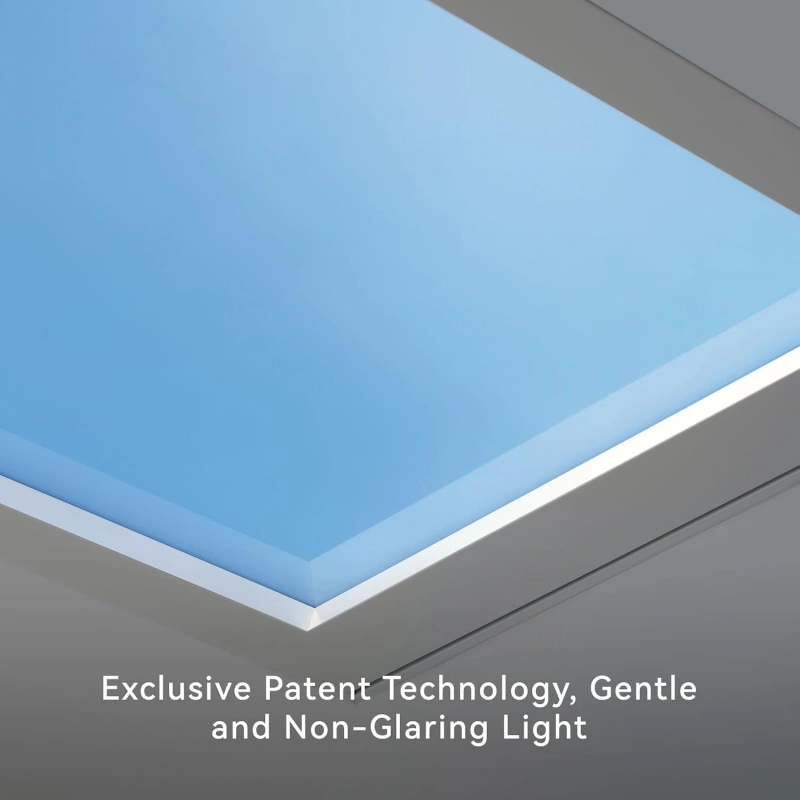
In the context of EASY artificial skylight, a faux lighted window is one application form of Rayleigh scattering artificial skylight. It is not simply a flat blue luminous panel. Instead, its optical structure scatters blue light to form the deep blue tone of a real sky, while retaining warm white light around the sun direction. For windowless rooms, it functions both as a lighting fixture and a psychological spatial compensation device.
Relationship with artificial skylight, fake window light and blue sky light: from imitation skylight to faux window with light Artificial skylight is the technical category. Fake window light and blue sky light are common market names. Faux lighted window refers more to products shaped like windows or skylights. When made into a ceiling skylight effect, it is often called an imitation skylight; when made into a wall-mounted window frame effect, it becomes a faux window with light.
False windows with light is mostly used in architectural and interior design contexts, highlighting “no real window, but with light”. Artificial window with light is more straightforward, meaning artificial light sources that simulate window daylight. Faux light window can serve as a general term for these names.
They share the same goal: reconstruct visual cues of “having a window” in windowless rooms, dark living rooms, basements or inner office zones. The difference lies in optical quality. Low-end products merely use blue LEDs with white dots, while high-end Rayleigh scattering artificial skylights handle sky colour, sun colour, scattering depth and glare control simultaneously.
Working principle: Rayleigh scattering, nano scattering plates, backlight uniformity, and key points of artificial skylight led Rayleigh scattering is the core of artificial skylights. The real sky appears blue because tiny molecules in the atmosphere scatter short-wavelength blue light more strongly. When your line of sight moves away from the sun, you see scattered blue light, while the area near the sun remains white or warm-toned.
Artificial skylights simulate this process with nano scattering plates. Light emitted by LEDs enters the scattering layer containing nano particles; blue light is preferentially scattered, and the direct viewing direction retains warm white or neutral white light, creating a layered effect of “blue sky + sun”.
An artificial skylight led is not equivalent to an ordinary LED light box. The key lies in backlight uniformity: the LED array, light guide plate, diffuser plate, reflection cavity and dimming driver must work in coordination. Otherwise, bright spots, dark bands and grey edges will occur.
Premium products also add effects such as fake skylight with moving clouds, where clouds drift slowly to boost realism. However, dynamic effects are only an add-on bonus; the foundation remains spectrum, scattering and uniformity.
Essential difference from ordinary blue LED sheets Ordinary blue LED sheets usually have a blue light peak around 450nm, mixed with a little white light. They look “blue”, but feature sharp spectral peaks, poor colour rendering and strong glare. They are dazzling when viewed directly and look like a light box in photos rather than a sky. Long-term exposure to low-quality blue light also reduces visual comfort.
Differences of Rayleigh scattering artificial skylights:
- More continuous spectrum: scattered blue light will not cause direct harsh glare, and the sky tone is softer.
- Sun orientation: not a uniformly blue full surface, with transitions of brightness and colour temperature.
- Higher colour rendering index: high-quality products reach Ra above 90 with reliable R9, keeping colours of objects in the space natural.
- Stronger sense of depth: it looks like “sky at a distance”, not a blue panel attached to the ceiling.
- Better glare control: scattering plates, grilles or light guide structures reduce direct light.
Therefore, do not only ask “whether it is blue” when purchasing. Instead, ask “whether it adopts Rayleigh scattering structure, is equipped with nano scattering plates, and how its backlight uniformity performs”.
Suitable spaces: windowless rooms, basements, offices, dark living rooms A faux lighted window works best in spaces lacking natural daylight. Basements are the most typical scenario. False windows with light can ease the sense of oppression, turning storage rooms, home theatres and gyms away from sealed boxes.
Windowless offices, meeting rooms and inner workstations are also suitable. A faux window with light provides a visual resting point and helps the brain perceive “daytime”. Dark living rooms, corridors, stairwells and windowless bathrooms can use faux light window to add spatial depth.
If the space cannot install real windows at all, an artificial window with light can be made as wall-mounted light boxes, ceiling-mounted skylights or embedded panels.
For spaces requiring circadian lighting, a daylight simulation lamp can be used as desktop or partial supplementary lighting. But large-area spaces still recommend artificial skylight systems instead of single table lamps.
Key points before purchase: colour temperature, colour rendering index, brightness, installation method, and details of faux window led light panel
- Colour temperature: the sky area is usually above 7000K–10000K, and the sun direction is around 4000K–5000K. Adjustable colour temperature is more suitable for offices and residences.
- Colour rendering index: Ra≥90 and R9≥50 are ideal. Poor colour rendering makes the space look grey and skin tones distorted.
- Brightness: do not judge solely by wattage; check illuminance. Offices are recommended for 300–500 lux, while basements and corridors can adopt 200–500 lux, calculated according to area and ceiling height.
- Installation method: ceiling-mounted, embedded, wall-mounted, hoisted and light box styles fit different scenarios. Ceiling installation needs reserved space for heat dissipation and drivers.
- Details of faux window led light panel: check uniformity, border thickness, driver brand, heat dissipation structure, dimmability, timer support and smart control. Low-cost panels commonly suffer from dark edges, flicker and short driver service life.
- Safety and certifications: prioritize products with photobiological safety and electrical safety certifications, especially for residences and offices with long-hour usage.
FAQ: Will it hurt eyes? How much power does it consume? How long can it last?
Will it hurt eyes? Qualified artificial skylights are designed complying with photobiological safety standards, and proper use will not inherently “harm eyes”. Nevertheless, do not stare at any high-brightness light source for a long time.
The advantage of Rayleigh scattering structure is that blue light is scattered instead of concentrated to cause direct glare. Still, avoid staring at the sun spot. For children and users working for long hours, choose flicker-free, low-glare products with high colour rendering.
How much power does it consume? LED artificial skylights are generally more energy-saving than traditional halogen or incandescent lamps. Common household or office panels have power consumption of 20–100W, depending on size and brightness. If equipped with dynamic cloud effects and smart controls, standby power consumption should also be considered.
How long can it last? High-quality LED light sources often have a service life of 30,000–50,000 hours, and drivers usually come with a 3–5 year warranty. Actual lifespan is affected by heat dissipation, driver quality and ambient temperature. Embedded installation will significantly shorten service life with poor heat dissipation.
In summary, the value of a faux lighted window is not merely “adding light on the wall”. It brings the optical logic of real sky into windowless spaces via Rayleigh scattering, nano scattering plates and uniform backlighting.
When selecting one, do not only look at the blue colour. Check whether it truly simulates the sky, sun and depth. For EASY artificial skylight, this is also the key that upgrades artificial skylight products from “decorative lights” to “natural daylight environment equipment”.