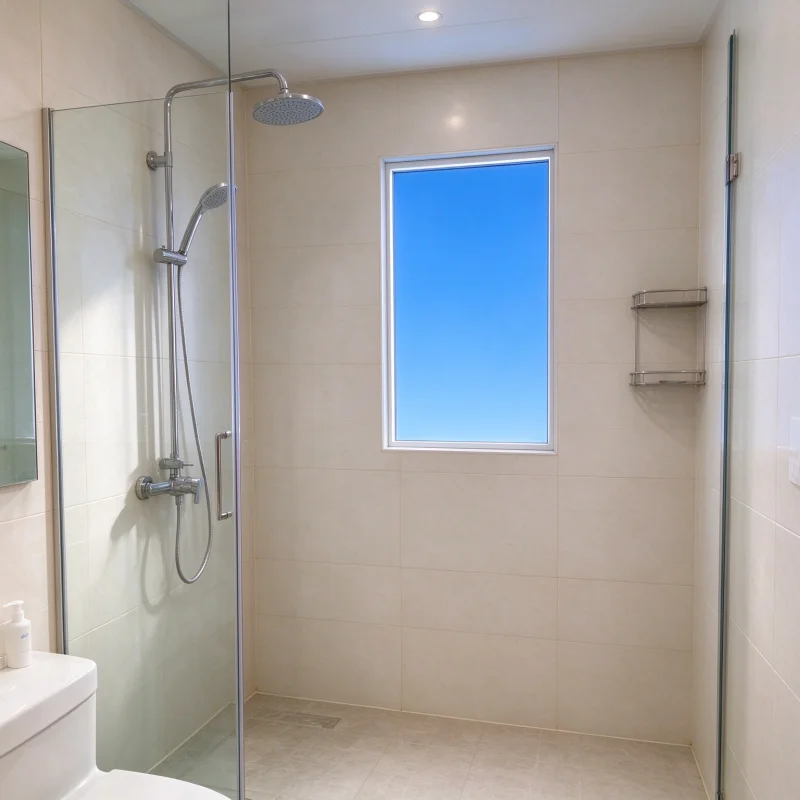
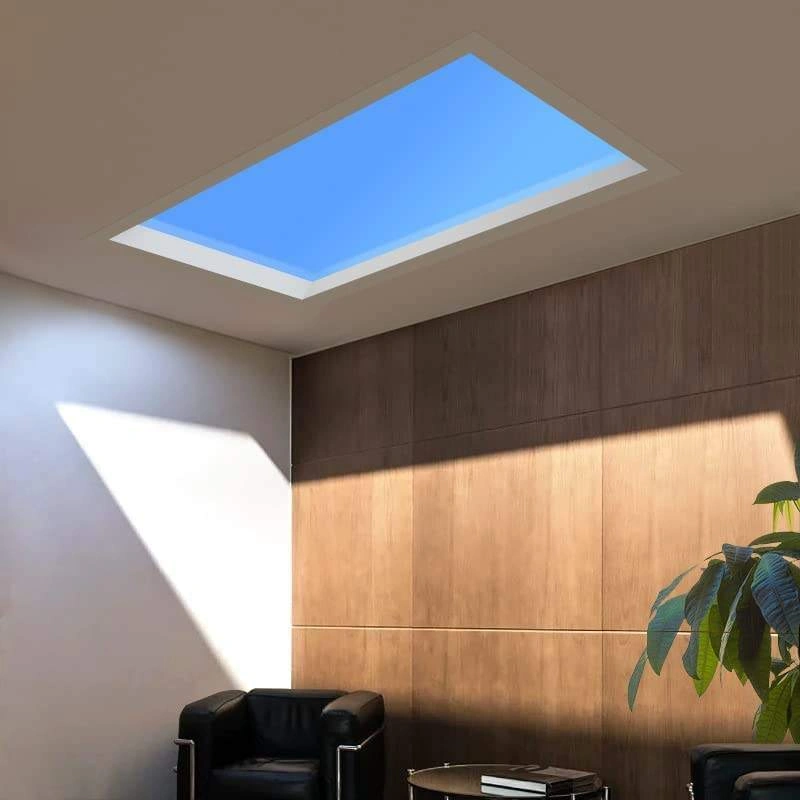
A fake window lamp is not an ordinary lighting fixture; it is a complete lighting system that simulates natural window scenery and skylight. It generally consists of a luminous panel, window frame, diffusion layer, power driver and dimming controls. Its purpose is to create the sensation of “light coming from outside a window” in windowless or dim spaces.
When shopping for fake window lights, do not only focus on brightness. A high-quality fake window lamp needs to address illuminance, color temperature, color rendering, glare and realism all at once. It should illuminate the space while tricking the human eye into believing there is a real window there.
A good fake window light casts soft skylight onto walls or ceilings instead of presenting a glaring light panel. For basements, offices, hallways, bathrooms and windowless bedrooms, this “outdoor window sensation” directly improves comfort and space value.
How to distinguish fixture type, panel type and ceiling-mounted type
Fixture type: flexible solution for fake window with artificial sunlight
Fixture-type products usually resemble wall lamps, window frame lights or standalone luminous windows. They feature flexible installation and are suitable for residences, entryways, bedrooms and renovation projects. If you want to quickly achieve the effect of fake window with artificial sunlight, this category is easier to implement.
Pros: simple installation, multiple size options, retrofittable. Cons: visual depth and light uniformity are limited by structure; low-cost versions tend to reveal visible LEDs or hot spots.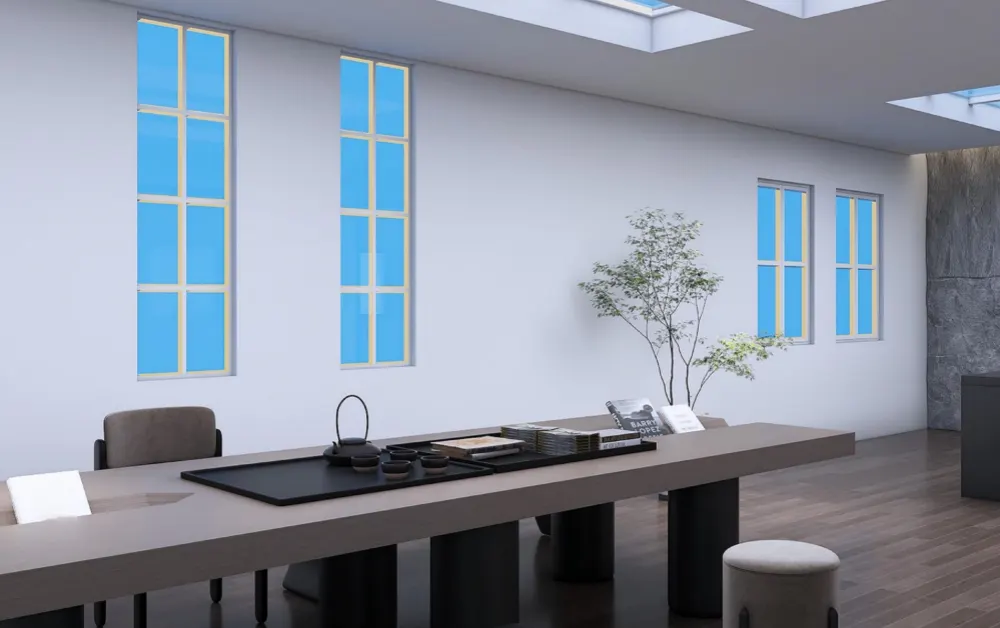
Panel type: how led fake window panel achieves uniform window scenery
The panel type centers on the led fake window panel, adopting a light guide plate, diffusion plate and printed or digital window scenery on the front face. It has a flat surface and even light emission, ideal for modern offices, meeting rooms and commercial spaces.
When selecting, check panel thickness, frame width, light transmission uniformity and driver quality. Slim panels suit surface mounting, while thicker light boxes deliver better depth of field.
Ceiling-mounted type: overhead solution for natural light fake windows for windowless rooms
Ceiling-mounted models often simulate skylights, suitable for hallways, bathrooms, basements and interior rooms. They meet the demand of natural light fake windows for windowless rooms, using soft overhead lighting to reduce the sense of oppression.
For ceiling-mounted units, pay special attention to moisture resistance, heat dissipation and accessibility for maintenance. Units installed near bathrooms and kitchens should have a higher ingress protection rating to prevent condensed water from entering the driver compartment.
Surface mount vs recessed mount: how to choose
Surface mount is suitable for renovation projects. If walls or ceilings already have power supply, surface-mounted fake window lamp features fast installation, lower cost and convenient later maintenance. For fake window for windowless office, surface mounting is usually more practical than rebuilding the ceiling.
Recessed mounting delivers a cleaner look and visually resembles a real window opening or skylight. It requires advance confirmation of cutout dimensions, joist positions, heat dissipation space and service access for drivers. If a seamless finish is desired, you may choose faux window led light panel, though installation demands higher precision.
Quick reference: For rental properties, light renovations and limited budgets, surface mount is preferred. For owner-occupied homes, fine decoration and ceilings available for modification, recessed mount is recommended.
Power supply, wiring, switches and dimming requirements
The power supply is the core of fake window lamp stability. Constant-current or constant-voltage drivers are recommended, with about 20% power margin reserved. Verify that the driver supports dimming, is serviceable and has good heat dissipation.
For wiring, reserve live wire, neutral wire and ground wire. If smart control is required, confirm compatibility with 0-10V, DALI, TRIAC, Zigbee or Matter. Recessed installation should use flame-retardant conduits and place drivers near access panels.
Switches and dimming determine user experience. Ordinary switches work for fixed scenarios; smart switches can set morning, daytime, dusk and night modes. Dimming must be flicker-free: no flickering at low brightness and no color shift at high brightness.
Adjustable color temperature is recommended, such as 2700K-6500K. Neutral white for daytime and warmer tone for dusk. Color rendering index CRI>90 is suggested, and R9 value should not be too low; otherwise window scenery and indoor materials will look dull and grey.
How to enhance the “window realism”: frame, depth of field and beam angle
Realism lies in details. A lighted fake window with a narrower frame fitting closely to the wall looks more like a genuine window opening. Frame color should match walls or ceilings, with proper light shielding to prevent light leakage.
Depth of field is also critical. A gap of 3–8 cm should be kept between the scenery layer and the light source. Too small a gap exposes LEDs; too large a gap reduces brightness and increases fixture thickness. Uniform diffusion materials are used inside the light box to eliminate hot spots.
Beam angle defines the “direction of sunlight”. Narrow beam angles create angled sunlight effects, while wide beam angles simulate diffuse sky light. In either case, direct glare to eyes must be avoided. Glare control with low UGR is recommended, especially for office spaces.
Lighted faux window is widely used in hallways, basements and hotel guest rooms. Its success does not depend on complicated imagery, but the coordinated performance of frame, depth of field, color temperature and brightness.
Maintenance and cleaning notes
Power off completely before cleaning. Wipe with dry microfiber cloth or slightly damp soft cloth; neutral detergent is acceptable. Do not spray liquid directly onto panel edges to avoid liquid seeping into drivers and wiring areas.
Acrylic or PC diffusion plates must not be cleaned with strong solvents, acetone or rough rags. For dusty environments, clean heat dissipation holes and driver surfaces quarterly. If flickering, partial dark areas or color shift occurs, inspect drivers and wiring first; do not keep the fixture running abnormally.
FAQ: Can I install it myself? Can it be fitted to gypsum board ceilings?
Can I install it myself? Surface-mounted fake window light with plug-in power or existing power supply can be installed by yourself. For new wiring, recessed cutouts, dimming drivers and ceiling reinforcement, hire a licensed electrician. Safety always outweighs installation cost savings.
Can it be fitted to gypsum board ceilings? Yes. Fake window lamp can be mounted on gypsum board ceilings, but joist reinforcement is required to confirm load capacity and cutout dimensions. Large-size led fake window panel needs multi-point fixing, together with reserved service access for drivers and heat dissipation space.
Before installation, confirm ceiling thickness, joist positions, power location and dimming method. If ceiling cavity space is insufficient, slim panel or surface-mounted solutions are preferred.
Conclusion
Selecting a fake window lamp is essentially choosing a spatial experience. Define your application first, then pick fixture type, panel type or ceiling-mounted type, followed by surface/recessed mounting, power supply, dimming, frame and depth of field. For windowless spaces, a well-made fake window light is more than supplementary lighting; it brings “daytime” back indoors.
EASY Artificial Skylight suggests you select products by checking space conditions, ceiling conditions, power supply conditions and maintenance requirements item by item. When selecting for offices, basements or residences, list dimensions, color temperature, dimming and control requirements before finalizing the solution.