Celestial Lighting
Here, celestial lighting refers to an artificial optical system that reproduces the scattering light of real sky, direct sunlight, sky gradient and a sense of openness.
It is not simply tuning lamp beads to blue. Instead, it brings atmospheric optics indoors.
This article serves as core popular science content for artificial skylight products, explaining what it is, why it resembles real sky, and how to select it.
I. What is Celestial Lighting?
Traditional sky light usually refers to roof skylights or natural light entering rooms from the sky. However, celestial lighting does not rely on roof openings; it uses an artificial system to simulate the sky.
Traditional sky lights require architectural structures, proper orientation and favorable weather conditions. In contrast, artificial celestial lighting can be installed in basements, corridors, windowless offices and internal bathrooms.
From a professional perspective, a complete set of celestial lighting consists of at least three layers:
- Light source layer: High CRI LEDs, blue light chips, warm white / red light compensation.
- Scattering layer: Nanoparticles, microstructured diffusion plates or optical films to trigger effects similar to Rayleigh scattering.
- Control layer: Dimming, color tuning, circadian rhythm, sun angle and scene control.
Therefore, it is not a single light bulb, but a “sky simulation system”. This is the biggest difference between it and ordinary ceiling lamps or LED panel lights.
II. Rayleigh Scattering: Why the Sky Is Blue and How Celestial Lighting Replicates It
Rayleigh scattering is the core of celestial lighting. When sunlight enters the atmosphere, it scatters with air molecules. Scattering intensity is inversely proportional to the fourth power of wavelength: I ∝ 1/λ⁴. The wavelength of blue light is approximately 450 nm, while red light is around 650 nm. Blue light has a markedly higher scattering efficiency, which is why the sky appears blue in daytime.
When the sun approaches the horizon, sunlight travels through a thicker layer of atmosphere. Blue light gets scattered away, while red and orange light can more easily reach human eyes, creating sunsets.
Genuine sky lighting is not about turning the whole panel blue. Instead, different viewing angles deliver varying sky brightness: bluer at the zenith, brighter near the sun, halos around the sun, and gradual transitions at edges.
EASY artificial skylight, among Rayleigh scattering skylight products, normally adopts short-wave blue light paired with a nano scattering layer, then blends warm white and red light to form composite light of “blue sky + sun”. The difficulty of this solution lies not in color, but in brightness distribution, spectral continuity and glare control.
In other words, the key of sky lighting is simulating the atmosphere, not simulating a photo of blue sky.
Within English design contexts, lighting sky is also frequently used to describe “light shaping for a sense of sky”. It is more than brightening the ceiling; it creates an illusion of distant spatial extension in the room. High-quality celestial lighting makes people feel the ceiling recede when looking up, rather than seeing a glowing panel.
III. artificial skylight led: Hardware Entry for Celestial Lighting
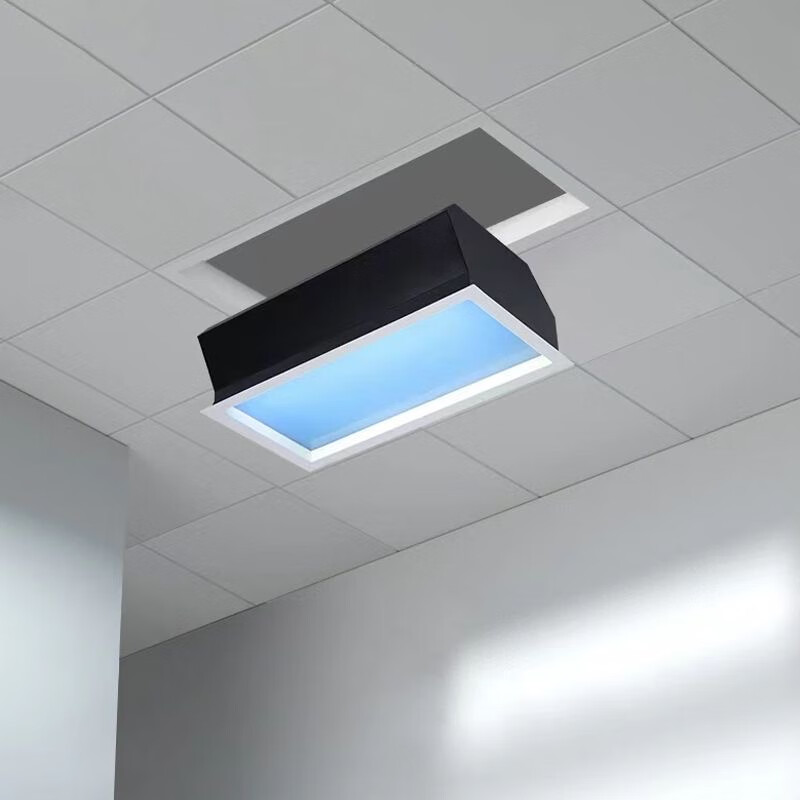
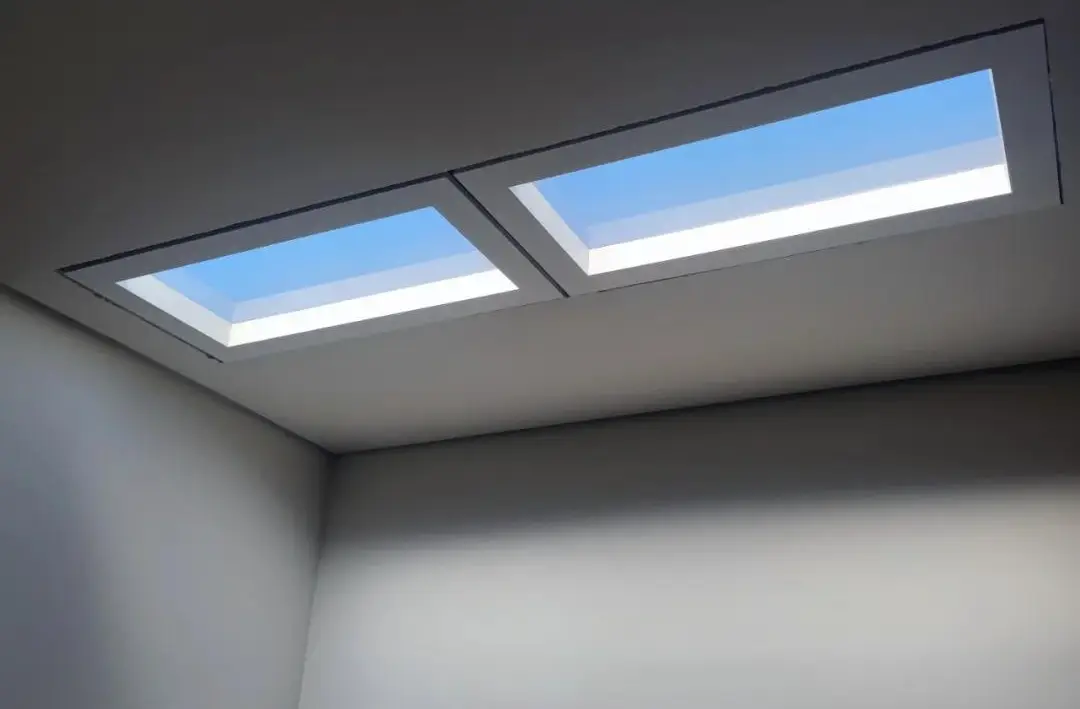
artificial skylight led is one of the most common hardware forms of celestial lighting. It looks like a skylight window, with built-in LED light sources, scattering layers and light guide structures.
Different from decorative fake skylights, professional artificial skylight led focuses on color temperature, spectrum, luminance and view-angle variation.
It is suitable for basements, windowless bathrooms, corridors, meeting rooms, inner zones of hotels and other spaces where real skylights cannot be installed.
When selecting such products, do not only judge by “whether it looks like a skylight”. You need to ask:
- Does it deliver sky gradient rather than uniform blue light?
- Is there an adjustable sunlight halo?
- Is it high CRI, low glare and flicker-free?
- Does it support circadian rhythm and timing functions?
These indicators determine whether it is just a blue light panel or a genuine set of celestial lighting.
IV. daylight simulation bulb: Boundary Between Bulb-Level Simulation and System-Level Simulation
daylight simulation bulb is an entry-level product searched by many users. It generally refers to high-color-temperature, high-CRI bulbs with spectra close to natural daylight, which can improve reading, makeup, photography or plant lighting. Nevertheless, bulb-level simulation can only solve “whether the light color resembles daytime light”. It hardly creates the perception of “where the sky is, where the sun is, and how deep the space feels”.
Celestial lighting is system-level simulation. It integrates the design of direct light, diffuse light, sky background and sun angle. You can understand daylight simulation bulb as a tube of paint, while celestial lighting is a complete painting. If you only want to replace table lamps or ceiling lights, daylight simulation bulb will suffice. If you want windowless rooms to gain a genuine sky sensation, a Rayleigh scattering artificial skylight system is required.
V. faux window with backlight: How Backlit Fake Windows Approach Real Sky
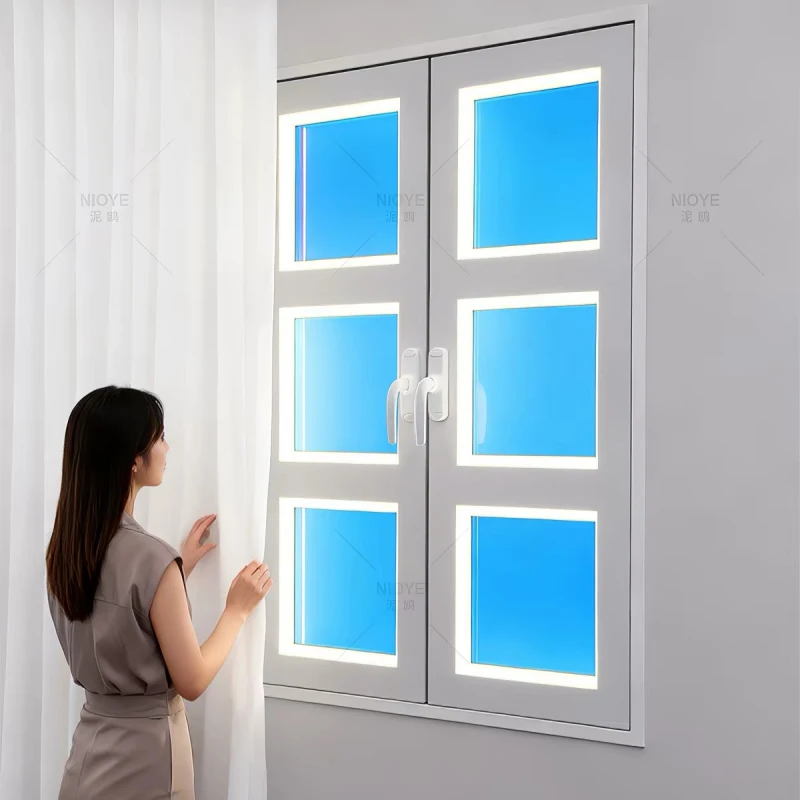
faux window with backlight is a backlit fake window solution, commonly used for basements, interior office walls, corridors and rental properties. Traditional fake windows only print landscape images, and their backlight emits uniform brightness.
When combined with celestial lighting, however, the backlight can produce sky gradient, sun light spots, cloud layers and day-night variations, so the fake window no longer looks like a light box.
For windowless spaces, the value of faux window with backlight goes beyond decoration. It can help create natural brightness layers and reduce claustrophobic feelings. During installation, attention should be paid to backlight uniformity, edge light leakage, color rendering index and dimming compatibility.
Over-cool color temperature or excessive blue light peaks of the backlight will instead create unnatural visuals. The ideal solution is to make the “sky” of the fake window coordinate with the main indoor lighting instead of clashing against it.
VI. indoor lights that mimic sunlight: From Mood to Circadian Rhythm
indoor lights that mimic sunlight represent a fast-growing demand in recent years. People want indoor light to be more like outdoor light, not merely for aesthetics, but also for mood, concentration and daily routines.
Light with higher illuminance, higher color temperature and complete spectrum in daytime helps maintain alertness; at night, illuminance should be lowered, blue light reduced and tone shifted to warm colors.
The advantage of celestial lighting here is that it “changes just like the real sky”. It can simulate sunrise in the morning, maintain clear sky in daytime, turn warm at dusk, and keep low brightness at night.
Compared with lights of fixed single color temperature, it better matches human circadian rhythm. It should be noted that lighting is not medical treatment. Please consult professionals if you have sleep or mood disorders.
But as indoor environmental design, simulating natural light is a clear direction.
VII. best light bulbs to simulate sunlight: What to Really Look For During Selection
If you are searching for best light bulbs to simulate sunlight, you have already noticed the insufficient spectrum of ordinary bulbs. The following indicators are recommended for evaluation:
- Spectral continuity: Whether the spectrum approximates sunlight, instead of only blue peaks and yellow fluorescence.
- Color rendering index: Higher CRI is preferred; R9 red rendering should also be checked.
- Color temperature: 5000K–6500K is common for daytime, while sky background may be cooler.
- Blue light control: Blue light is needed during daytime; excessive blue light should be avoided at night.
- Glare and flicker: Low UGR and no visible flicker offer greater comfort.
- Dimming and control: Support for 0–100% dimming, timing and scene modes.
- Service life and heat dissipation: LED heat dissipation determines light decay and stability.
Bear in mind that even the best light bulbs to simulate sunlight can only provide “a portion of sunlight”. To achieve the sense of celestial vault, a system solution such as celestial lighting is necessary. The comfort of sky light comes from the combined effect of sky and sun, not a single light source.
VIII. Typical Application Scenarios of Celestial Lighting
- Residential basements: Bring sky sensation to windowless spaces and relieve oppressiveness.
- Windowless offices: Interior meeting room walls, workstation zones and corridors.
- Bathrooms and internal restrooms: Simulate skylight when real skylights cannot be constructed.
- Hotels and retail: Inner zones, fitting rooms and exhibition halls.
- Elderly care and medical facilities: Public areas and rehabilitation spaces requiring professional design.
- Photography and live streaming: Stable, high-CRI and adjustable sky backdrops.
- Plant lighting: Distinguish visual sky simulation from photosynthetic requirements of plants.
The common feature of these scenarios is the absence of real window views, yet the demand for directional natural light, sense of time and spatial perception.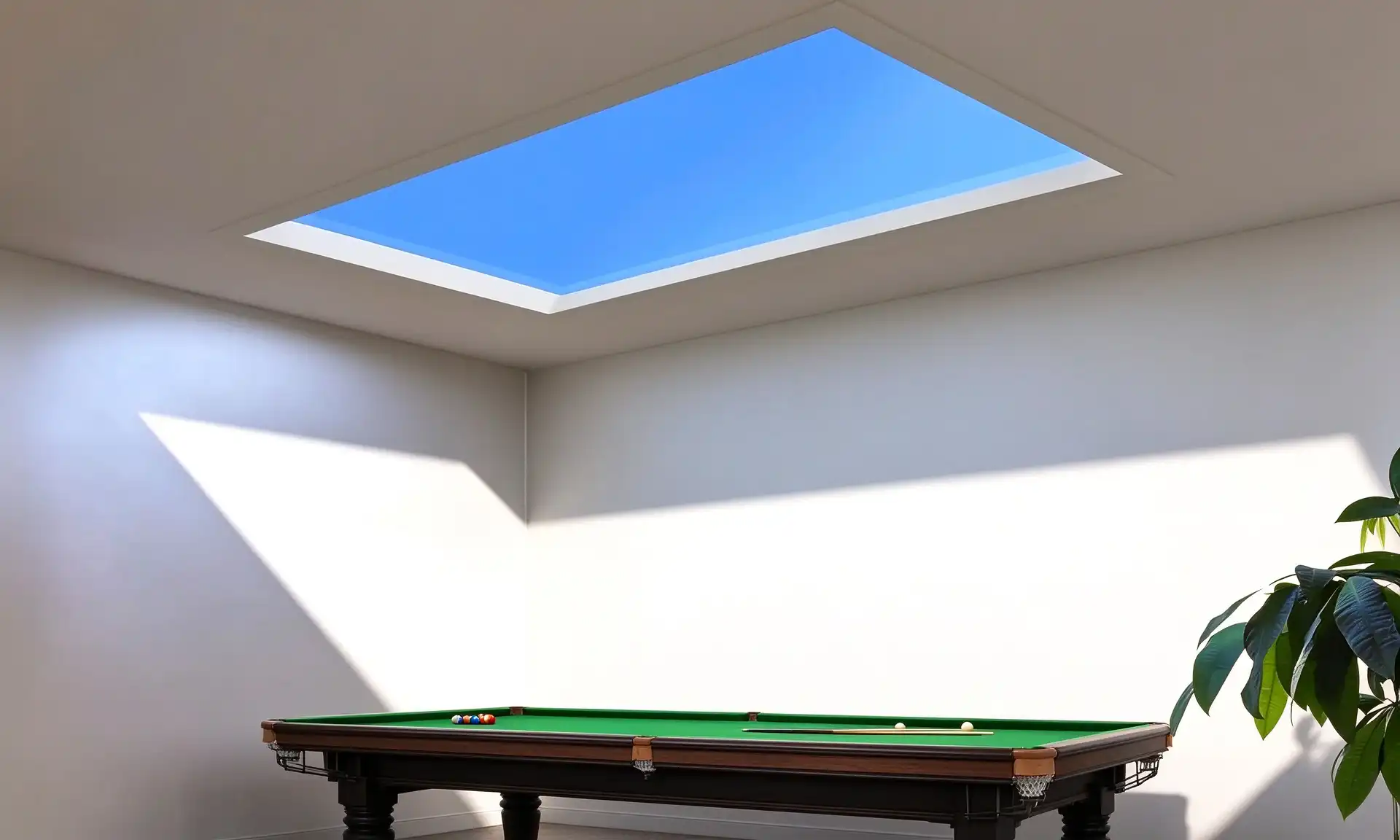
IX. How to Judge If a Set of Celestial Lighting Is Professional
- Scattering: Equipped with genuine Rayleigh scattering layer instead of blue filters.
- Sky effect: Features gradient from zenith to horizon.
- Sun effect: Delivers adjustable halos rather than uniform bright spots.
- Viewing angle: Sky appearance changes as viewers move.
- Spectrum: High color rendering, continuous spectrum and minimal sharp peaks.
- Glare: No harsh glare upon direct viewing, with balanced spatial brightness.
- Control: Circadian rhythm, timing, scene modes and smart linkage.
- Practical experience: Verified real project cases and long-term stability data.
In EASY artificial skylight product practice, we prioritize “looking like sky” rather than “looking like a lamp”. What users ultimately perceive is not LED parameters, but whether the space feels open, comfortable and natural.
Conclusion: Celestial Lighting Is Sky Lighting, Not Gimmickry
The essence of celestial lighting is using an artificial optical system to reproduce Rayleigh scattering sky. It integrates the natural sensation of sky light, structural imagination of sky lights, systematic design of sky lighting and spatial shaping of lighting sky into one product category. For windowless rooms, dark chambers, basements and inward-facing spaces, it is not merely decoration, but a lighting approach closer to natural daylight.
If you are looking for Rayleigh scattering artificial skylights, evaluate from a systematic perspective: sky gradient, sunlight halo, spectrum, glare, control and installation.
EASY artificial skylight focuses on developing deployable, long-lasting artificial skylight products for celestial lighting, enabling spaces without windows to own authentic sky.