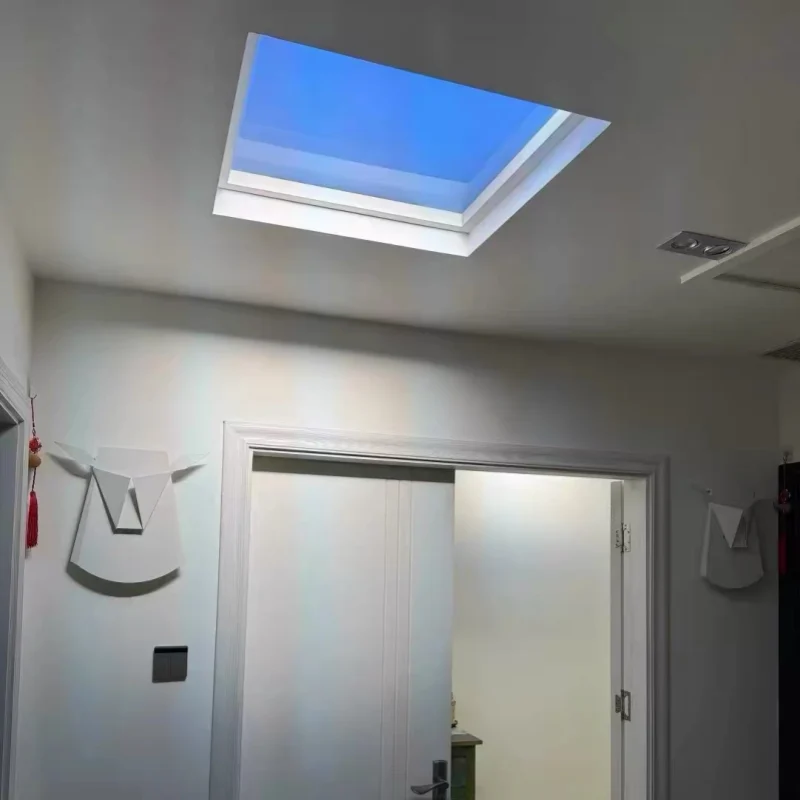
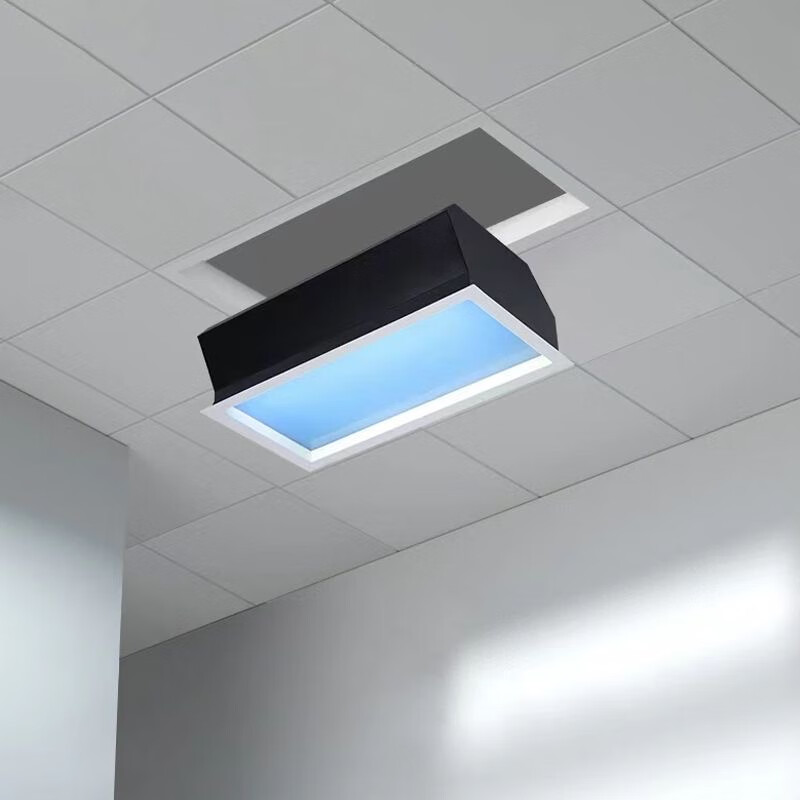
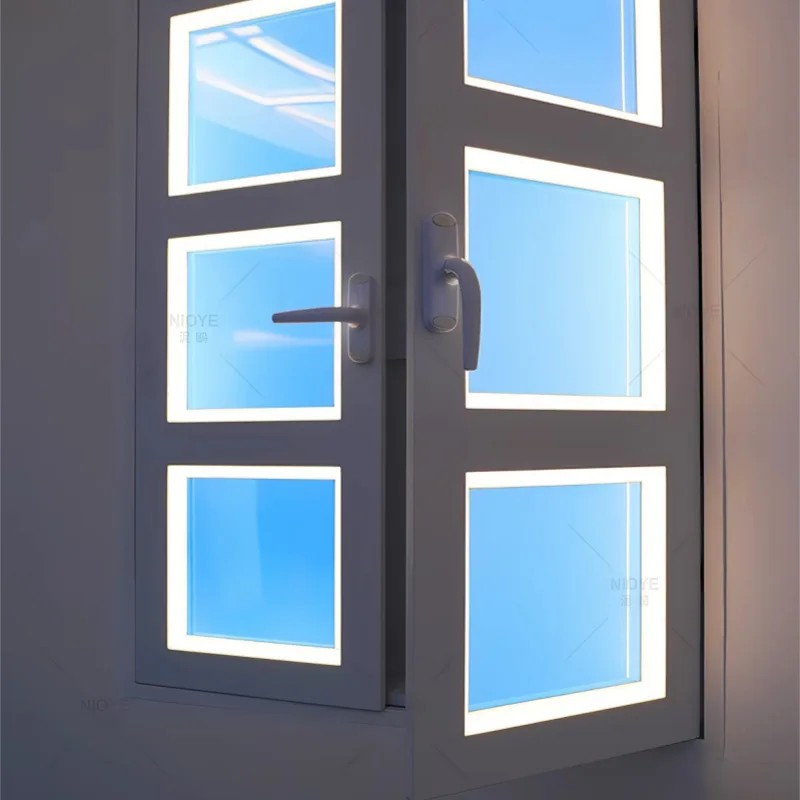
Lumen, symbol lm, is the international unit describing luminous flux. Its physical definition: the luminous flux emitted within a solid angle of 1 steradian by a point source with luminous intensity of 1 candela.
Simply put, lumens measure the total amount of light emitted by a light source.
It is critical to distinguish lumens from illuminance. Lumens represent the “total output” of a light source, while illuminance (unit: lux, lx) refers to “the luminous flux density falling onto a surface”. The formula is: Illuminance = Luminous Flux ÷ Area.
For windowless spaces, we need to consider both the total lumen output of the virtual window (source output) and the actual illuminance achieved in the space (light received by the eyes).
Traditional incandescent lamps are often labelled in watts, yet watts only indicate power consumption rather than brightness. Luminous efficacy (lm/W) is the key metric. Modern high-quality led lighting windows adopt LED light sources with luminous efficacy reaching approximately 120 lm/W. This means a power draw of 50W can deliver around 6000 lumens of luminous flux.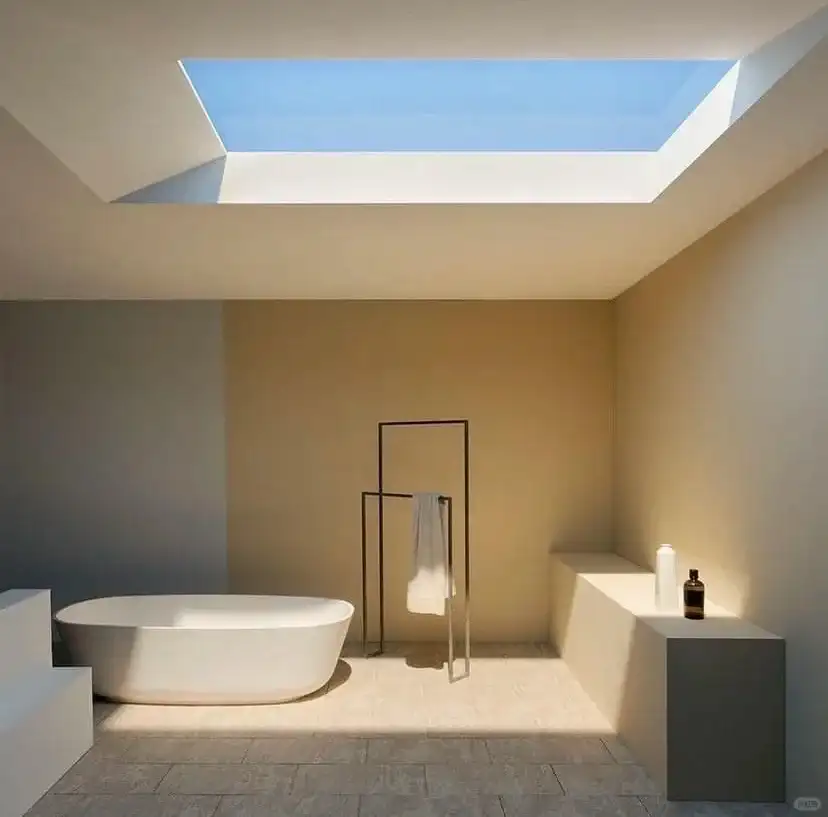
Lumen Requirements for Windowless Space Lighting
Windowless spaces receive no natural daylight, so all illumination must be supplied by artificial light sources. When calculating required lumens, you may refer to the following rule of thumb: living rooms or bedrooms need roughly 10–20 lumens per square foot, while spaces requiring higher brightness such as kitchens or bathrooms require about 70–80 lumens per square foot.
Take a 15 m² (approx. 161 sq ft) basement as an example. Used as an activity room and calculated at 15 lumens per square foot, the total luminous flux required for this space is approximately 2415 lumens.
When faux lighted window serves as supplementary primary lighting, its lumen output should cover a considerable proportion of this requirement.
Some buying guides recommend a total luminous flux of 1500–2000lm for faux lighted window as supplementary main lighting in small rooms of 5–6 ping (approx. 16.5–19.8 m²), which delivers the most comfortable effect; excessive brightness will instead cause light pollution.
It is worth noting that lighting design for windowless spaces should not rely solely on a single light source. Layer faux window lights together with general lighting and task lighting to avoid over-bright zones and completely dark corners, which would otherwise amplify the enclosed feeling of the space.
Lumens and Visual Authenticity of faux skylight
To create the convincing illusion that light streams in through a real window, a faux skylight must strike a balance between lumen output and its visual display. Among commercial products, small-sized faux window panels deliver roughly 3840lm, medium-sized around 4800lm, and large-sized about 7200lm. Certain sky-simulating faux window models can reach brightness up to 8000 lumens with only 50W power consumption and a color rendering index (CRI) above 95.
Lumen values alone cannot guarantee realism; the manner of light diffusion is the key. High-quality faux window lights install a diffuser or diffusion film in front of the LED array to produce light similar to the diffuse reflection of sunlight through clouds, rather than harsh direct light. If the light is overly concentrated and creates hard shadows, the human brain will immediately recognize it as a glowing panel instead of a window.
Color temperature selection is equally important as lumen output. 4000K–5000K color temperature works best to mimic early morning or mid-morning natural light. This range boosts concentration without the visual strain caused by cool white light above 6000K. If the faux window light is used as ambient lighting in the evening, it should support color temperature adjustment down to 3000K warm white, paired with reduced lumen output to replicate soft twilight light.
Application Scenarios and Lumen Strategies for false windows with light
false windows with light are best suited for spaces sharing one common trait: fully windowless areas where occupants have a strong psychological need for natural daylight.
Basements and semi-underground spaces. These spaces inherently lack daylight and tend to feel oppressive. Faux window lights can be mounted on walls or ceilings. Lumen output planning can reference the rule that 10%–15% of the room area is covered by the “window surface”. For a 20 m² basement fitted with a 1.5m × 1m virtual window, the luminous flux of the window panel itself should form a distinct brightness gradient around the frame. Illuminance at the centre of the window panel can reach 300–500lx and gradually fade inward, replicating the light decay pattern of genuine windows.
Windowless bathrooms / dark bathrooms. Dark bathrooms are usually small (3–5 m²). In this scenario, the faux skylight often acts as the sole source of “daylight sensation”. High lumens are unnecessary; 800–1200lm paired with roughly 5000K color temperature delivers a fresh and bright visual effect. Note that dark bathrooms have high humidity, so fake window with light must be selected with an appropriate ingress protection rating.
Hallways and enclosed stairwells. For long narrow hallways, faux window light serves not only for supplementary lighting but also to break the tunnel effect. Here, the lumen output of faux window light should exceed the functional lighting of the hallway, making the window panel a visual focal point. Multiple fake window with light units can be installed at intervals along the far end or side walls of the hallway, each rated at approximately 2000–3000lm, creating a spatial rhythm of “passing one window after another”.
Conclusion
Lumens form the starting point for faux window light design, yet they are not the end goal. For windowless spaces, the value of faux window light lies not in how many lumens it outputs, but how those lumens are perceived: whether color temperature is appropriate, whether light is soft, and whether brightness matches the scene.
EASY recommends that when configuring false windows with light for clients, first define the base lumen requirement according to room size and usage, then use color temperature tuning and diffusion design to convert luminous flux into convincing “light coming from outside the window”.